

 Make Resume Now a preferred source on Google
A new national survey from Resume Now reveals that fewer than one-third (31%) of workers say they feel fully focused at work every day, while the vast majority report that their time is consumed by low-value tasks, constant interruptions, and pressure to stay connected beyond normal working hours.
Resume Now's Fleeting Flow Report paints a picture of a fragmented workday where productivity is less about motivation and more about fighting distractions. More than three-quarters of workers (77%) say busy work takes up a meaningful portion of their week, and nearly two-thirds report that only about half or fewer of their meetings are productive.
Key Findings
- Flow is fleeting. Only 31% of workers feel fully focused every day, while 23% rarely or never reach a true flow state. Nearly half (46%) say they feel deeply focused several times a week but not consistently.
- Busy work dominates the week. 77% say low-value, repetitive tasks take up a meaningful portion of their time, including 40% who spend a quarter or more of their week on such work.
- Distractions are constant. Fatigue or burnout tops the list of productivity killers (41%), followed by personal distractions (35%) and interruptions from coworkers (35%).
- Meetings often miss the mark. Nearly two-thirds of workers (64%) say only about half or fewer of their meetings are productive and 38% spend at least five hours per week in meetings.
- Work extends beyond the workday. 58% feel pressure to be available outside normal working hours, including 32% who feel this pressure often or constantly.
- Employees are stretched beyond the workday. 44% work outside normal hours due to unfinished workload, while 19% cite pressure from management or company culture.
- Burnout is nearly universal. Nearly 8 in 10 workers (79%) report experiencing some level of Zoom fatigue.
Busy Work & Meetings Crowd Out Deep Focus
Survey data shows that much of the modern workday is consumed by low-value tasks and meetings that fail to support meaningful progress.
- 77% say busy work takes up a meaningful portion of their week.
- 40% spend a quarter or more of their time on low-value, repetitive tasks.
- 64% say only about half or fewer of their meetings are productive.
- 38% spend at least 5 hours per week in meetings.
What this means: When low-value tasks and unproductive meetings take up a large share of the week, focused work becomes something employees squeeze in rather than plan for. That shift can make progress feel slower and workdays feel fuller without feeling more accomplished, leading to widespread burnout.
Always "On" Leaves Little Room for Flow
Pressure to stay connected outside normal hours further erodes workers' ability to recover and concentrate.
- 58% feel pressure to be available outside normal working hours, with 32% experiencing this pressure often or constantly.
- 44% work outside normal hours due to unfinished workload.
- 19% cite pressure from management or company culture.
The following is a visual representation of the data above:
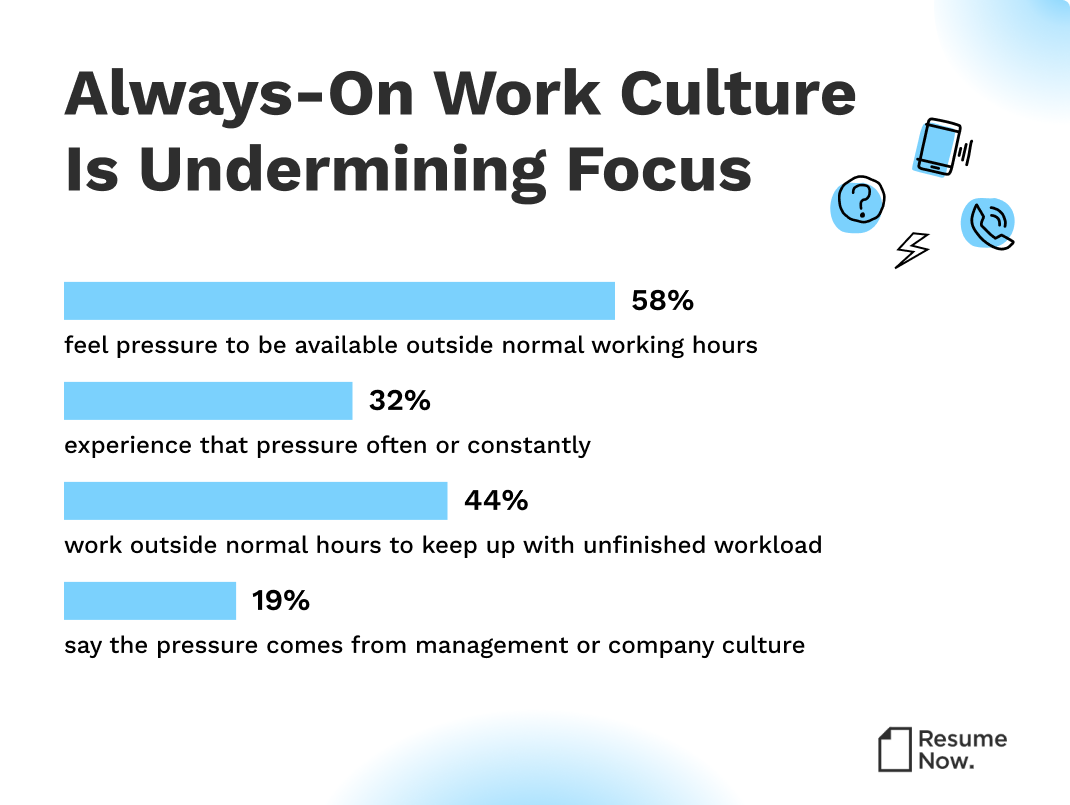
What this means: If workers feel they need to stay reachable beyond normal hours, focus starts to compete with constant responsiveness. That environment makes it harder to settle into uninterrupted stretches of work, even during the day.
Daily Disruptions Undermine Productivity
Beyond workload structure, frequent interruptions and fatigue further erode employees' ability to stay focused throughout the day.
- 41% cite fatigue or burnout as a top productivity disruptor.
- 35% cite personal distractions.
- 35% cite interruptions from coworkers.
- 25% cite social media.
- 21% cite too many meetings.
- 19% cite constant notifications or pings.
- 15% cite technical glitches.
What this means: Productivity isn't just about workload, it's also about how often attention gets broken. When fatigue and frequent interruptions stack up, even simple tasks can take longer than they should. Productivity drain happens when busy work and interruptions keep workers from achieving true focus.
Flow State Remains Out of Reach for Many
Many workers struggle to sustain deep focus long enough to reach a true flow state.
- 31% feel fully focused every day.
- 46% reach a flow state several times a week.
- 15% reach it only once in a while.
- 8% rarely or never experience deep focus.
What this means: If deep focus only happens sporadically, workers may spend more time ramping up, resetting, and catching up than producing at their peak. That can make performance feel inconsistent, even when effort stays high.
Burnout Is Widespread
Constant digital communication and meeting overload are contributing to widespread burnout across the workforce. As digital demands grow, sustained focus becomes harder to maintain.
- 79% experience some level of Zoom fatigue.
- 8% experience Zoom fatigue every day.
- 19% experience it a few times a week.
- 32% experience it occasionally.
- 20% experience it but rarely.
The following is a visual representation of the data above:
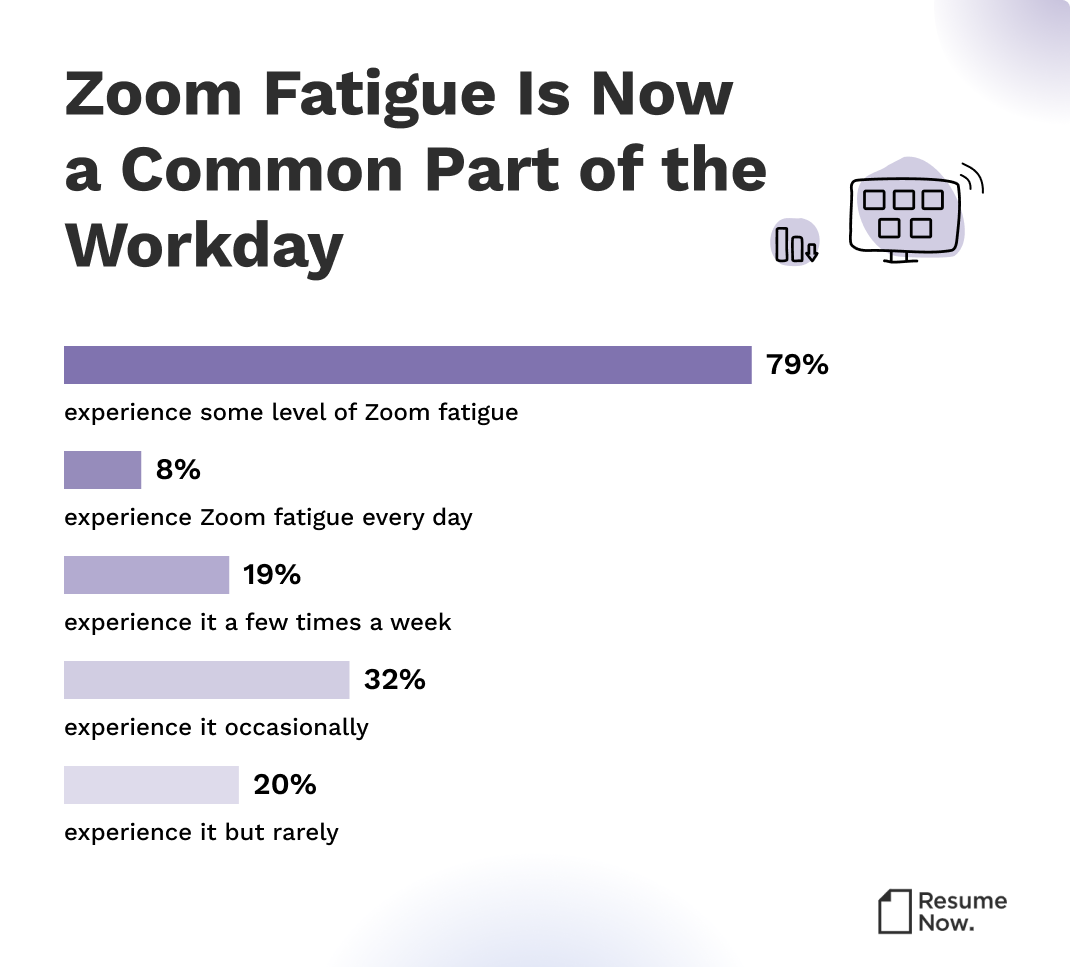
What this means: When digital communication and meeting volume become constant, exhaustion can start to feel like part of the job rather than a temporary phase. In that kind of climate, focus becomes harder to sustain, time is frequently wasted, and recovery becomes harder to protect.
Methodology
The findings in this report are based on a survey of 1,012 employed U.S. adults, conducted in December 2025. Respondents answered questions about workplace focus, productivity, meetings, busy work, digital communication, burnout, and expectations around availability outside normal working hours. Question formats included multiple-choice, frequency-based scale responses, and multi-select questions.
Demographic Breakdown
Survey respondents represented a broad cross-section of the U.S. workforce. Participants were 52% female and 48% male. Generational representation included 15% Gen Z (born 1997 or later), 27% millennials (born 1981–1996), 27% Gen X (born 1965–1980), and 30% baby boomers (born 1946–1964).
About Resume Now
Resume Now is a powerful resource dedicated to helping job-seekers achieve their potential. Resume Now's AI Resume Builder is a cutting-edge tool that makes creating a resume fast, easy, and painless. Resume Now has been dedicated to serving job seekers since 2005. Alongside its powerful AI Resume Builder and stylish ready-to-use templates, it also features free advice for job seekers at every career stage, guides for every step of the hiring process, and free resources for writing cover letters. Resume Now is committed to supporting job seekers and workers alike and has conducted numerous surveys related to the experience, trends, and culture of the workplace. These surveys have been featured in Business Insider, CNBC, Fast Company, Yahoo!, Forbes, and more. Keep up with Resume Now on LinkedIn, Facebook, X, and Pinterest.
For press inquiries, contact Alexa Kalechofsky at alexa.kalechofsky@bold.com.


Keith is a Certified Professional Resume Writer (CPRW) and trusted media source in the career industry with over a decade of experience helping job seekers stand out.
More resources
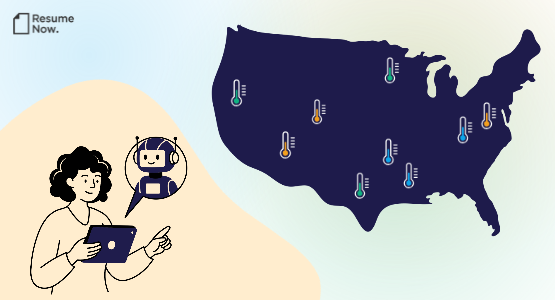
Workplace AI Temp Check: Washington, DC, Arizona, & Colorado Lead in Business AI Use
Resume Now analyzed AI adoption by state revealing where repo...

The AI Whelmed Worker: 44% Feel Overwhelmed by the Pressure to Learn & Use AI at Work
Resume Now s new report reveals that workers feel uncertain u...
The AI Skills Race: 43% of Workers Feel They’ve Fallen Behind
Resume Now finds that 43% of workers feel behind in their AI s...
Human-AI Trust in the Workplace: 97% of Workers Still Put Human Judgment First
In an analysis of human-AI trust in the workplace Resume Now ...
Future Proof Career Skills: 10 Human Skills for Resumes in the Age of AI
Resume Now s analysis of O NET cognitive ability data across 8...
10 Jobs That AI Can't Replace Thanks to “Superhuman” Skills
Resume Now analyzed O NET data to identify AI-proof jobs that ...
 Get the job 2x faster*
  Customize your cover letter