

Table of contents
 Make Resume Now a preferred source on Google
As AI continues to reshape daily workflows, a growing share of employees are allowing machine-generated output to pass through with limited or no human review.
According to the AI Oversight Gap Report from Resume Now, which surveyed over 1,000 employed U.S. adults, more than 1 in 3 workers (35%) say they rarely or only occasionally review AI-generated output before using it. Additionally, 15% report using AI tools for work without telling their manager.
These AI at work statistics highlight not just rising adoption, but also inconsistent oversight practices and informal use patterns that are becoming increasingly common across organizations.
Key Insights
- Too much trust in AI-generated content: 35% of workers say they rarely or only occasionally review AI-generated output before using it.
- High AI adoption rates at work: 52% of workers say AI plays some role in their typical workweek, including 19% who say it accounts for more than a quarter of their time.
- Some AI use happens in secret: 40% of workers say they have used AI tools for work, and 15% report doing so privately without telling their manager.
Oversight Practices Vary Widely, Increasing Risk of Low-Quality AI Output
As the use of AI in the workplace becomes more common, oversight practices remain inconsistent across individuals and teams.
Some workers say they carefully evaluate AI-generated work, while others rely on it with minimal verification, creating conditions where errors or low-quality AI-generated content, otherwise known as "workslop," can slip through.
- 35% say they rarely or only occasionally review AI output.
- 18% say they usually trust AI output as-is.
- 17% say they only review AI output when something seems off.
Among workers who take a more consistent approach to reviewing AI output:
- 25% say they review it most of the time.
- 40% say they review it every time.
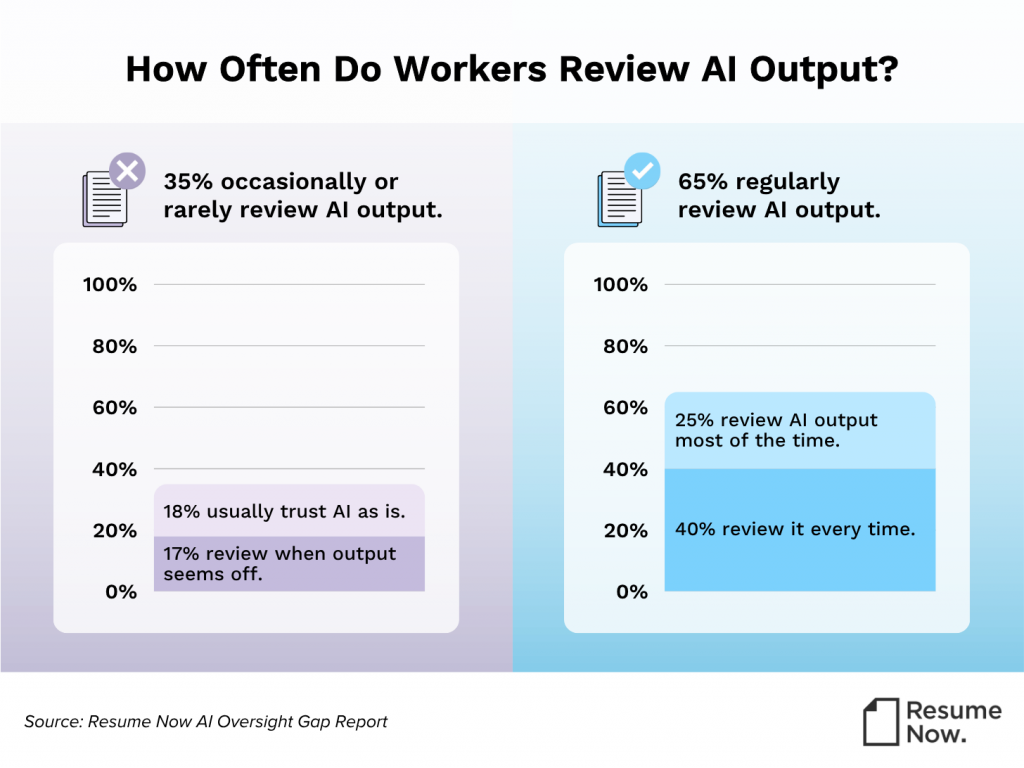
What this means: AI oversight at work is often driven by individual habits rather than standardized workplace practices. When reviewing AI output is inconsistent, or workers don't check AI output at all, the risk of low-quality AI-generated content increases, and errors can spread across teams. Over time, this variability can lead to uneven output quality and reduced reliability in everyday work.
AI Is Becoming Operational, Not Occasional
AI is no longer limited to one-off tasks or experimental use cases. For many employees, it now plays an active role in day-to-day workflows.
- 52% say AI plays some role in their workweek.
- 19% say it accounts for more than a quarter of their time.
- 33% say it accounts for up to a quarter of their workweek.
What this means: The use of AI in the workplace is shifting from occasional assistance to operational dependency. As AI becomes part of routine workflows, the need for structured AI oversight at work and clear guidelines around reviewing AI output becomes more critical.
Organizations increasingly need to define when human judgment should intervene—especially in cases where employees skip AI review—to ensure quality and accountability.
AI Use Is Often Informal & Not Always Disclosed
Workers report a mixed approach to transparency when it comes to AI usage at work. While some teams openly incorporate AI tools into their workflows, others operate more discreetly and conceal AI use from their managers.
- 25% say they have used AI tools openly with their team.
- 15% say they have used AI tools privately without telling their manager.
- 17% say they have not yet used AI tools for work, but plan to.
- 42% say they have not used AI tools for work.
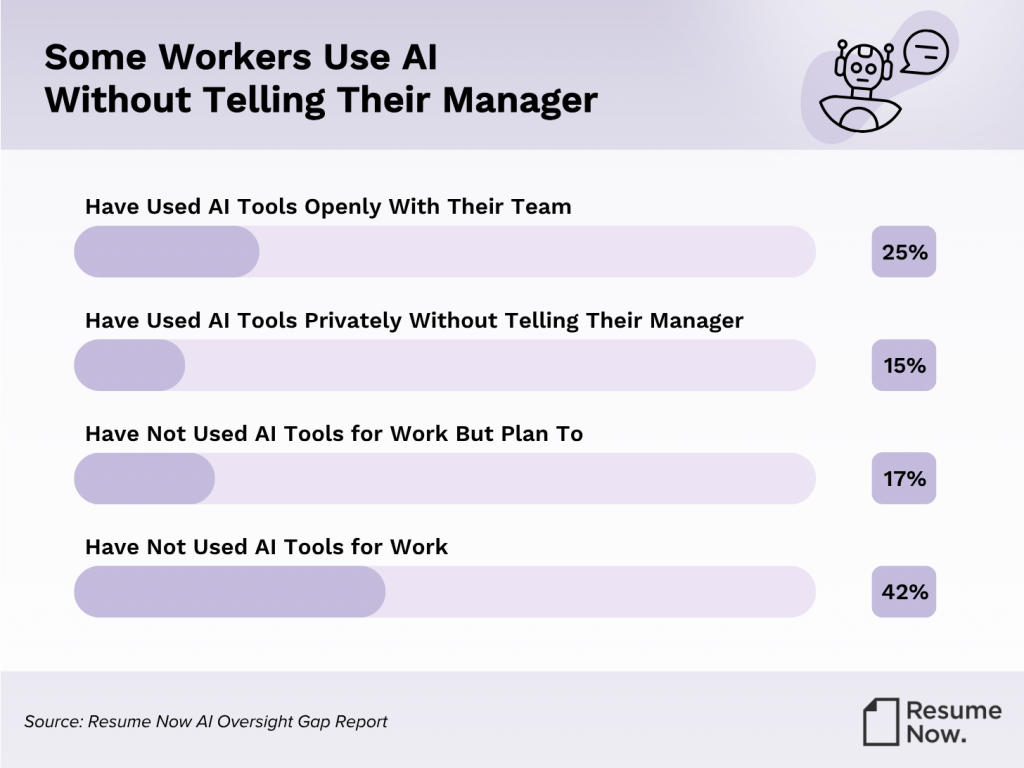
What this means: AI adoption is advancing faster than workplace policies and norms around transparency and disclosure. When employees are unsure how AI use will be perceived, they may choose to use tools without communicating it. This informal approach can make it harder for organizations to track how AI is being used, assess risk, and implement consistent standards for reviewing AI output.
The Growing Need for AI Oversight at Work
These AI at work statistics point to a workplace reality where adoption is widespread, but oversight and transparency have not kept pace. While the use of AI in the workplace continues to grow, inconsistent reviewing practices, informal usage, and varying levels of trust in AI output introduce new challenges for quality control.
As AI becomes a more integral part of daily operations, organizations that establish clear expectations around reviewing AI output and AI oversight at work will be better positioned to maintain accuracy, reduce the risk of low-quality AI-generated content, and ensure more consistent outcomes across teams.
Methodology
The findings in this report are based on a survey of 1,012 employed U.S. adults, conducted by Resume Now using Pollfish in December 2025. Respondents answered questions about AI usage, communication, and trust in AI-generated work. Question formats included multiple-choice and scaled-response questions.
Demographic Breakdown
Survey respondents represented a broad cross-section of the U.S. workforce. Participants were 52% female and 48% male. Generational representation included 15% Gen Z (born 1997 or later), 27% millennials (born 1981–1996), 27% Gen X (born 1965–1980), and 30% baby boomers (born 1946–1964).
About Resume Now
Resume Now is a powerful resource dedicated to helping job-seekers achieve their potential. Resume Now's AI Resume Builder is a cutting-edge tool that makes creating a resume fast, easy, and painless. Resume Now has been dedicated to serving job seekers since 2005. Alongside its powerful AI Resume Builder and stylish ready-to-use templates, it also features free advice for job seekers at every career stage, guides for every step of the hiring process, and free resources for writing cover letters. Resume Now is committed to supporting job seekers and workers alike and has conducted numerous surveys related to the experience, trends, and culture of the workplace. These surveys have been featured in Business Insider, CNBC, Fast Company, Yahoo!, Forbes, and more. Keep up with Resume Now on LinkedIn, Facebook, X, and Pinterest.
For press inquiries, contact Alexa Kalechofsky at alexa.kalechofsky@bold.com.


Keith is a Certified Professional Resume Writer (CPRW) and trusted media source in the career industry with over a decade of experience helping job seekers stand out.
More resources
Workplace AI Temp Check: Washington, DC, Arizona, & Colorado Lead in Business AI Use
Resume Now analyzed AI adoption by state revealing where repo...

The AI Whelmed Worker: 44% Feel Overwhelmed by the Pressure to Learn & Use AI at Work
Resume Now s new report reveals that workers feel uncertain u...
The AI Skills Race: 43% of Workers Feel They’ve Fallen Behind
Resume Now finds that 43% of workers feel behind in their AI s...
Human-AI Trust in the Workplace: 97% of Workers Still Put Human Judgment First
In an analysis of human-AI trust in the workplace Resume Now ...
Future Proof Career Skills: 10 Human Skills for Resumes in the Age of AI
Resume Now s analysis of O NET cognitive ability data across 8...
10 Jobs That AI Can't Replace Thanks to “Superhuman” Skills
Resume Now analyzed O NET data to identify AI-proof jobs that ...
 Get the job 2x faster*
  Customize your cover letter