


Table of contents
- Key Findings
- Rising Anxiety Over AI and Job Security
- Workers See AI Job Threats Coming, Many Sooner Than Expected
- Workers Expect AI to Reduce Jobs in Their Industry by 2026
- Most Workers Expect AI to Eliminate More Jobs Than It Creates in the Year Ahead
- Workers See a Real Possibility of AI Replacing Their Role by 2030
- Workers Are Already Seeing AI-Driven Job Loss in Their Circles
- Pessimism About AI’s Career Impact
 Make Resume Now a preferred source on Google
Workers across the country are stepping into 2026 with heightened uncertainty about how AI will shape their careers. In Resume Now's new 2026 AI & Job Security Outlook Report, the national survey explores how employees are feeling about AI's impact on job security and what they expect in the year ahead.
The findings show that more than half of workers feel some level of concern about AI or automation affecting their jobs, and many are already seeing early signs of disruption in their own networks.
Key Findings
- 60% of workers believe AI will eliminate more jobs than it creates in the year ahead, showing strong expectations of net job loss across industries.
- 51% of workers are worried about losing their jobs to AI in 2026, including 10% who are extremely worried, indicating rising anxiety across all levels of the workforce.
- 67% think AI will eventually threaten their job, with 1 in 10 saying the threat is already happening and another 15% expecting impact within the next one to two years.
- 46% expect job reductions in their industry by the end of 2026, while only 4% believe AI will create more roles than it eliminates.
- 1 in 5 workers know someone personally who lost a job to AI in the past year, suggesting early signs of displacement are becoming more visible.
Rising Anxiety Over AI and Job Security
Workers are entering the new year with a noticeable rise in anxiety about how AI and automation could affect their job security in 2026.
- More than half of workers (51%) admit they are worried about losing their job to AI or automation in 2026, including those who are extremely, moderately, or slightly concerned.
- Nearly 1 in 5 workers (19%) say they are moderately worried about AI threatening their role.
- 10% are extremely worried, already experiencing high levels of AI-related job insecurity.
- While 49% say they are not worried, the data shows that a majority remain uneasy about how AI may impact their job stability in the year ahead.
What this means: This level of concern shows that rising uncertainty about AI is already shaping how workers view their future at work, even before major changes take hold. It also indicates that many are bracing for potential disruption in the coming months, regardless of whether they have felt its effects firsthand.
Workers See AI Job Threats Coming, Many Sooner Than Expected
Many workers anticipate that AI could impact their jobs sooner than they expected, with varying timelines for when the threat might become real.
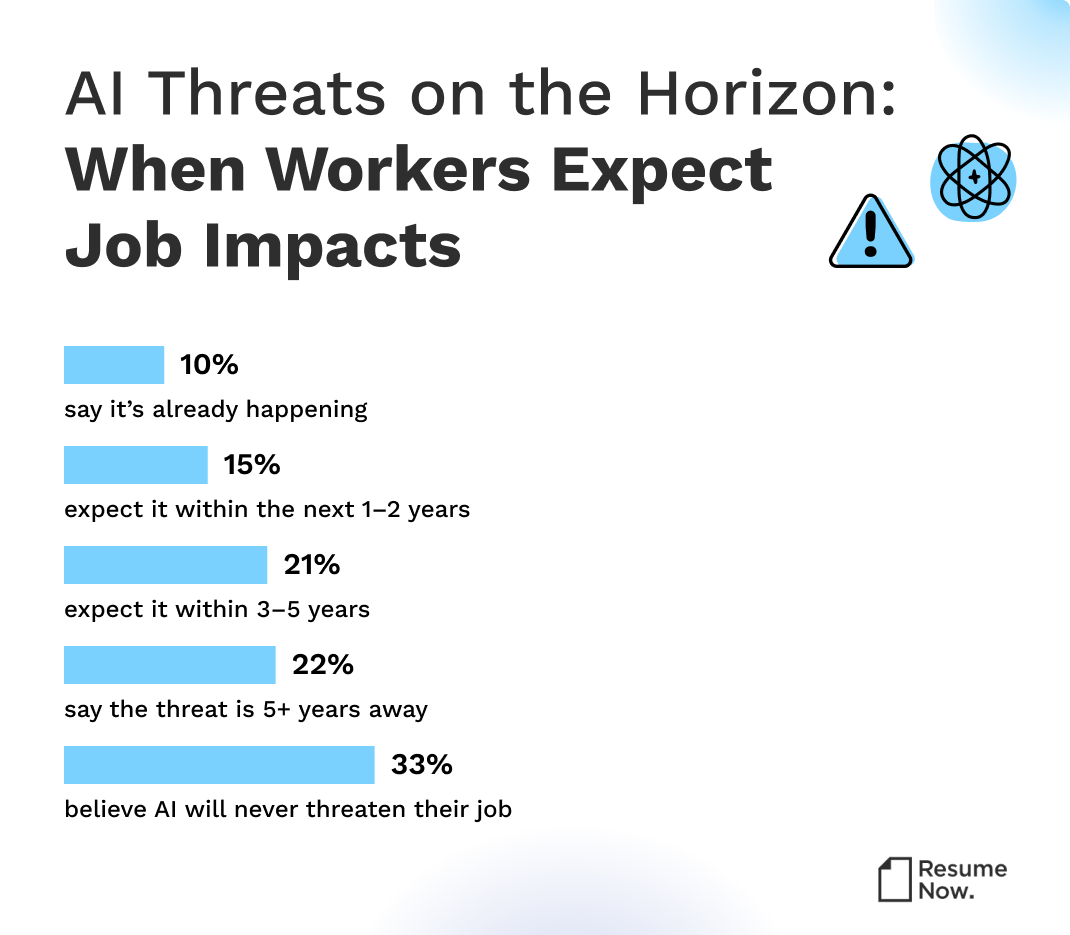
- A third of workers (33%) believe AI will never directly threaten their job, but the remaining 67% see some level of risk on the horizon.
- 1 in 10 workers (10%) say the threat is already happening, with AI beginning to encroach on their responsibilities.
- 15% expect their job to be threatened within the next one to two years, showing short-term concern.
- An additional 21% believe AI will threaten their job within three to five years, indicating longer-term but still significant vulnerability.
- 22% expect the threat to arrive in five years or later, reflecting uncertainty about future automation.
What this means: The data shows that while some employees feel secure, a majority are preparing for potential disruption, with concern spanning both the near and longer-term future. This highlights that AI is no longer seen as a distant possibility, but as a technology that could imminently shape career paths in the years ahead.
Workers Expect AI to Reduce Jobs in Their Industry by 2026
A significant number of workers are anxiously anticipating that AI will reduce jobs in their industry by 2026, with differing levels of concern about the potential scale of impact.
- Nearly half of workers (46%) expect moderate job reductions in their industry by the end of 2026, reflecting widespread concerns about AI-driven cuts.
- 12% anticipate large-scale job losses, signaling a notable segment bracing for major disruption.
- 38% expect no major change, suggesting uncertainty about how quickly AI will reshape their field.
- Only 4% believe AI will create more jobs than it eliminates, showing very limited optimism about net job growth.
What this means: The findings show that a substantial portion of workers are preparing for potential job losses, while others remain uncertain about how quickly AI will transform their industry. Overall, confidence that AI will create more opportunities than it eliminates is very low, underscoring widespread concern about workforce shifts in the year ahead.
Most Workers Expect AI to Eliminate More Jobs Than It Creates in the Year Ahead
As AI continues to advance, workers are preparing for a year in which technology may reduce employment opportunities across industries.
- 60% of workers believe AI will eliminate more jobs than it creates over the next year, underscoring widespread expectations of net job loss.
- Only 12% think AI will create more jobs, indicating very limited optimism about near-term opportunities.
- 28% expect a balanced impact, with job creation and job loss offsetting each other.
What this means: The data shows that optimism about AI generating new opportunities is very low, with the majority of employees bracing for net job losses. Even those who anticipate a balanced impact may still be preparing for shifts in responsibilities or roles as AI reshapes the workplace.
Workers See a Real Possibility of AI Replacing Their Role by 2030
A significant portion of employees see a real possibility that AI could replace their roles by 2030, highlighting growing long-term concerns about job security.
- Nearly half of workers (46%) believe their job could be replaced by AI by 2030, including those who say it is very likely or somewhat likely.
- 16% say replacement is very likely, indicating serious concern about long-term job security.
- 30% say it is somewhat likely, reflecting widespread uncertainty about the future of their role.
- 38% consider replacement unlikely, but not impossible.
- Only 16% believe AI could never replace what they do, the smallest and most confident group.
What this means: The findings highlight that uncertainty about AI's long-term impact is shaping how workers view the future of their careers. Many employees are feeling increasingly replaceable by AI, signaling that concerns about AI job security are already influencing workplace outlook.
Workers Are Already Seeing AI-Driven Job Loss in Their Circles
AI-driven job loss is no longer just a future concern, as many workers are beginning to see its impact through both direct and indirect connections within their professional networks.
- 1 in 5 workers personally know someone who has lost a job to AI in the past year, including 13% who know multiple people.
- 8% know at least one person who has been displaced, showing that AI-related job loss is becoming more visible.
- 78% say they do not know anyone affected, but the growing number of direct connections suggests early signs of acceleration.
What this means: The data indicates that AI's impact on employment is becoming increasingly tangible for workers, making the technology's effects feel more immediate, relatable, and concerning. Even for those not directly affected, witnessing job loss within their professional networks may heighten worries about personal job security.
Pessimism About AI's Career Impact
A majority of workers are feeling negative about how AI could affect their careers over the next few years, highlighting tangible concerns about job security.
- More than half of workers (54%) feel pessimistic about how AI will affect their career over the next three years, including those who expect challenges or outright job replacement.
- 42% are somewhat pessimistic, anticipating that AI could create obstacles for their role.
- 12% are very pessimistic, believing AI will replace or diminish their job entirely.
What this means: The survey results show that pessimism about AI is widespread, influencing how employees view their professional future. Many are anticipating obstacles or the possibility of job replacement, underscoring the need to plan for potential shifts in responsibilities and career paths.
Methodology
The findings in this report are based on a survey of 1,006 U.S. adults, conducted on December 9, 2025. Participants responded to a broad range of questions focused on expectations, concerns, and perceptions related to artificial intelligence in the workplace. The survey included a mix of multiple-choice, scaled-response, and multi-select formats to capture both general sentiment and specific attitudes toward AI's potential impact on job security, industry change, and career development.
For press inquiries, contact Alexa Kalechofsky at alexa.kalechofsky@bold.com.


Keith is a Certified Professional Resume Writer (CPRW) and trusted media source in the career industry with over a decade of experience helping job seekers stand out.
More resources
Workplace AI Temp Check: Washington, DC, Arizona, & Colorado Lead in Business AI Use
Resume Now analyzed AI adoption by state revealing where repo...

The AI Whelmed Worker: 44% Feel Overwhelmed by the Pressure to Learn & Use AI at Work
Resume Now s new report reveals that workers feel uncertain u...

The AI Skills Race: 43% of Workers Feel They’ve Fallen Behind
Resume Now finds that 43% of workers feel behind in their AI s...

Human-AI Trust in the Workplace: 97% of Workers Still Put Human Judgment First
In an analysis of human-AI trust in the workplace Resume Now ...

Future Proof Career Skills: 10 Human Skills for Resumes in the Age of AI
Resume Now s analysis of O NET cognitive ability data across 8...

10 Jobs That AI Can't Replace Thanks to “Superhuman” Skills
Resume Now analyzed O NET data to identify AI-proof jobs that ...
 Get the job 2x faster*
  Customize your cover letter