

Table of contents
 Make Resume Now a preferred source on Google
A new national survey from Resume Now suggests that the biggest impact of AI may not be about productivity gains but about how the workplace feels.
Resume Now's AI and Workplace Humanity Report finds that nearly two-thirds (63%) of workers expect AI to make the workplace feel less human this year, and 42% cite dehumanization of work as one of the biggest workforce issues linked to AI.
Key Insights
- Workers expect loss of workplace humanity. 63% of workers say AI will make the workplace feel less human in 2026.
- Skill erosion tops workers' expectations for AI's impact. 57% say AI reducing human skills will be the biggest workforce issue in 2026, ranking above job displacement (49%).
- Job loss is the leading personal fear, followed by privacy and critical thinking. 29% cite job loss as their biggest AI-driven worry, followed by data misuse/privacy violations (23%) and loss of creativity/critical thinking at work (20%).
- AI skills are expected to matter, but not everywhere. Nearly half of workers (48%) say AI skills will be important in some roles but not most by the end of 2026, while just 18% expect them to be required across nearly all white-collar jobs.
AI Is Expected to Make Work Feel Less Human
While much of the conversation around AI centers on productivity, the data suggests the deeper impact may be cultural. For many workers, the concern is not just what AI will automate, but how it will change the human experience of work in 2026.
- A combined 63% say AI will make the workplace feel less human, either somewhat or significantly.
- 43% say the workplace will feel less human, with work becoming more devalued and automated.
- 20% say it will feel much less human, resembling a cold, machine-driven environment.
- Only 16% say AI will make the workplace feel more human.
- 9% say somewhat more human.
- 7% say much more human, freeing people for more meaningful work.
- 21% expect no real change.
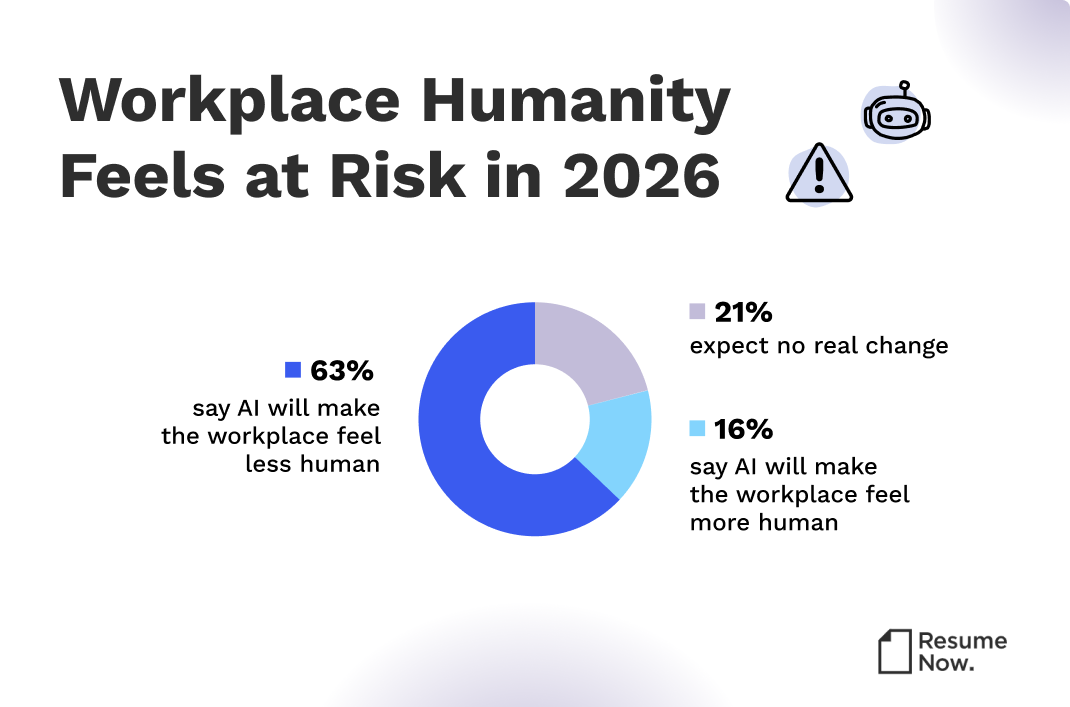
What this means: Workers are signaling that the AI conversation is not just about efficiency, but about atmosphere. Many concerns relate to whether automation in the workplace could erode connection, judgment, and the sense that work is fundamentally human.
For leaders, the challenge is not simply adopting AI tools, but ensuring that human presence and shared purpose remain visible in an increasingly automated environment.
Human Skill Decline Is the Leading AI Workforce Issue
Workers primarily identify overreliance on AI as the leading workforce problem, reflecting fears that increased automation could weaken critical thinking and other essential human skills. AI job loss fears and dehumanization follow closely behind, as these results show:
- 57%: Overreliance on AI reducing human skills
- 49%: Job displacement or loss
- 42%: Dehumanization of work
- 36%: Surveillance or data misuse
- 35% Lack of transparency or accountability
- 21%: Bias in hiring or promotions
- 2%: Other concerns
What this means: The dominant concern is not just that AI will change work, but that it could reshape how people think and contribute. Workers appear wary of becoming too dependent on automation in ways that weaken judgment, creativity, and problem-solving over time.
Ultimately, employees want reassurance that AI will strengthen human capability, not diminish it.
Job Loss & Privacy Top Workers' Immediate AI Fears
Workers rank job loss as the main AI risk this year, followed by worries about data misuse, privacy, and declining creativity and critical thinking, qualities that shape the human side of work.
- 29%: Job loss
- 23%: Data misuse or privacy violations
- 20%: Loss of creativity or critical thinking at work
- 18%: Constant surveillance and monitoring
- 10%: Hidden bias in hiring or promotions
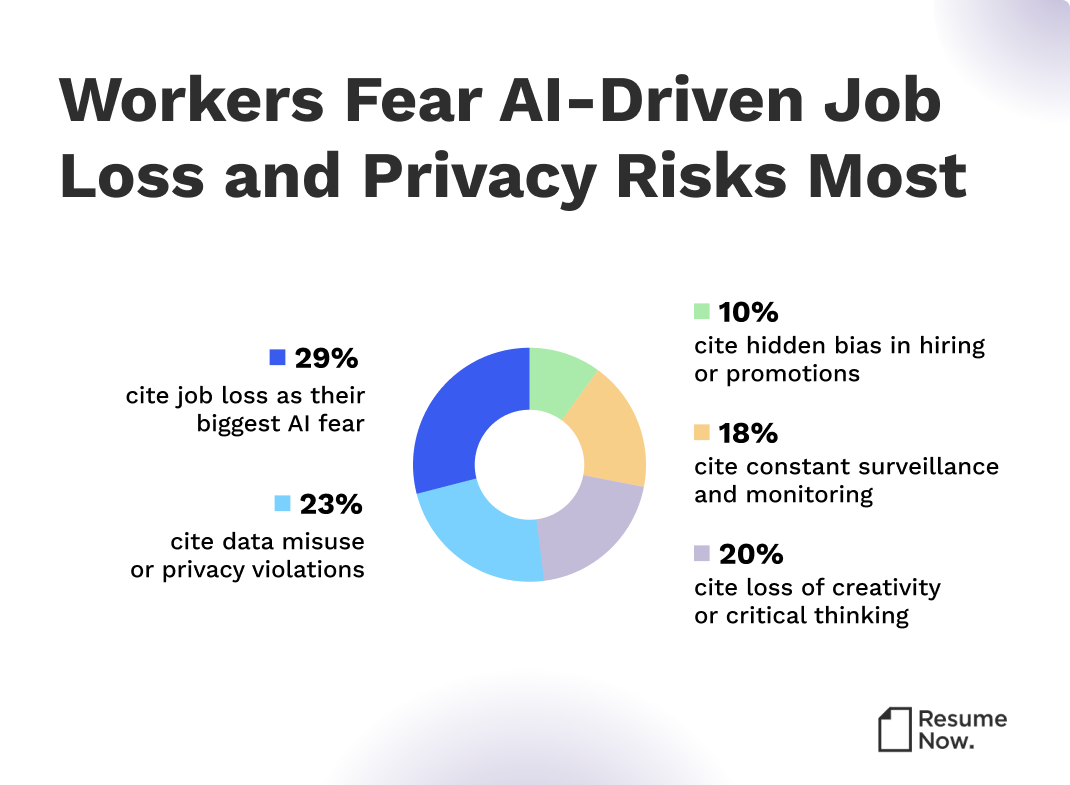
What this means: Workers are focused on tangible risks that feel immediate and personal. Fears about job stability, surveillance, and diminished creativity sit alongside privacy concerns with AI in the workplace, signaling unease about both security and autonomy.
Together, these responses suggest employees are evaluating AI as both a tool and a force that could directly affect their stability, independence, and ability to think critically at work.
AI Skills Are Viewed as Relevant, But Not Universal
While concerns about declining human skills are prevalent, most workers do not expect AI expertise to become mandatory across nearly all white-collar roles by the end of 2026. Instead, they believe those skills will matter in some jobs, but not most.
- 48% say AI skills will be important in some jobs but not most.
- 18% say they will be required across nearly all white-collar jobs.
- 17% say they will be optional or niche.
- 17% say they will be overhyped and unnecessary.
What this means: Despite widespread debate about AI's expansion, workers are not bracing for an all-or-nothing transformation. Many seem to expect uneven adoption, with certain roles evolving quickly while others change more gradually.
This reflects a measured view of AI's trajectory, where relevance depends on context rather than sweeping, universal disruption.
Methodology
The findings in this report are based on a survey of 1,003 employed U.S. adults, conducted by Resume Now using Pollfish in October 2025. Respondents answered questions about the anticipated impact of artificial intelligence on workplace culture, skill development, job security, and AI-related risks in 2026. Question formats included multiple-choice, single-select, and multi-select questions.
Demographic Breakdown
Survey respondents reflected a broad cross-section of the U.S. workforce. Participants were 67% female and 33% male. Generationally, 13% identified as Gen Z, 32% as millennials, 36% as Gen X, and 19% as baby boomers.
For press inquiries, contact Alexa Kalechofsky at alexa.kalechofsky@bold.com.


Keith is a Certified Professional Resume Writer (CPRW) and trusted media source in the career industry with over a decade of experience helping job seekers stand out.
More resources
The Two-Sided Job Market Report: When Growth Forecasts & Employee Outlook Don’t Match
Resume Now s Two-Sided Job Market Report reveals a mismatch ...
Workplace AI Temp Check: Washington, DC, Arizona, & Colorado Lead in Business AI Use
Resume Now analyzed AI adoption by state revealing where repo...

The AI Whelmed Worker: 44% Feel Overwhelmed by the Pressure to Learn & Use AI at Work
Resume Now s new report reveals that workers feel uncertain u...
The AI Skills Race: 43% of Workers Feel They’ve Fallen Behind
Resume Now finds that 43% of workers feel behind in their AI s...
Human-AI Trust in the Workplace: 97% of Workers Still Put Human Judgment First
In an analysis of human-AI trust in the workplace Resume Now ...
Future Proof Career Skills: 10 Human Skills for Resumes in the Age of AI
Resume Now s analysis of O NET cognitive ability data across 8...
 Get the job 2x faster*
  Customize your cover letter