

Artificial intelligence (AI) skills have become a valuable asset in today's job market. Employers seek candidates who can use AI to solve complex problems, analyze data, and improve processes that positively impact their organizations.
If you have these skills, then properly showcasing them is crucial to getting noticed by employers. We'll show you how.
In this article, you will find:
- What AI skills are
- Why AI skills are essential for job seekers
- The top 10 AI skills to list on your resume
- Key sections of your resume to include AI-related expertise
- An example resume featuring AI skills
- Tips for incorporating AI skills into your resume
Want to create your resume quickly and easily? With our AI Resume Builder, you can upload an old resume or create a new one in just a few clicks. Check out our dozens of templates and fill them out with the content suggestions the builder generates from any device to help you describe your career today!
What Are Artificial Intelligence Skills?
Artificial intelligence (AI) skills include both building AI systems and using AI tools effectively.
From a technical standpoint, these skills involve machine learning, data modeling, programming, and working with AI frameworks to build and refine AI-powered systems. On the practical side, AI skills also include using AI-powered tools to automate work, organize and brainstorm ideas, and increase efficiency.
Strong AI skills combine technical knowledge with real-world application. As AI becomes part of everyday work across industries, professionals who can both understand how AI works and apply it responsibly are increasingly valuable to employers.
Why AI Skills Are Important
AI is revolutionizing industries, from healthcare and finance to retail and marketing. This means employers from across industries are looking for candidates who can harness the technology to drive innovation, streamline processes, and solve real-world challenges.
Here's why showcasing your AI skills on your resume matters:
- Growing demand: Jobs requiring AI expertise are expanding across all sectors, including roles in data analysis, software engineering, marketing, and more.
- Competitive edge: Highlighting AI skills on your resume sets you apart from candidates who lack this expertise, making you more appealing to hiring managers.
- Versatility: AI knowledge is valuable in various applications, such as automating tasks, improving customer experiences, and analyzing big data.
By effectively demonstrating your abilities in AI, employers can easily see you're ready to contribute to their success in an ever-evolving digital world.
Top 10 AI Skills to Include on Your Resume
Whether you're working to build AI systems or using AI to increase efficiency in your workday, showcasing AI skills on your resume will show employers that you're ready to innovate.
Below are the top AI skills to include on your resume to show employers how you can apply artificial intelligence in real-world work environments.
#1
Prompt Engineering
Prompt engineering is the skill of writing clear, strategic inputs that guide AI tools to produce accurate and relevant outputs. Prompt engineering is an essential skill that allows you to use generative AI effectively in writing, analysis, coding, and automation.
#2
AI Tool Proficiency
AI tool proficiency involves confidently using AI tools to improve productivity. From ChatGPT and Gemini to specialized tools for vibe-coding, video editing, and automation, showing employers that you can use AI tools to streamline your work gives your resume a boost.
#3
Machine Learning Fundamentals
Machine learning fundamentals focus on understanding how AI models learn from data. This knowledge helps you work with AI systems, evaluate results, and contribute to the development of AI technology.
#4
Data Analysis & Modeling
Data modeling involves building the structural framework that ensures large, complex datasets are well prepared for AI algorithms to analyze and interpret. Strong data analysis enables you to evaluate and use AI outputs to uncover trends and predict future outcomes, helping inform business decisions.
#5
Programming Basics for AI
Programming basics—including proficiency with common programming languages—support AI development, customization, and integration. Even light coding knowledge helps you work more effectively with AI technologies. This is an especially useful skill to enhance the outputs you can achieve with vibe-coding AI software.
#6
Natural Language Processing (NLP)
NLP relates to how AI understands and generates language. Understanding NLP is important for working with chatbots, search tools, and sentiment analysis. As generative AI becomes a key tool in content creation, search, and customer service, NLP skills are increasingly valuable.
#7
Automation & AI Workflows
Automation skills involve using AI to streamline repetitive tasks and build intelligent workflows. This may include connecting AI tools with business software or automation platforms. Automation and prompt engineering work together to empower workers in and outside of technical fields to streamline work processes.
#8
Model Evaluation & Output Review
This skill focuses on assessing AI outputs for accuracy, bias, and relevance. Employers value professionals who can validate results and ensure AI is used responsibly.
#9
Ethical AI & Responsible Use
Ethical AI skills involve understanding data privacy, bias, and compliance when working with AI systems. While AI usage is widespread, ethical concerns about AI are more pressing than ever. Candidates who demonstrate responsible AI usage show that they're adaptable while demonstrating integrity and AI policy compliance.
#10
AI Strategy & Business Application
AI strategy skills involve identifying where AI can create value and how to implement it effectively. This includes aligning AI initiatives with business goals and measuring their impact.
Where to Include AI Skills on Your Resume
When writing a resume, your first goal is to make a lasting impression on hiring managers and ensure it passes applicant tracking systems (ATS).
Start by being strategic about where you put your AI skills on your resume. Consider the following sections to use to your advantage.
1. Resume Summary or Objective
If you have relevant professional experience, then write a resume summary to highlight your AI expertise tailored to the role you're applying for. Focus on key skills and accomplishments, and how your knowledge contributes to business goals.
If you still have AI skills but are a recent graduate or are changing careers, you can write an objective statement instead. In this case, you will focus more on your skills, career goals, and interest in the position.
Resume summary example:
Data scientist with 5+ years of experience leveraging machine learning and AI tools like TensorFlow and Python to drive business insights, optimize workflows and improve decision-making.
Resume objective example:
Recent graduate with a B.S. in Data Science. Eager to use background in AI development projects and skills in automation analysis and prompt engineering to produce new models for data efficiency protocols.
Pro tip
Check out our AI Resume Summary Generator to get help writing a resume summary. Fast and easy to use, you'll be able to quickly write a summary that is perfect for you.
2. Work History
Employers love to see how your job history makes you a valuable employee. In this section, demonstrate how you've applied AI skills to achieve tangible results. Pick responsibilities and accomplishments that align with the job description.
Also, remember to start off each bullet with action-oriented language and quantify your achievements wherever possible to show the impact of your work.
Example:
AI Developer
Tech Solutions Co. | Remote | January 2023 – Present
- Designed and deployed a machine learning model to predict customer churn, reducing churn rates by 15%.
- Implemented a natural language processing (NLP) algorithm to improve chatbot accuracy, leading to a 30% increase in customer satisfaction scores.
- Automated data analysis workflows using Python, saving 10 hours per week in manual labor.
3. Skills Section
A well-organized skills section ensures that hiring managers and ATS can quickly identify your AI-related competencies.
List your technical skills in AI development and usage alongside a robust list of soft skills, such as communicating AI-generated results to clients.
Example:
- Machine learning: Regression, clustering, classification
- Programming languages: Python, R, Java
- AI platforms: Google Cloud AI, Microsoft Azure AI
- Data visualization: Tableau, Power BI
- Natural language processing (NLP): spaCy, NLTK, Hugging Face
- AI-training: Instruct and train employees in automation best practices
- Analytical thinking: Interpret AI outputs, identifying patterns, and validating results
- Critical evaluation: Review model outputs for accuracy, bias, and relevance
4. Certifications
Certifications are an optional section on most resumes. They are very useful when they validate your expertise and commitment to professional development.
List any relevant certifications you may have that are connected to the AI skills you wish to promote.
Example:
- "AI for Everyone" by Coursera, issued February 2026
- Google Cloud Professional Machine Learning Engineer Certification, issued May 2025
- IBM Data Science Professional Certificate, issued November 2024
5. Professional Projects
If you lack work experience and need to further your case about your qualifications with AI, then add a section about professional projects to show how your skills were put to use to produce quantifiable impact.
Examples:
- Predictive analytics model: Developed a predictive model using Python and TensorFlow to forecast sales trends, improving forecasting accuracy by 20%.
- AI-powered chatbot: Designed and implemented an AI chatbot using NLP frameworks, reducing customer query resolution times by 40%.
- Image recognition system: Built a computer vision system with TensorFlow and OpenCV to classify and detect objects in real time, achieving 95% accuracy.
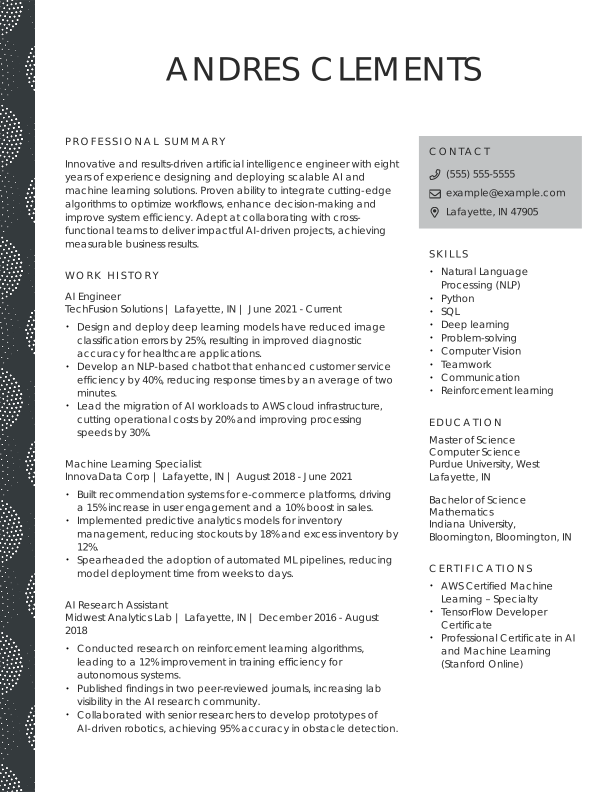
Example of AI Skills on a Resume
Check out the example below to see how AI skills can be added to your resume.
Tips for Putting AI Skills on Your Resume
- Highlight key skills. Include both technical skills (e.g., machine learning, data analysis) and relevant tools or platforms (e.g., TensorFlow, Python, Google Cloud AI) that match the job description.
- Tailor your resume. Align your AI skills and experience with the specific requirements in the job posting. Use keywords from the description to optimize your resume for ATS and hiring managers.
- Focus on impact. Showcase how your AI expertise has driven results in previous roles by quantifying achievements, such as improving model accuracy or reducing costs.
- Include certifications. Add in-demand certifications that validate your knowledge, such as IBM Applied AI Professional Certificate or Google Cloud Machine Learning Engineer.
- Focus on relevant applications. Tailor your resume to highlight AI applications relevant to the industry, such as predictive analytics in finance or NLP in customer service.
- Mention soft skills. Don't forget to mention soft skills like analytical thinking, problem-solving, and collaboration, which complement your technical expertise.
- Be concise. Avoid overloading your resume with unnecessary details. Focus on the skills and experiences that directly demonstrate your AI expertise and align with the job.
Key Takeaways
- AI skills are in high demand.
Employers across industries are seeking candidates with AI expertise to drive innovation, streamline processes, and tackle real-world challenges. - Be strategic.
Incorporate your AI skills into key sections of your resume, such as the summary, work history, skills section, certifications, and professional projects. Tailor each section to highlight your AI expertise in alignment with the job description. - Focus on measurable impact.
Demonstrate how your AI skills have achieved results, such as improving efficiency, reducing costs, or increasing customer satisfaction. Quantifying your accomplishments makes your resume more compelling. - Certifications boost credibility.
Listing certifications like Google Cloud Machine Learning Engineer or IBM Data Science Professional Certificate validates your expertise and shows your commitment to staying current in the field. - Tailoring is key.
Customize your resume to match the job description by using relevant keywords and emphasizing skills and achievements that align with the employer's needs.
FAQ
What AI skills should I include on my resume?
Your resume should include AI skills that reflect your abilities and align with the job description, such as machine learning, natural language processing, programming languages (e.g., Python, R), and AI frameworks like TensorFlow or PyTorch. Be sure to include any tools or platforms you're proficient in, such as Google Cloud AI or Tableau.
How can I showcase AI projects if I'm a beginner?
As a beginner, you should highlight personal or academic projects where you applied AI concepts. For example, mention creating a simple machine learning model or automating a process using Python. You can also list relevant coursework, certifications, or participation in AI-related hackathons.
Where should I list AI skills on my resume?
- Skills section: List technical and soft skills related to AI.
- Work experience section: Highlight achievements involving AI technologies.
- Education section: Mention AI-related coursework or degrees.
- Certifications section: Add any AI-focused certifications you've earned.
Include AI skills in multiple sections:
Do I need technical experience to list AI skills on my resume?
You don't need technical experience to create a resume that shows proficiency with AI. Many AI skills focus on using AI tools rather than building systems from scratch. If you've used AI for data analysis, content creation, automation, or decision-making, you can list those skills as long as you explain how you applied them in real work scenarios.
How do I list AI skills without overstating my experience?
List AI skills without exaggerating your experience by being transparent about your level of involvement. Instead of claiming "AI expert," describe what you actually did, whether that's building an AI workflow or simply using a dedicated tool. Clear, honest descriptions build more credibility with employers.
Are AI skills relevant outside of tech roles?
Yes, AI skills are relevant outside of tech roles. AI is particularly valuable in marketing, finance, healthcare, operations, HR, and many other fields. Employers in nontechnical roles increasingly look for candidates who can use AI tools to improve efficiency, insights, and outcomes.


Conor is a Certified Professional Resume Writer (CPRW) and member of the Professional Association of Resume Writers & Career Coaches dedicated to helping job seekers excel in their careers.
More resources

8 Current Resume Trends for 2026 (With Tips & Examples)
Stay current with 2026 resume trends and learn how to make you...
How to Write a Resume: Guide & Examples for 2026
Learn how to write a resume that gets interviews with our step...

How to Write a Resume With ChatGPT (Step by Step Guide & Prompts)
Learn how to write a resume with ChatGPT using targeted prompt...

Transferable Skills: Examples & How to List Them on Your Resume
Write a resume that stands out by making the most of your tran...

How to Use Resume Now’s AI Resume Builder for Free
Try Resume Now s AI-powered Resume Builder for free to access ...

References Available Upon Request on Your Resume: Is It Necessary?
References available upon request is a phrase added to the bot...
 Get the job 2x faster*
  Customize your cover letter