


Table of contents
 Make Resume Now a preferred source on Google
Crying at work is no longer an exception, it's part of the employee experience. According to Resume Now's Quiet Cry Report, 39% of employees say they have cried at work at least once, whether at their desk, in a meeting, or privately in a bathroom or car.
At the same time, more than half of workers (52%) worry about losing their job even when there is no clear reason, signaling that emotional strain is being driven as much by uncertainty as by workload. The data shows that many workers are quietly venting, disengaging, and preparing for a potential job change while still on the clock.
Key Findings
- Crying at work is common. 39% of employees say they have cried at work, including 14% who have cried multiple times and 25% who have cried once or twice.
- Emotional strain goes beyond tears. An additional 21% say they have not cried at work but have felt close to tears.
- Job insecurity is widespread. 52% worry they could lose their job even without a clear performance issue or business reason.
- Frustration spills outward. 55% vent or complain about their job to friends, coworkers, or on social media.
- Quiet job searching happens on the clock. 4 in 10 workers (41%) have used work hours to update their resume.
- Personal tasks bleed into work hours. 49% use work time for personal tasks such as online shopping, errands, or appointment scheduling.
- Disengagement is subtle but real. Nearly 6 in 10 workers do not meaningfully re-engage when they feel mentally checked out at work.
Fear & Uncertainty Are Driving the Quiet Cry
Job insecurity is widespread even without a clear trigger.
- 52% of workers worry about losing their job, even when there's no obvious reason, including 24% who worry constantly or at least once a week and 28% who worry occasionally.
- Only 27% say they never worry and feel confident and secure in their role.
What this means: Emotional stress at work is not only about heavy workloads or long hours. Ongoing uncertainty about job security can weigh just as heavily, even when nothing specific seems wrong. When employees are left guessing about their stability, that constant mental pressure can build over time, causing widespread worker burnout and making stress harder to contain and more likely to surface during the workday.
Emotional Strain Is Showing Up at Work
For a majority of workers, emotional stress tied to their jobs has spilled directly into the workplace, with many reporting crying at work or coming close to tears.
- 14% say they've cried at work multiple times.
- 25% say they've cried once or twice.
- 21% say they haven't cried but have felt close.
- 39% say they've never cried at work.
The following is a visual representation of the data above:
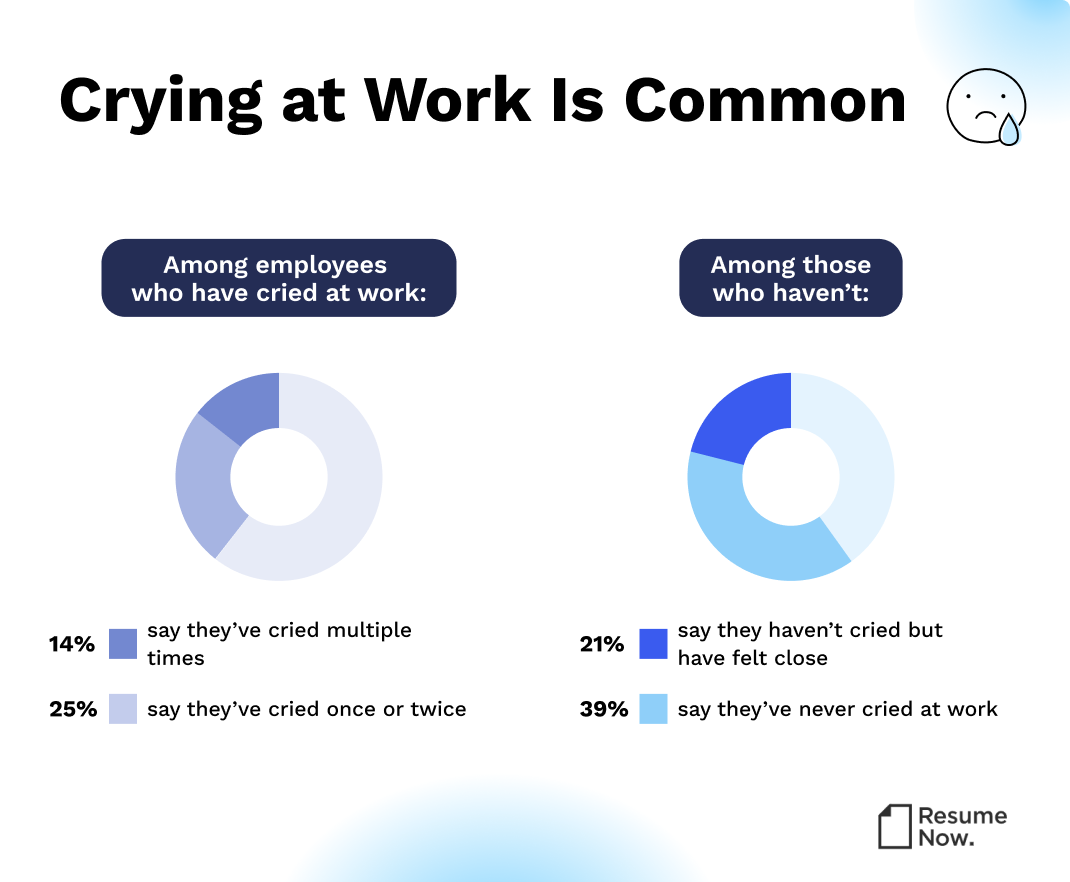
What this means: When emotional stress at work reaches the point where it surfaces during the workday, it signals that strain is no longer something employees are managing privately. Crying at work or feeling close to tears reflects pressure that has built up over time, often without a clear release valve. These moments suggest that many workers are carrying emotional weight into their daily routines, making it harder to separate emotional overwhelm from workplace demands.
Venting as a Coping Mechanism at Work
Venting has become a routine way many workers cope with job stress.
- 55% of workers vent or complain about their job at least occasionally, whether to a friend, coworker, or on social media.
- 34% vent frequently, doing so every day or a few times a week.
- Only 12% say they never vent.
What this means: When venting becomes a regular part of how employees deal with work stress, it suggests that pressure is being released informally rather than addressed at the source. Talking things out can offer temporary relief, but frequent venting can also signal that stressors are persistent and unresolved. Over time, this pattern can normalize frustration as part of the workday, shaping how employees relate to their jobs and to each other.
The Rise of the Quiet Job Search
Instead of openly disengaging or resigning, many workers are quietly preparing an exit while still employed:
- 41% have updated their resume during work hours.
- 39% have performed other job search activities such as interview prep or networking.
- 53% use work hours for professional development such as taking online courses or earning certifications.
- About half (49%) also admit they use work time for personal tasks such as shopping, appointments, or errands.
The following is a visual representation of the data above:
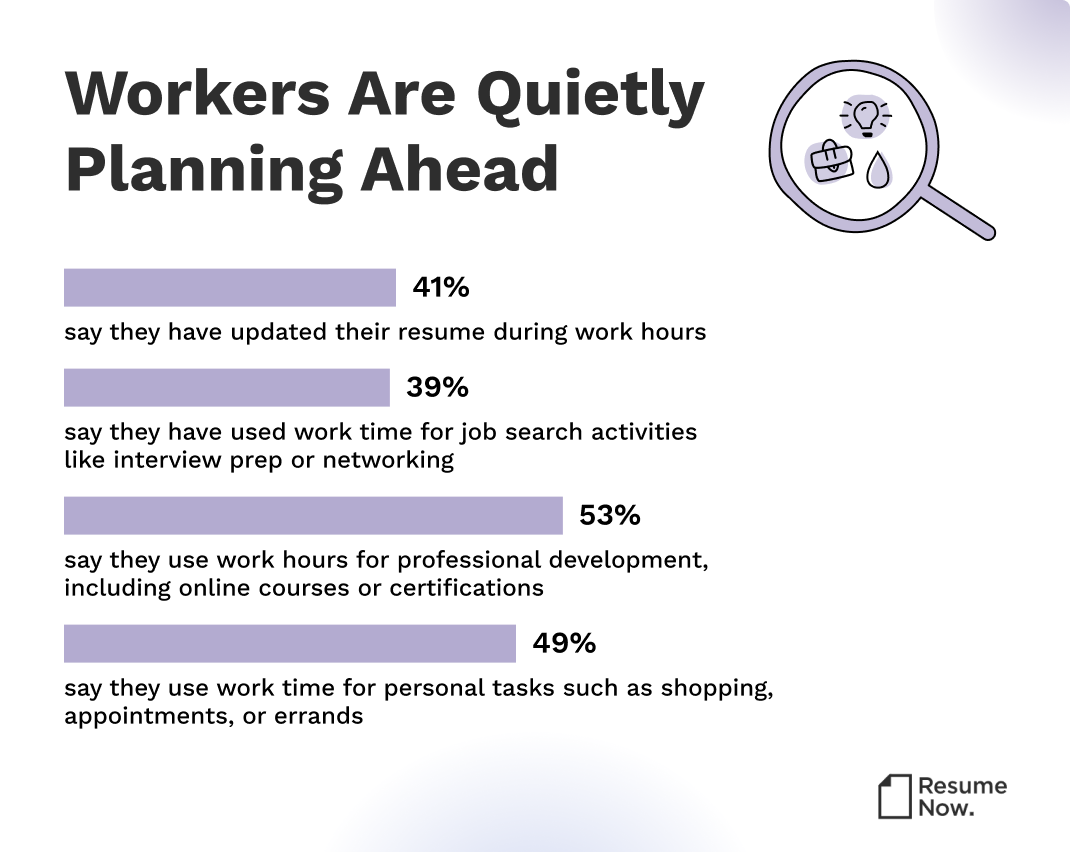
What this means: Rather than disengaging openly, many employees are quietly using the workday to plan ahead, build skills, or manage personal needs. This pattern of "ghostworking" on the job suggests a workforce that remains present on paper, but is increasingly focused on options beyond their current role.
Workers Struggle to Re-engage
When workers feel mentally checked out:
- 40% try to re-engage.
- 46% redirect energy elsewhere (26% distract with non-work tasks, 20% focus on upskilling or job search).
- 13% do the bare minimum.
What this means: When employees feel mentally checked out, re-engaging is not always the default response. Many shift their energy elsewhere or scale back their effort, suggesting that disengagement often shows up as quiet withdrawal rather than open frustration. Over time, this pattern can affect momentum, performance, and how connected employees feel to their work.
What This Signals for Employers
Together, these findings show that emotional strain is no longer an isolated workplace issue, but a defining feature of the modern employee experience. The Quiet Cry at Work Report reflects a workforce that is showing up physically while struggling emotionally, with implications for productivity, morale, and long-term retention.
Methodology
The findings in this report are based on a survey of 1,018 U.S. adults, conducted on December 6, 2025. Participants responded to questions about job anxiety, emotional experiences at work, workplace behaviors, and engagement using a combination of multiple-choice, frequency-based scaled, and yes/no formats.
Demographic Breakdown
Survey respondents reflected a broad cross-section of the workforce. Participants were 58% female and 41% male. Generational representation was evenly distributed, with 14% identifying as Gen Z, 30% as Millennials, 31% as Gen X, and 25% as Baby Boomers.
About Resume Now
Resume Now is a powerful resource dedicated to helping job-seekers achieve their potential. Resume Now's AI resume builder is a cutting-edge tool that makes creating a resume fast, easy, and painless. Resume Now has been dedicated to serving job seekers since 2005. Alongside its powerful AI resume builder and stylish ready-to-use templates, it also features free advice for job seekers at every career stage, guides for every step of the hiring process, and free resources for writing cover letters. Resume Now is committed to supporting job seekers and workers alike and has conducted numerous surveys related to the experience, trends, and culture of the workplace. These surveys have been featured in Business Insider, CNBC, Fast Company, Yahoo!, Forbes, and more. Keep up with Resume Now on LinkedIn, Facebook, X, and Pinterest.
For press inquiries, contact Alexa Kalechofsky at alexa.kalechofsky@bold.com.


Keith is a Certified Professional Resume Writer (CPRW) and trusted media source in the career industry with over a decade of experience helping job seekers stand out.
More resources
Workplace AI Temp Check: Washington, DC, Arizona, & Colorado Lead in Business AI Use
Resume Now analyzed AI adoption by state revealing where repo...

The AI Whelmed Worker: 44% Feel Overwhelmed by the Pressure to Learn & Use AI at Work
Resume Now s new report reveals that workers feel uncertain u...
The AI Skills Race: 43% of Workers Feel They’ve Fallen Behind
Resume Now finds that 43% of workers feel behind in their AI s...
Human-AI Trust in the Workplace: 97% of Workers Still Put Human Judgment First
In an analysis of human-AI trust in the workplace Resume Now ...
Future Proof Career Skills: 10 Human Skills for Resumes in the Age of AI
Resume Now s analysis of O NET cognitive ability data across 8...
10 Jobs That AI Can't Replace Thanks to “Superhuman” Skills
Resume Now analyzed O NET data to identify AI-proof jobs that ...
 Get the job 2x faster*
  Customize your cover letter