


Table of contents
- What Are Resume Keywords & Why Do They Matter?
- How to Find the Right Keywords for Your Resume
- Where to Put Keywords on Your Resume
- Example Resume That Makes the Most of Keywords
- 80 of the Most Common Resume Keywords Across Popular Industries
- Resume Keywords Best Practices & Common Mistakes
- Final Thoughts
- FAQ
A truly impressive resume isn't always enough to get noticed by employers. Your qualifications might be perfect for the role, but does your resume emphasize the right keywords to show employers and applicant tracking systems (ATS) that you have what it takes?
Sometimes, the thing that makes or breaks a resume is the use of resume keywords. Our guide will walk you through how resume keywords work and how to adapt and build a resume with keywords that get you noticed.
Our guide covers:
- What resume keywords are and why they matter
- How to find the right keywords for the role
- Where to put keywords on your resume
- A resume example that makes the most of keywords
- Resume keyword examples by industry
Need help building or updating your resume? Try our AI Resume Builder for help getting started. This tool handles the formatting for you and provides fully customizable text suggestions to help you beat that pesky writer's block.
What Are Resume Keywords & Why Do They Matter?
Resume keywords are the specific words or phrases employers look for on your resume to identify qualified candidates. Using the right keywords is essential for passing through applicant tracking systems (ATS), which many companies use to filter resumes before a human ever sees them.
ATS works by scanning resumes for keywords related to skills, work experience, education, and other qualifications. By carefully incorporating phrases directly from the job listing, you can create an ATS-friendly resume that reaches a human recruiter. Keywords also help your resume stand out by clearly showing how your experience aligns with the role.
Pro tip
Hiring managers spend an average of seven seconds scanning a resume, so your resume needs to grab attention immediately. Keywords don't just help your resume pass through ATS; they also ensure that your most important information catches the hiring manager's eye.
How to Find the Right Keywords for Your Resume
You might be wondering, now that I know that keywords are important, how do I know which keywords to use on my resume?
To find the keywords you need to include on your resume, read the job description closely. As you review the job description, identify and separate hard skills (tools, software, certifications, and technical abilities) from soft skills (communication, collaboration, leadership, or time management).
Hard skills are often listed in requirements, while soft skills are embedded in responsibility descriptions. Both types can function as keywords when they appear repeatedly or are emphasized by the employer.
For example, if you're applying for a marketing coordinator position, a job description might include the following requirements:
- Assist in planning and executing marketing campaigns
- Manage social media accounts and track engagement
- Coordinate events and promotional activities
- Analyze marketing data and create performance reports
- Bachelor's degree in marketing, communications, or related field
Based on that job description, the keywords an ATS would likely pick up include: marketing campaigns, social media management, event coordination, data analysis, performance reporting, and bachelor's degree.
Once you've identified the keywords, strive to use them exactly as they appear in the job ad to ensure your resume matches the employer's desired experience and skills. Even using small variations in phrasing, like "track social engagement" instead of "social media management," can affect whether your resume passes the initial screening.
Pay special attention to how the job description lists terms with common variations, such as B.A. vs. Bachelor of Arts. It's always a good idea to match the employer's description of these qualifications.
Identifying Resume Keywords in the Job Listing
Let's review how to select the resume keywords that will help you ace the ATS screening and impress employers.
Let's use an example job listing to demonstrate:
Example Job Listing With Keywords
Position: Marketing Copywriter for Simply Software Inc.
Responsibilities
:
- Create compelling and original copy for various marketing materials, including website content, blog posts, social media, and more.
- Utilize WordPress to update and maintain website content.
- Implement SEO strategies to drive organic web traffic and improve search engine rankings.
- Collaborate with cross-functional teams, including marketing, design, and development, to ensure cohesive messaging.
- Manage and meet deadlines for multiple projects simultaneously.
Requirements
:
- Proven experience as a copywriter with a strong portfolio showcasing diverse writing samples.
- Proficiency in using WordPress for content management.
- Knowledge of SEO best practices to optimize content for search engines.
- Excellent communication and collaboration skills to work effectively with cross-functional teams.
- Ability to thrive in a fast-paced environment and meet tight deadlines.
It might be tempting to look at a job listing like this and try to squish every single word onto your resume, but choosing the right keywords is an important skill. Look at each section and pay attention to the words that stand out as important.
Take this sentence as an example:
- Knowledge of SEO best practices to optimize content for search engines
Role-specific words or phrases that highlight a specific skill or task are more likely to be keywords. Phrases like "SEO" and "optimization" are requirements specifically for a marketing copywriter job, making them keywords a candidate could use to apply for this role.
Also, notice how some phrases come up in the job listing more than once? "SEO," "search engines," and "WordPress" all appear multiple times.
Keywords that appear multiple times, are tied to core job duties, or are listed as required qualifications should be treated as high-priority. These are the terms that should appear most prominently in your resume summary, skills section, and experience bullets.
Pro tip
The job description is your main source of keywords, but it isn't the only one. Browse the company's website, mission statement, and LinkedIn page to identify culture-focused keywords like "collaborative," "fast-paced," or "customer-first."
Where to Put Keywords on Your Resume
Now that you've identified the keywords from the job ad, where do you put them? You need to include keywords throughout all the parts of your resume to show how perfectly you align with the role. Using the example job ad from above, let's go through each section that could display keywords.
Start With a Keyword-Rich Profile
Opening with a resume profile that naturally incorporates keywords allows you to immediately grab attention. For example, instead of saying:
"Marketing professional with experience managing campaigns and social media."
You could write:
"Marketing coordinator with 3+ years of experience executing multi-channel campaigns, managing social media accounts, coordinating promotional events, and analyzing engagement data to drive measurable results."
Add a Skills Section
A dedicated skills section makes it easy for both ATS and human recruiters to quickly see your core competencies. Include a mix of hard and soft skills relevant to the role, using the exact keywords from the job description when possible:
Skills
- Multi-channel marketing campaigns
- Social media management (Instagram, LinkedIn, Facebook, TikTok)
- Content creation and editorial planning
- Data analysis and performance reporting
- Event coordination and promotion
- Paid advertising (Google Ads, Meta Ads)
- Marketing automation tools (HubSpot, Mailchimp)
- Collaboration and cross-functional communication
This section highlights your abilities at a glance and reinforces the keywords found in your profile and experience sections.
Show Keywords in Action
Listing keywords is a good start, but showing them in action is stronger. ATS and human recruiters want to know whether you've applied your skills to achieve results. Do this by contextualizing your abilities within a keyword-rich work experience section.
Marketing Coordinator | BrightWave Media | June 2021 – Present
- Executed multi-channel marketing campaigns, including email, social media, and paid ads, resulting in a 25% increase in lead generation.
- Managed social media accounts for three product lines, creating content calendars and tracking engagement metrics to improve follower growth by 40%.
- Coordinated quarterly promotional events and webinars, collaborating with cross-functional teams to drive attendance and customer engagement.
- Analyzed marketing performance data and created detailed reports to inform strategy, optimizing campaigns for higher ROI.
Pro tip
Start each bullet point with an action-driven verb like "coordinated" or "analyzed." This shows motivation and impact—plus, these action verbs are keywords too!
Example Resume That Makes the Most of Keywords
Now that we've gone over how to find keywords in a job listing, let's look at an example resume that uses keywords to maximize the candidate's chances of success. This job listing is rich in project management keywords that our candidate can use to guide their resume and align their experience with the role.
Example keywords are bolded for demonstration purposes.
Seeking innovative project manager for role at growing consulting firm
Responsibilities
:
- Develop and execute project plans, including scope, timeline, budget, and resource allocation to maximize efficiency.
- Coordinate and collaborate with cross-functional teams to ensure project goals are met.
- Monitor project progress and address any issues that may arise.
- Manage project budgets, ensuring cost-effectiveness and resource optimization.
- Communicate regularly with stakeholders to provide updates on project status and address concerns.
- Identify and mitigate risks to ensure successful project delivery.
- Foster a positive team environment and lead by example in terms of professionalism and accountability.
Qualifications
:
- Bachelor's degree in a relevant field (Project Management, Business, Engineering, etc.).
- Proven experience as a project manager in a similar industry.
- Excellent organizational and leadership skills.
- Strong problem-solving and decision-making abilities.
- Exceptional communication and interpersonal skills.
- Proficient in project management tools and software, particularly Asana.
- PMP or PRINCE2 certification is a plus.
Below, you'll see how language from a job description can be mirrored and adapted in a tailored resume to demonstrate alignment.
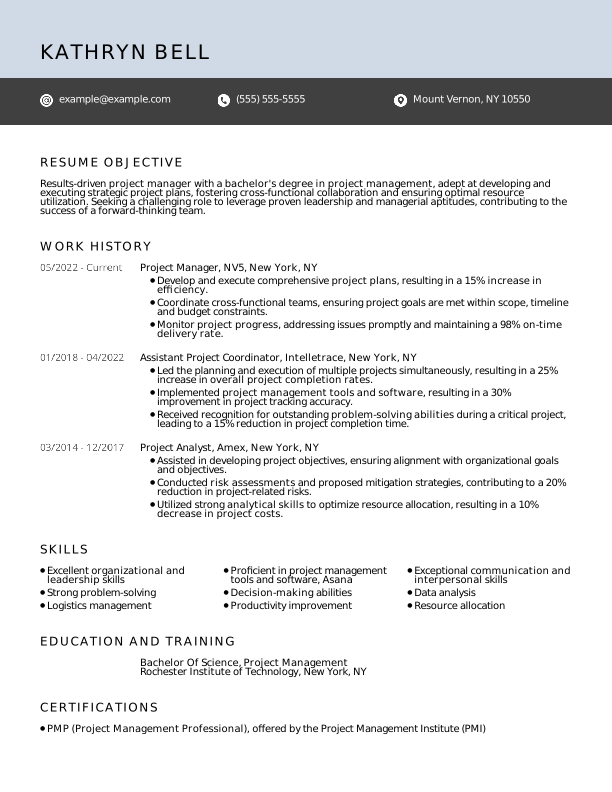
Notice how some of the bolded words and phrases are pulled directly from the job listing? This candidate is poised for success because of her strategic use of keywords. Not only is this resume likely to pass through ATS with ease, but it's aligned with the role in a way that will likely resonate with the hiring manager.
Pro tip
Keywords aren't the only aspect of this resume that grabs attention. The use of numerical data allows the reader to visualize the real-world impact of this candidate's experience. This is an important tool to help get your resume noticed.
80 of the Most Common Resume Keywords Across Popular Industries
Use these keyword lists as a reference when tailoring your resume. Align with the roles you're targeting by checking in on the industry terms and phrases that professionals in your field include on their resumes. Just make sure that you target your specific role and study the job listing as well.
Administrative & Office Support
- Calendar management
- Scheduling
- Data entry
- Travel coordination
- Document preparation
- Meeting facilitation
- Filing and organization
- Customer support
- Office administration
- Expense reporting
Childcare & Teaching
- Lesson planning
- Classroom management
- Child development
- Curriculum design
- Behavior management
- Student assessment
- Parent communication
- Special education support
- Early childhood education
- Educational technology
Healthcare
- Patient care
- Medical documentation
- Clinical support
- Health record management (EHR)
- Patient scheduling
- Care coordination
- Medical billing and coding
- HIPAA compliance
- Vital signs monitoring
- Healthcare administration
IT & Technical Roles
- Network administration
- Troubleshooting
- Database management
- Python
- SQL
- Cloud computing
- Cybersecurity
- System configuration
- Software deployment
- Technical support
Manufacturing & Skilled Trades
- Quality control
- Equipment operation
- Process optimization
- Lean manufacturing
- Safety compliance
- Preventive maintenance
- Production planning
- Supply chain coordination
- Inventory management
- Technical troubleshooting
Marketing & Communications
- Content creation
- Social media management
- Email marketing
- SEO optimization
- Copywriting
- Brand strategy
- Campaign management
- Digital advertising
- Public relations
- Market research
Project Management & Operations
- Project planning
- Risk management
- Process improvement
- Budget management
- Timeline development
- Resource allocation
- Stakeholder communication
- Workflow optimization
- Vendor management
- Quality assurance
Sales & Business Development
- Lead generation
- Account management
- Sales strategy
- Contract negotiation
- Customer relationship management (CRM)
- Pipeline management
- Revenue growth
- Market analysis
- Prospecting
- Client retention
Resume Keywords Best Practices & Common Mistakes
A great resume uses keywords to pass ATS screening and show alignment with the role, but adding too many can harm your resume. Make sure that you use keywords naturally and appropriately.
Dos:
- Use keywords naturally throughout your profile, skills, and experience sections.
- Match your keywords to the exact phrases in the job description when possible.
- Include both hard skills and soft skills.
- Contextualize keywords by showing how you applied them to achieve results.
- Update your keywords for each job you apply to.
Don'ts:
- Don't stuff your resume with keywords without context—it looks unnatural and can be flagged by ATS.
- Avoid using vague terms like "experienced" or "hardworking" without specifying skills.
- Don't rely solely on a skills section; keywords need to appear throughout your resume.
- Avoid overusing acronyms or jargon that the ATS or hiring manager might not recognize.
- Don't copy the job description word-for-word without adapting it to your real experience.
Final Thoughts
In a job search environment where applicant tracking systems are widely used, keywords are nonnegotiable. By carefully identifying the right keywords from job listings, company websites, and industry research, and strategically placing them throughout your resume, you increase your chances of getting noticed by both software and human recruiters.
Remember to include keyword variations, use action verbs, and highlight measurable results to make your resume truly stand out.
Ready to see how your resume performs? Try our free ATS Resume Checker to optimize your document and apply with confidence.
FAQ
What are keywords in a resume?
Keywords in a resume are terms and phrases taken from the job description to show the employer that you align with the needs of the role. Using phrases that match the job description to describe your experience and skills helps your resume pass through ATS screening and impress employers.
How important are resume keywords?
Resume keywords are critical for passing ATS screening and showing alignment with a role. They signal to both software and human recruiters that your skills and experience match what the employer is looking for. Without relevant keywords, even a highly qualified candidate can be overlooked.
Where should I include keywords on my resume?
Keywords should appear throughout your entire resume. List them as skills in your skills section, weave them into your professional summary, and show them in action with context and measurable results in your work experience section. This ensures ATS recognizes them and demonstrates to hiring managers how you've applied these skills in real-world situations.
Should I just copy the keywords from the job description?
No, you shouldn't just copy your keywords from the job listing. You should adapt the language from the job description to fit your experience. Contextualizing keywords within accomplishments and responsibilities is more effective than simply listing terms, and gives you the chance to add data and results to these key phrases.
Can I use the same keywords for every job?
No, you shouldn't use the same keywords for each job you apply to. Review the job listing carefully and tailor your keywords for each application to match the employer's specific needs. You may find significant overlap when applying to multiple roles in the same industry, but taking the time to customize—even just a little—will help your resume stand out.
Do soft skills count as keywords?
Yes. Many employers and ATS now screen for soft skills such as collaboration, communication, or leadership. Include them naturally alongside your technical or hard skills to create a balanced resume.
How many keywords should I include?
There's no exact number of keywords a resume should use. Instead, focus on quality over quantity. Include the most relevant keywords for the role that demonstrate your accomplishments. Overstuffing your resume with keywords can hurt readability and raise red flags with ATS.
What if my experience doesn't match all the keywords in a job description?
If your experience doesn't match every keyword in the job description, prioritize the ones that reflect your strongest, most relevant skills. You don't need to force experience you don't have. Instead, highlight transferable skills and demonstrate your abilities in context wherever possible.


Hailey is a career writer whose work for Resume Now helped job seekers excel in their careers.
More resources

8 Current Resume Trends for 2026 (With Tips & Examples)
Stay current with 2026 resume trends and learn how to make you...

How to Write a Resume: Guide & Examples for 2026
Learn how to write a resume that gets interviews with our step...

How to Write a Resume With ChatGPT (Step by Step Guide & Prompts)
Learn how to write a resume with ChatGPT using targeted prompt...

Transferable Skills: Examples & How to List Them on Your Resume
Write a resume that stands out by making the most of your tran...

How to Use Resume Now’s AI Resume Builder for Free
Try Resume Now s AI-powered Resume Builder for free to access ...

References Available Upon Request on Your Resume: Is It Necessary?
References available upon request is a phrase added to the bot...
 Get the job 2x faster*
  Customize your cover letter