


Table of contents
- Key Findings
- Most Employees Say Their Skills Are Not Fully Used
- Daily Work Leaves Many Employees Bored or Understretched
- Skill Recognition & Role Alignment Often Fall Short
- Recognized Strengths Rarely Translate Into Real Influence
- Underutilization Is Driving Turnover
- Underutilization Dramatically Shortens Employee Tenure
- Most Employees Say Leadership Fails to Act
- Career Growth Is Being Impacted
 Make Resume Now a preferred source on Google
A new national survey from Resume Now reveals that the majority of employees feel underutilized at work, with serious implications for engagement, career growth, and retention.
According to Resume Now's Untapped Talent Report, 69% of workers report that their skills and abilities are not fully leveraged in their current roles, and 77% say being underutilized has slowed their career progression.
Key Findings
- Underutilization is widespread. 69% of employees say their skills and abilities are not fully used at work.
- Work lacks challenge for most. 87% find their day-to-day work only moderately challenging or less.
- Recognition falls short. 65% say their organization shows limited recognition or alignment with their skills, interests, and passions.
- Strengths are acknowledged but not activated. 62% report their unique strengths are underutilized at least sometimes, even when recognized.
- Underutilization fuels turnover. 72% say they would likely look for a new job if they felt consistently underutilized.
- Retention is at risk. 67% would consider leaving their company within a year if underutilization continued.
- Leadership blind spots persist. 38% say leadership fails to notice underutilization, including 11% who say leadership does not notice or care.
- Career momentum is suffering. 77% say being underutilized has slowed their career progression in some capacity.
Most Employees Say Their Skills Are Not Fully Used
Survey results show a clear disconnect between what employees are capable of contributing and what their roles actually demand of them.
- 13% feel deeply underchallenged and disengaged all the time.
- 28% often feel they could be contributing much more.
- 28% feel underutilized occasionally.
- Only 31% say they rarely or never feel underutilized.
What this means: Many employees feel their roles fail to tap into their full capabilities, creating a gap between what they can contribute and what their jobs actually require. Over time, this underuse can quietly erode motivation, performance, and long-term engagement.
Daily Work Leaves Many Employees Bored or Understretched
For most workers, daily tasks fail to provide enough challenge to fully engage their skills or sustain long-term motivation:
- 13% find their work extremely challenging.
- 58% say it is moderately challenging.
- 24% say it is barely challenging.
- 5% say it is not challenging at all and that they're bored.
What this means: When daily tasks fail to challenge employees, work can quickly feel repetitive and uninspiring rather than motivating. Over time, boredom and understretching can negatively impact energy, creativity, and commitment. With 58% of workers admitting to "ghost working," bored and disengaged employees can have a real productivity cost.
Skill Recognition & Role Alignment Often Fall Short
Many employees say their organizations have only a surface-level understanding of their skills, resulting in roles that fail to fully reflect what they do best:
- 36% say their organization shows little to no recognition of their skills (9% no recognition, 27% limited awareness with little action).
- 29% say their skills are only somewhat aligned with their day-to-day work.
- Just 24% say their role closely matches what they do best.
What this means: Many organizations have an incomplete picture of what their employees are actually good at, leading to roles that don't fully reflect and leverage individual strengths. This misalignment can leave employees feeling overlooked and miscast in their own jobs.
Recognized Strengths Rarely Translate Into Real Influence
Even when employees feel seen for their strengths, those abilities are rarely activated in ways that shape meaningful work or drive new initiatives:
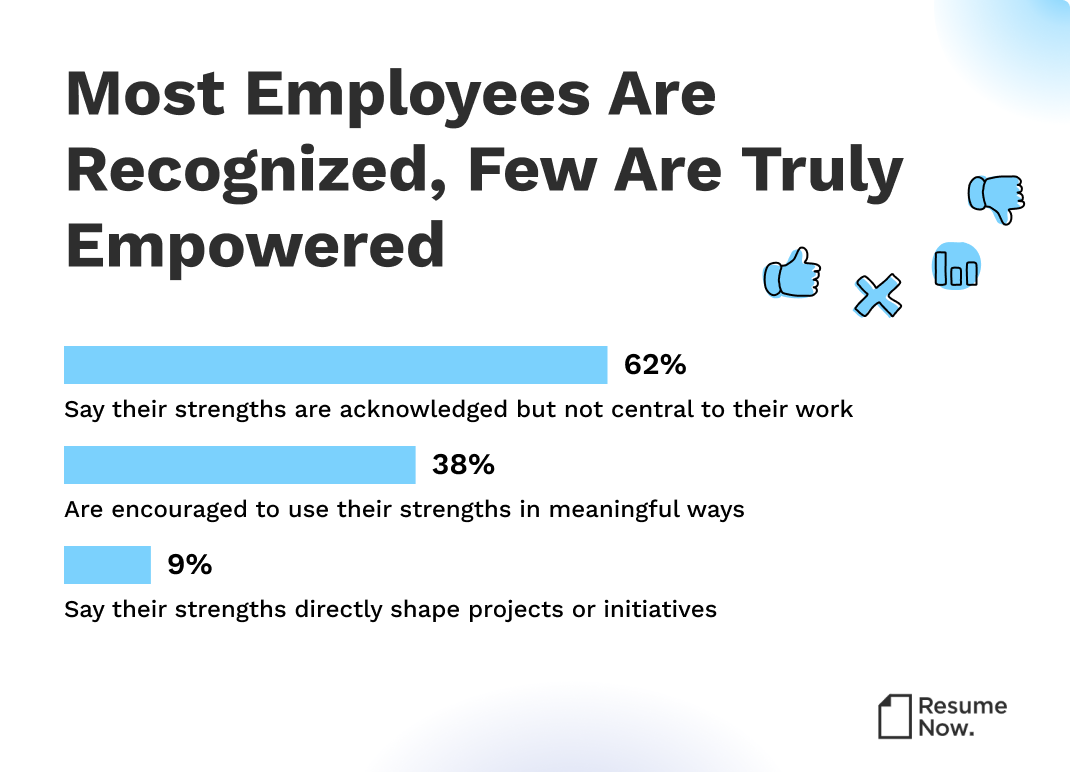
- 62% say their strengths are acknowledged but not central to their work.
- 38% say they are encouraged to use their strengths in meaningful ways.
- Only 9% say their unique strengths directly shape projects or initiatives.
The following is a visual representation of the data above:
What this means: Being recognized for strengths does not always translate into meaningful opportunities to use them. When employees are acknowledged but not empowered, recognition can feel symbolic rather than impactful.
Underutilization Is Driving Turnover
Persistent underutilization is not just a morale issue, but a major catalyst pushing employees to consider leaving:
- 26% would be very likely to look for a new job if underutilization continued.
- 46% would be likely to look for a new job.
- 22% would be unlikely to look for a new job.
- 6% would be very unlikely to look for a new job.
What this means: When employees consistently feel underused, job searching feels rational, not reactive. Even otherwise acceptable jobs can lose their appeal when growth and contribution feel capped.
Underutilization Dramatically Shortens Employee Tenure
When employees feel their skills are consistently underused, most do not envision staying long-term, and many anticipate leaving within months:
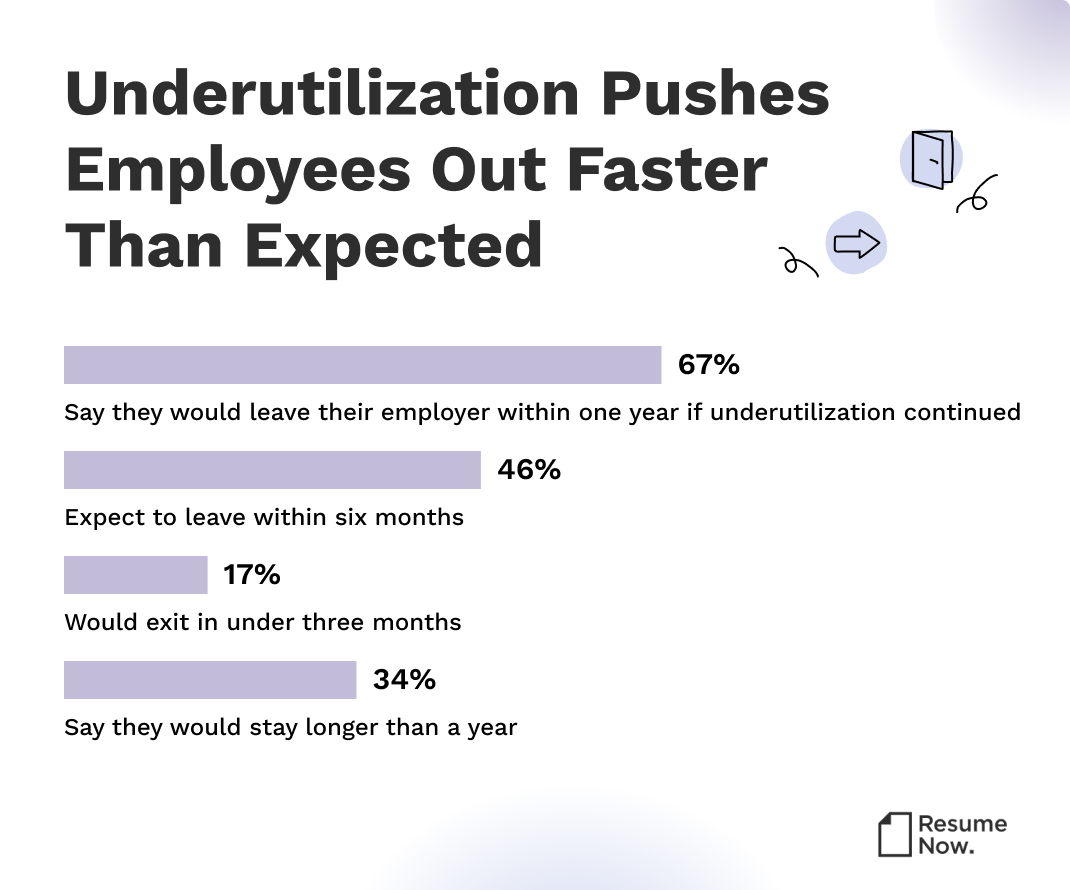
- 67% say they would leave their employer within a year if underutilization continued.
- Nearly half (46%) say they would leave within 6 months, including 17% who would exit in under 3 months.
- Just 34% say they would stay longer than a year.
The following is a visual representation of the data above:
What this means: Feeling underused accelerates how quickly employees envision leaving, shrinking what might have been a long-term role into a short-term stop. For many, underutilization turns retention into a matter of months rather than years.
Most Employees Say Leadership Fails to Act
While some leaders recognize when employees are underused, most fail to respond in ways that meaningfully address the problem:
- 80% of employees say leadership either does not notice underutilization or notices but rarely takes action.
- Just 21% say leadership recognizes underutilization and addresses it quickly.
- More than 1 in 3 (38%) say leadership does not notice underutilization at all, including 11% who say leadership does not notice or care.
What this means: Underutilization often persists because leaders either fail to notice it or fail to respond decisively when they do. Without timely action, missed potential becomes normalized rather than addressed.
Career Growth Is Being Impacted
Over time, feeling underutilized compounds into slower skill development, fewer opportunities, and stalled career progress:
- 17% say underutilization has significantly slowed their career progression and held them back in major ways.
- 32% say it has moderately delayed their growth.
- 28% say it has had a slight impact.
- 23% say their career progression hasn't been affected.
What this means: When employees aren't able to fully apply their skills, professional growth can slow in subtle but lasting ways. Missed opportunities compound, making advancement harder over time.
Methodology
The findings in this report are based on a survey of 1,018 U.S. adults conducted in November 2025. Participants responded to questions about skill utilization, job challenge, leadership awareness, career progression, and job search behavior using multiple-choice and scaled formats.
Demographic breakdown: Survey respondents reflected a broad cross-section of the workforce. Participants were 58% female and 41% male. Generational representation was evenly distributed, with 14% identifying as Gen Z, 30% as millennials, 31% as Gen X, and 25% as baby boomers.
About Resume Now
Resume Now is a powerful resource dedicated to helping job-seekers achieve their potential. Resume Now's AI Resume Builder is a cutting-edge tool that makes creating a resume fast, easy, and painless. Resume Now has been dedicated to serving job seekers since 2005. Alongside its powerful AI Resume Builder and stylish ready-to-use templates, it also features free advice for job seekers at every career stage, guides for every step of the hiring process, and free resources for writing cover letters. Resume Now is committed to supporting job seekers and workers alike and has conducted numerous surveys related to the experience, trends, and culture of the workplace. These surveys have been featured in Business Insider, CNBC, Fast Company, Yahoo!, Forbes, and more. Keep up with Resume Now on LinkedIn, Facebook, X, and Pinterest.
For press inquiries, contact Alexa Kalechofsky at alexa.kalechofsky@bold.com.


Keith is a Certified Professional Resume Writer (CPRW) and trusted media source in the career industry with over a decade of experience helping job seekers stand out.
More resources
Workplace AI Temp Check: Washington, DC, Arizona, & Colorado Lead in Business AI Use
Resume Now analyzed AI adoption by state revealing where repo...

The AI Whelmed Worker: 44% Feel Overwhelmed by the Pressure to Learn & Use AI at Work
Resume Now s new report reveals that workers feel uncertain u...

The AI Skills Race: 43% of Workers Feel They’ve Fallen Behind
Resume Now finds that 43% of workers feel behind in their AI s...

Human-AI Trust in the Workplace: 97% of Workers Still Put Human Judgment First
In an analysis of human-AI trust in the workplace Resume Now ...

Future Proof Career Skills: 10 Human Skills for Resumes in the Age of AI
Resume Now s analysis of O NET cognitive ability data across 8...

10 Jobs That AI Can't Replace Thanks to “Superhuman” Skills
Resume Now analyzed O NET data to identify AI-proof jobs that ...
 Get the job 2x faster*
  Customize your cover letter