


Table of contents
- Key Insights
- AI Is Expected to Serve Employers Over Workers
- Workers Draw the Line at AI-Led Hiring & Promotions
- Mandatory AI Use Divides the Workforce
- Most Workers Expect Little Workload Relief
- Who Is Responsible for Ethical AI Use in the Workplace?
- Workers Anticipate AI Will Reshape Jobs Through Cuts & Control
 Make Resume Now a preferred source on Google
As debate intensifies around AI taking over jobs, workers are increasingly skeptical about how artificial intelligence will reshape employment.
A new survey of more than 1,000 U.S. workers from Resume Now explores perceptions of AI in the workplace heading into 2026. While companies continue investing in automation and productivity tools, many employees say they expect AI job cuts and cost-reduction strategies—not expanded opportunity.
Resume Now's AI Agenda Report reinforces growing concerns about whether AI is taking over jobs or simply reshaping how work is controlled and distributed.
Key Insights
- AI job cuts dominate expectations. 59% of workers believe employers will use AI to reduce jobs and cut costs in 2026.
- Workers don't trust AI to make career decisions. 63% say AI should not be involved in hiring or promotion decisions.
- Mandatory use of AI in the workplace creates employee pushback. 29% would feel negatively about being required to use AI tools at work every day.
- Workload expectations remain flat. 53% of workers expect their workload to stay about the same in 2026.
- Ethical responsibility falls on employers. 39% say companies, not workers, should ensure ethical AI use on the job.
AI Is Expected to Serve Employers Over Workers
When asked how businesses will use AI in 2026, workers overwhelmingly expect efficiency gains, but not necessarily in ways that benefit employees.
- 59% say employers will use AI to cut jobs and reduce costs.
- 48% expect AI to be used to improve productivity and collaboration.
- 39% expect AI to be used to monitor and control employee activity.
- 11% believe AI will be used to create new opportunities for workers.
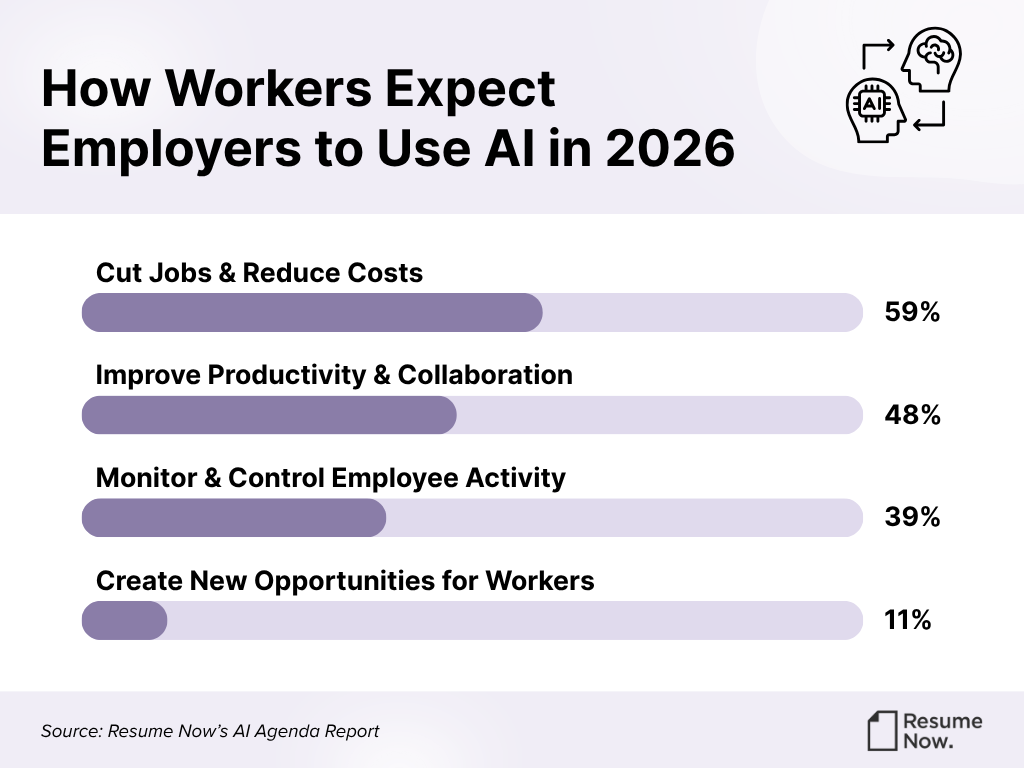
What this means: While companies frame AI as a productivity tool, employees increasingly associate AI taking over jobs with cost-cutting and organizational restructuring rather than workforce expansion. Few see it as a path to career growth or advancement.
Workers Draw the Line at AI-Led Hiring & Promotions
Despite growing adoption of AI in HR tools and workplace systems, most workers strongly reject AI involvement in hiring and promotion decisions.
- 63% say AI should not be involved at all in hiring or promotion decisions.
- 28% would accept AI involvement, but only with human oversight.
- 9% would trust AI more than managers with these decisions.
What this means: The question of whether AI is taking over jobs becomes more sensitive when career outcomes are involved. Workers may accept AI as a productivity tool, but not as a decision-maker affecting livelihood or advancement. Most want human judgment to remain central to these decisions.
Mandatory AI Use Divides the Workforce
When asked how they'd feel if their employer required them to use AI tools every day in 2026, workers were mixed, with some feeling optimistic and others so deterred by the idea that they'd consider leaving their job altogether.
- 11% would feel very positive about AI use, saying it would make their job easier.
- 22% would feel somewhat positive and say they could adapt to new tools.
- 38% would feel neutral and wait to see how AI affects their work.
- 20% would feel somewhat negative and feel AI is being forced.
- 9% would feel very negative and consider leaving their job.
What this means: Mandatory AI adoption in the workplace could accelerate concerns about AI job cuts, especially if employees feel forced to integrate tools they don't trust or understand.
Most Workers Expect Little Workload Relief
Despite optimism from employers that AI will save time, most workers don't expect the technology to meaningfully reduce their workload in 2026. Nearly three-quarters expect their workload to stay the same or become heavier due to the added complexity of managing AI.
- 53% expect their workload to stay about the same.
- 20% expect their workload to increase due to AI complexity.
- 27% expect their workload to decrease due to time-saving automation.
What this means: Rather than replacing tasks entirely, AI in the workplace may shift responsibilities—creating new tasks even as it automates and removes others.
Who Is Responsible for Ethical AI Use in the Workplace?
Workers place responsibility for AI oversight primarily on employers. When asked who should be most responsible for ensuring AI is used ethically at work, they said:
- Employers (39%)
- Tech companies developing AI tools (24%)
- The government or regulators (19%)
- Individual employees (12%)
- No one (6%)
What this means: As concerns grow about AI taking over jobs, workers expect organizations—not individual employees—to establish clear boundaries, manage risks, and take ownership of AI use in the workplace.
Workers Anticipate AI Will Reshape Jobs Through Cuts & Control
The findings from Resume Now's AI Agenda Report suggest workers are approaching workplace AI with caution rather than optimism.
While employers continue positioning AI as a productivity driver, most employees expect it to result in job reductions, increased oversight, and limited workload relief. At the same time, workers are not rejecting the technology outright; they're drawing clear lines around its use in sensitive decisions like hiring and promotions.
Overall, the data points to a widening gap between how companies and employees view AI's role in the workplace, with trust and expectations still far from aligned as adoption accelerates.
For press inquiries, please contact Alexa Kalechofsky at alexa.kalechofsky@bold.com.
Methodology
The findings in this report are based on a survey of 1,003 employed U.S. adults, conducted by Resume Now using Pollfish in April 2026. Respondents answered questions about how they expect employers to use AI in 2026, whether they trust AI to make hiring and promotion decisions, how they'd feel about mandatory daily AI use, whether they expect AI to change their workload, and who should be responsible for ensuring AI is used ethically at work. Question formats included multiple-choice, single-select, and multi-select questions.
Demographic Breakdown
Survey respondents reflected a broad cross-section of the U.S. workforce. Participants were 67% female and 33% male. Generationally, 13% identified as Gen Z, 32% as millennials, 36% as Gen X, and 19% as baby boomers.


Keith is a Certified Professional Resume Writer (CPRW) and trusted media source in the career industry with over a decade of experience helping job seekers stand out.
More resources
The Two-Sided Job Market Report: When Growth Forecasts & Employee Outlook Don’t Match
Resume Now s Two-Sided Job Market Report reveals a mismatch ...
Workplace AI Temp Check: Washington, DC, Arizona, & Colorado Lead in Business AI Use
Resume Now analyzed AI adoption by state revealing where repo...

The AI Whelmed Worker: 44% Feel Overwhelmed by the Pressure to Learn & Use AI at Work
Resume Now s new report reveals that workers feel uncertain u...

The AI Skills Race: 43% of Workers Feel They’ve Fallen Behind
Resume Now finds that 43% of workers feel behind in their AI s...
Human-AI Trust in the Workplace: 97% of Workers Still Put Human Judgment First
In an analysis of human-AI trust in the workplace Resume Now ...
Future Proof Career Skills: 10 Human Skills for Resumes in the Age of AI
Resume Now s analysis of O NET cognitive ability data across 8...
 Get the job 2x faster*
  Customize your cover letter