

Table of contents
Resume Now has released the results of its latest national survey of more than 1,000 employed workers in the U.S., revealing that AI is entering the workplace faster than employers are preparing workers to use it.
According to our report, almost half of workers say their employers haven't provided them with the tools and resources they need to use AI at work. As a result, many are taking matters into their own hands, signing up for AI tools they've found rather than those their employers have provided—a trend referred to as "bring your own AI (BYOAI)."
Key Insights From the BYOAI Report
- Workers are figuring out AI on their own. 41% of workers say their employer has not provided tools, training, or guidance to prepare them to use AI at work.
- AI direction is inadequate. Only 21% of workers say their employer has provided clear AI guidelines with specific use cases for their role.
- Workers report bare-bones AI access. 52% of workers say their employer provides no AI tools or only free/publicly available AI tools for work-related use.
- Formal AI training for employees is largely missing. Only 19% of workers say their employer has provided comprehensive AI training with dedicated time or resources.
- BYOAI is already widespread. 76% of workers have used AI tools they personally found and signed up for to complete work tasks.
Employers Are Leaving Workers to Their Own Devices
AI adoption in the workplace may be moving faster than employers can keep up with. When asked how well their employer is preparing them to use AI, only a small share of workers say they have the support they need, with most reporting minimal, poor, or no support.
- 20% say their employer has prepared them very well with the tools and training they need.
- 31% say their employer has provided minimal support, but not enough to make a real difference.
- 8% say their employer has made an effort, but it falls significantly short.
- 41% say their employer has provided nothing to prepare them to use AI at work.
What this means: When workers are expected to use AI without meaningful preparation, the burden shifts from the organization to the individual. That can leave employees guessing how to build skills, choose tools, and apply AI responsibly in their roles.
Workers Are Getting Mixed Signals on AI Use
Access to AI tools is no guarantee that workers know when, where, and how to use them appropriately. When asked about employer guidance, many workers report limited, unclear, or general direction, while only a fraction say they've received clear guidelines with specific use cases for their role.
- 16% say little to no guidance has been provided.
- 5% say messages about when and how to use AI have been inconsistent or unclear.
- 4% say AI use is discouraged or restricted.
- 26% say their employer has provided general guidance, but nothing specific to their role.
- 21% say their employer has provided clear guidelines with specific use cases for their role.
- 28% say they do not use AI at work.
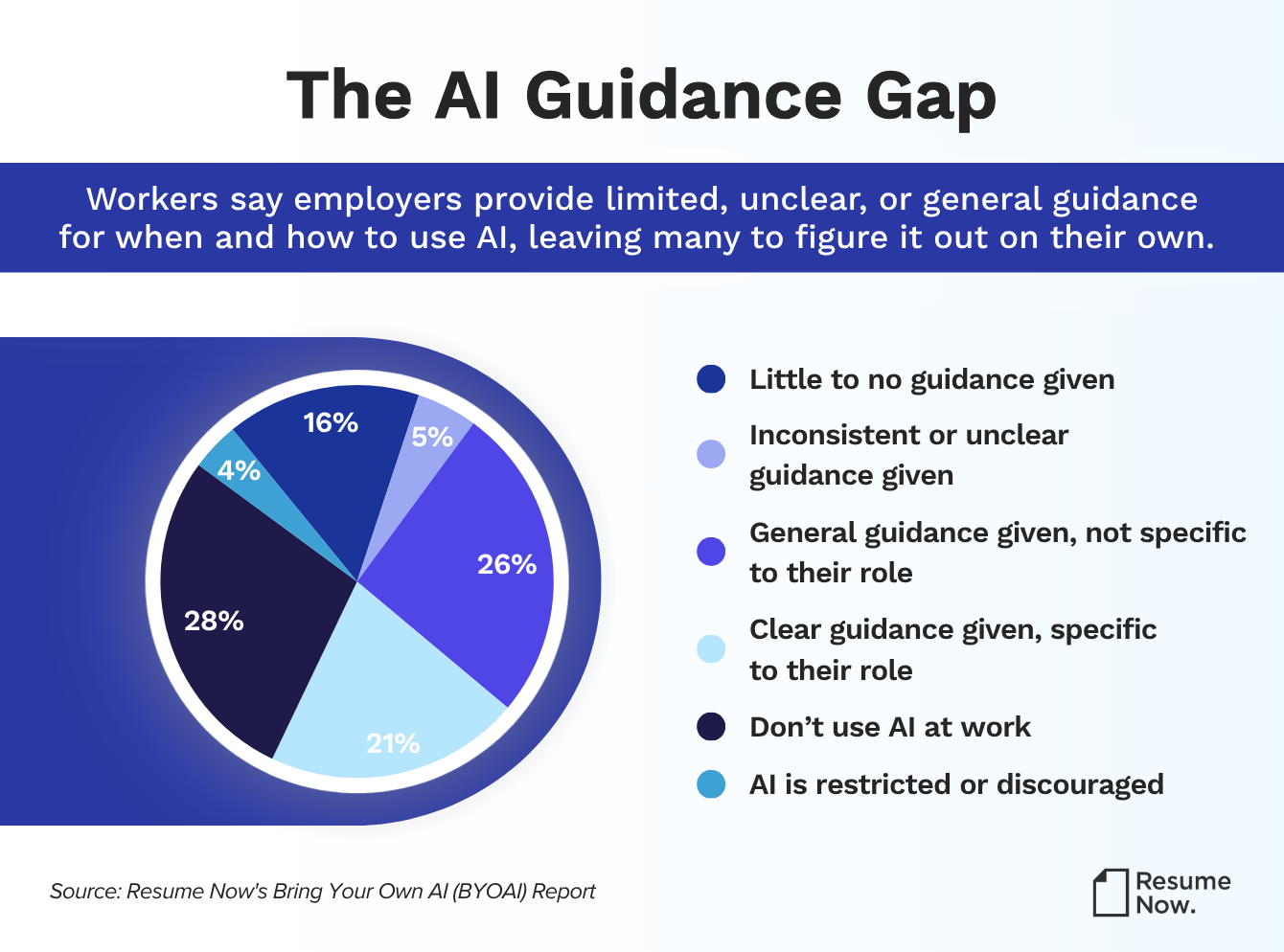
What this means: When expectations are vague or inconsistent, workers may either avoid AI altogether or use it in ways that create risk for themselves, their teams, or their employers.
AI Tools Are Still Out of Reach for Many Workers
More than half of workers say their employer provides no AI tools or only free/publicly available tools, leaving many employees without approved resources for work-related AI use.
- 28% say no AI tools are provided.
- 24% report their employer provides only free or publicly available AI tools.
- 20% say they get both paid and free AI tools from their employer.
- 14% say their employer provides paid AI tools or subscriptions.
- 14% report their employer does not allow the use of AI tools at work.
What this means: While some employees have access to paid or employer-supported resources, others rely on public tools or avoid AI entirely, and the inconsistency can create gaps in productivity, quality, and compliance across the workforce.
The AI Rollout Has a Training Gap
Training is what turns AI access into AI readiness. Despite growing business interest in incorporating AI into workflows, many workers are not receiving the formal training, learning resources, or dedicated time needed to build AI skills.
- 32% say their employer has provided no AI training resources at all.
- 23% say their employer has provided only limited or intro-level training.
- 19% say their employer has provided comprehensive training with dedicated time and resources.
- 26% say AI is not used or encouraged at their workplace.
What this means: Without structured learning and practical resources, workers may struggle to use AI effectively even when tools are available. For employers, the risk is a workforce that is expected to adapt without being fully equipped to do so.
Employees Are Embracing "Bring Your Own AI"
As employer support lags, workers are taking matters into their own hands to keep up. More than 3 in 4 workers have used AI tools they found and signed up for on their own, rather than tools provided or approved by their employer, to complete work tasks.
- 23% use personally sourced AI tools daily.
- 20% use them a few times a week.
- 17% use them occasionally.
- 16% use them rarely.
- 24% never use personally sourced AI tools for work tasks.
What this means: BYOAI is already part of how many employees are navigating the modern workplace. But while it may help them move faster in the short term, without clear oversight, this employee-led adoption can also create new questions around accuracy, data privacy, consistency, and accountability.
Bridging the AI Gap
Workers want to use AI, and they aren't waiting around for permission or a handbook to get started. The BYOAI trend proves how adaptable today's employees are, but it also puts companies in a tough spot. Operating without guardrails, official tools, or proper training is a recipe for security headaches and wildly inconsistent work quality.
Adopting company-wide policies, investing in training, and giving teams the secure, approved tools they need to be productive and efficient will allow employers to harness this momentum and employees to build the skills they need for the modern workplace.
For press inquiries, please contact Alexa Kalechofsky at alexa.kalechofsky@bold.com.
Methodology
The findings in this report are based on a survey of 1,020 employed U.S. adults, conducted by Resume Now using Pollfish in May 2026. Respondents answered questions about employer-provided AI tools, workplace AI guidance and training, personally sourced AI tool use, and employer preparation for AI at work. Question formats included single-select and multiple-choice questions.
Demographic Breakdown
Survey respondents reflected a broad cross-section of the U.S. workforce. Participants were 52% female, 47% male, 1% nonbinary, and less than 1% preferred not to answer. Generationally, 24% identified as Gen Z, 28% as millennials, 27% as Gen X, and 21% as baby boomers. Educationally, 18% held a graduate degree, 27% held a bachelor's degree, 18% held an associate degree, 35% held a high school degree or equivalent, and 2% had less than a high school degree.
About Resume Now
Resume Now is a powerful resource dedicated to helping job seekers achieve their potential. Resume Now's AI Resume Builder is a cutting-edge tool that makes creating a resume fast, easy, and painless. Resume Now has been dedicated to serving job seekers since 2005. Alongside its powerful AI Resume Builder and stylish ready-to-use templates, it also features free advice for job seekers at every career stage, guides for every step of the hiring process, and free resources for writing cover letters. Resume Now is committed to supporting job seekers and workers alike and has conducted numerous surveys related to the experience, trends, and culture of the workplace. These surveys have been featured in Business Insider, CNBC, Fast Company, Yahoo!, Forbes, and more. Keep up with Resume Now on LinkedIn, Instagram, Facebook, and TikTok. Follow Resume Now as a preferred source in Google to receive more workforce trends, career insights, and labor market research in your personalized search experience.


Keith is a Certified Professional Resume Writer (CPRW) and trusted media source in the career industry with over a decade of experience helping job seekers stand out.
More resources

The AI Whelmed Worker: 44% Feel Overwhelmed by the Pressure to Learn & Use AI at Work
Resume Now s new report reveals that workers feel uncertain u...
The AI Skills Race: 43% of Workers Feel They’ve Fallen Behind
Resume Now finds that 43% of workers feel behind in their AI s...
Human-AI Trust in the Workplace: 97% of Workers Still Put Human Judgment First
In an analysis of human-AI trust in the workplace Resume Now ...
Future Proof Career Skills: 10 Human Skills for Resumes in the Age of AI
Resume Now s analysis of O NET cognitive ability data across 8...
10 Jobs That AI Can't Replace Thanks to “Superhuman” Skills
Resume Now analyzed O NET data to identify AI-proof jobs that ...
Is AI Taking Over Jobs? 59% of Workers Expect AI Job Cuts in 2026
A Resume Now survey reveals growing concern that AI will lead ...
 Get the job 2x faster*
  Customize your cover letter