

 Make Resume Now a preferred source on Google
As AI automates more routine tasks, employers are likely to place greater emphasis on the human abilities that help workers interpret information, solve problems, communicate effectively, and exercise judgment.
Resume Now's Resume of the Future Report analyzes O*NET data to identify the cognitive abilities that are increasingly valuable in the age of AI. The findings suggest that while tools and technologies may change, job seekers can stand out by highlighting these valuable, AI-proof skills on their resumes.
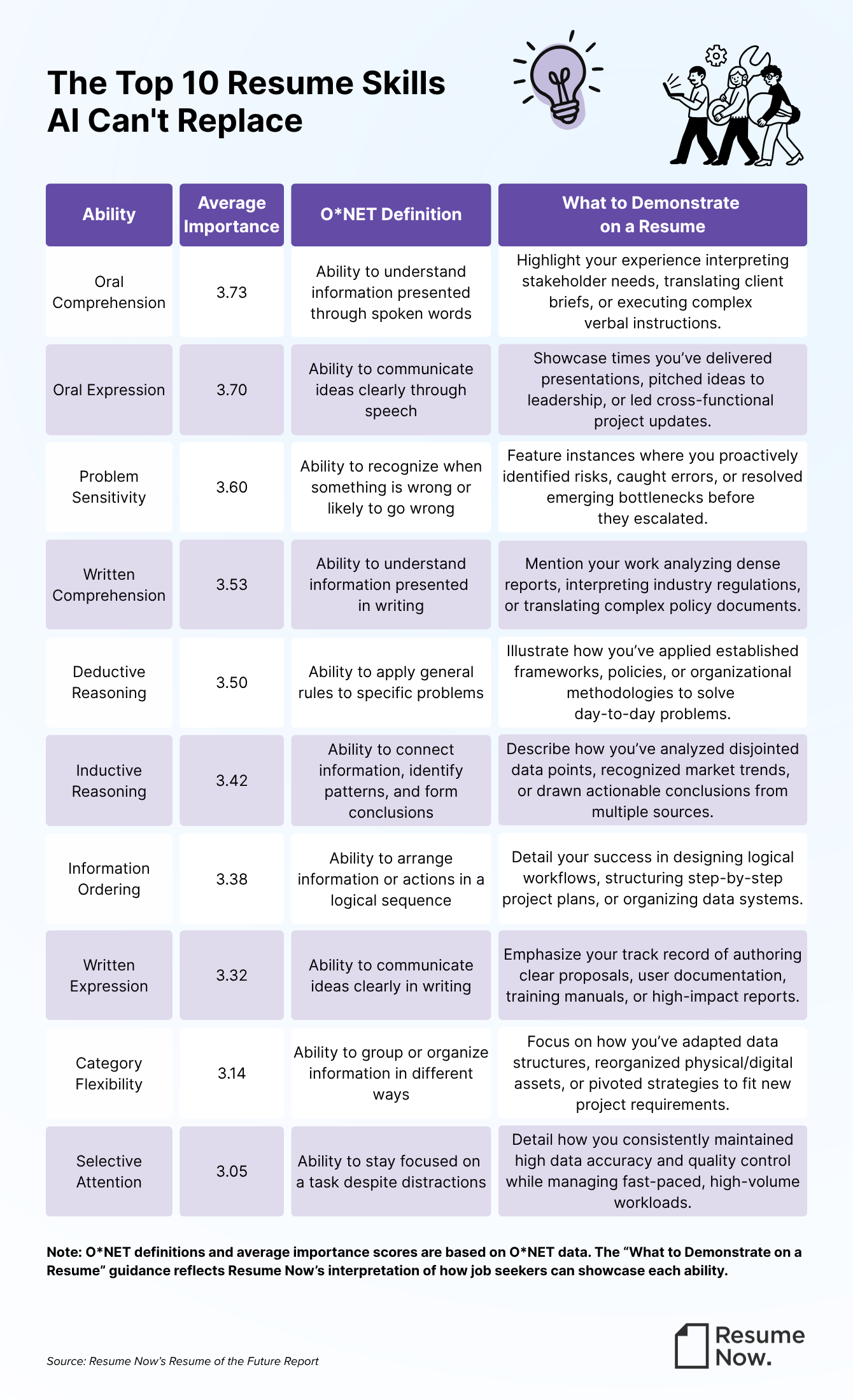
10 Resume Skills AI Can't Replace
The following list is based on an analysis of O*NET Importance ratings for 21 cognitive abilities across 894 occupations. Of the abilities analyzed, 10 have an average importance score of 3.00 or higher. This report highlights these abilities and offers guidance on how job seekers can effectively showcase related skills in their resumes.
O*NET uses a rating scale that ranges from 1 to 5. The scores provided reflect the average importance of each ability across all occupations examined, rather than the highest rating that any ability might receive in a specific role.
#1
Oral Comprehension
- Average importance: 3.73
- O*Net definition: Ability to understand information presented through spoken words
- What to demonstrate on a resume: Highlight your experience interpreting stakeholder needs, translating client briefs, or executing complex verbal instructions.
#2
Oral Expression
- Average importance: 3.70
- O*Net definition: Ability to communicate ideas clearly through speech
- What to demonstrate on a resume: Showcase times you've delivered presentations, pitched ideas to leadership, or led cross-functional project updates.
#3
Problem Sensitivity
- Average importance: 3.60
- O*Net definition: Ability to recognize when something is wrong or likely to go wrong
- What to demonstrate on a resume: Feature instances where you proactively identified risks, caught errors, or resolved emerging bottlenecks before they escalated.
#4
Written Comprehension
- Average importance: 3.53
- O*Net definition: Ability to understand information presented in writing
- What to demonstrate on a resume: Mention your work analyzing dense reports, interpreting industry regulations, or translating complex policy documents.
#5
Deductive Reasoning
- Average importance: 3.50
- O*Net definition: Ability to apply general rules to specific problems
- What to demonstrate on a resume: Illustrate how you've applied established frameworks, policies, or organizational methodologies to solve day-to-day problems.
#6
Inductive Reasoning
- Average importance: 3.42
- O*Net definition: Ability to connect information, identify patterns, and form conclusions
- What to demonstrate on a resume: Describe how you've analyzed disjointed data points, recognized market trends, or drawn actionable conclusions from multiple sources.
#7
Information Ordering
- Average importance: 3.38
- O*Net definition: Ability to arrange information or actions in a logical sequence
- What to demonstrate on a resume: Detail your success in designing logical workflows, structuring step-by-step project plans, or organizing data systems.
#8
Written Expression
- Average importance: 3.32
- O*Net definition: Ability to communicate ideas clearly in writing
- What to demonstrate on a resume: Emphasize your track record of authoring clear proposals, user documentation, training manuals, or high-impact reports.
#9
Category Flexibility
- Average importance: 3.14
- O*Net definition: Ability to group or organize information in different ways
- What to demonstrate on a resume: Focus on how you've adapted data structures, reorganized physical or digital assets, or pivoted strategies to fit new project requirements.
#10
Selective Attention
- Average importance: 3.05
- O*Net definition: Ability to stay focused on a task despite distractions
- What to demonstrate on a resume: Detail how you consistently maintained high data accuracy and quality control while managing fast-paced, high-volume workloads.
What the Analysis Reveals
Together, the findings show that while technologies, software, and workplace tools continue to change, core cognitive abilities like strong communication, sound reasoning, and mental flexibility are among the top skills employers want in 2026.
- Communication and comprehension lead the findings. 4 of the 10 abilities center on understanding or communicating information, reinforcing the value of clear listening, speaking, reading, and writing.
- Reasoning and problem recognition remain broadly important. Problem sensitivity, deductive reasoning, and inductive reasoning highlight the need to spot issues, apply knowledge, identify patterns, and reach sound conclusions.
- Organization, flexibility, and focus also matter. Information ordering, category flexibility, and selective attention point to the value of structuring work, adapting approaches, and maintaining accuracy during demanding tasks.
Future-Proof Your Career With Human-Centered Skills
For job seekers, building a resume that highlights distinctly human skills and connecting these abilities to specific examples from past roles is one of the best steps they can take to future-proof skills against AI automation.
For example, instead of listing a generic phrase like "strong communicator," "problem-solver," or "detail-oriented," a candidate could describe how they presented vetted recommendations, translated complex information for stakeholders, or created documentation that helped a team make decisions.
By transforming soft skills into active, contextual achievements, job seekers demonstrate the exact cognitive flexibility that automation can't replicate—turning an application into a road map for long-term career resilience.
For press inquiries, please contact Alexa Kalechofsky at alexa.kalechofsky@bold.com.
Methodology
Resume Now analyzed the cognitive abilities included in the O*NET Abilities dataset to identify abilities that are consistently important across occupations. The analysis was limited to O*NET's 21 cognitive abilities. Physical, psychomotor, and sensory abilities were excluded because the report examines abilities related to communication, reasoning, problem recognition, information processing, organization, and attention.
Resume Now used O*NET's Importance scale, which measures how important an ability is to successful job performance. For each cognitive ability, Resume Now calculated the average importance rating across the 894 occupations analyzed. Each ability included in the report was evaluated using ratings from the same 894 occupations.
Abilities with an average importance score of 3.00 or higher were included in the final analysis. This threshold identified 10 cognitive abilities that were broadly important across the occupational dataset. Average importance scores are included to show each ability's relative importance across occupations.
O*NET definitions in the report were condensed for readability. The "What to Demonstrate on a Resume" information reflects Resume Now's interpretation of how job seekers can showcase each ability and isn't provided by O*NET.


Keith is a Certified Professional Resume Writer (CPRW) and trusted media source in the career industry with over a decade of experience helping job seekers stand out.
More resources
The Two-Sided Job Market Report: When Growth Forecasts & Employee Outlook Don’t Match
Resume Now s Two-Sided Job Market Report reveals a mismatch ...
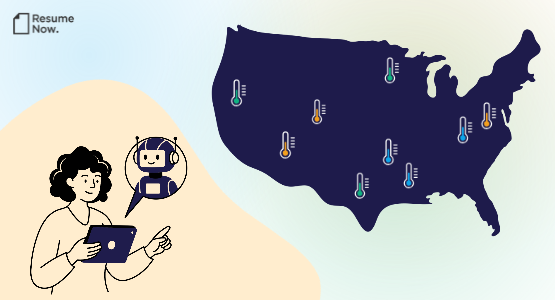
Workplace AI Temp Check: Washington, DC, Arizona, & Colorado Lead in Business AI Use
Resume Now analyzed AI adoption by state revealing where repo...

The AI Whelmed Worker: 44% Feel Overwhelmed by the Pressure to Learn & Use AI at Work
Resume Now s new report reveals that workers feel uncertain u...
The AI Skills Race: 43% of Workers Feel They’ve Fallen Behind
Resume Now finds that 43% of workers feel behind in their AI s...

Human-AI Trust in the Workplace: 97% of Workers Still Put Human Judgment First
In an analysis of human-AI trust in the workplace Resume Now ...

10 Jobs That AI Can't Replace Thanks to “Superhuman” Skills
Resume Now analyzed O NET data to identify AI-proof jobs that ...
 Get the job 2x faster*
  Customize your cover letter