

Table of contents
- Key Insights
- Workers’ Default First Step Is Human Evaluation
- Workers Still Choose People Under Pressure
- When AI & Coworkers Disagree, Workers Prefer People
- Workers Are Still Adjusting to AI
- Colleague Confidence Remains Steady
- Workers Rely on AI for Information, Not Strategy
- AI Disclosure Expectations Vary by Context
- The Future of Human-AI Collaboration
Despite AI becoming a routine part of work, employees still draw a clear line around where they're willing to trust it. According to a new national survey of more than 1,000 U.S. employed workers conducted by Resume Now, when it comes to human-AI trust in the workplace, nearly all workers (97%) rely on human judgment first, favoring their own perspective or input from colleagues before turning to automated systems.
The findings from the Workplace Trust in AI Report suggest workers are not anti-AI—they're willing to use it, but not when their work requires context, accountability, or strategic judgment. Transparency also emerged as an expectation, with the majority expecting some level of disclosure around AI use in work content.
Key Insights
- Human judgment comes first. 97% rely on their own judgment or input from coworkers or managers as their first step when making a work decision.
- Pressure doesn't make AI the default. 93% rely on themselves, coworkers, or managers when decisions are high-stakes and time-sensitive.
- Workers choose people over AI. 72% would follow a coworker's judgment over AI output if the two gave conflicting answers.
- Workplace AI trust is still developing. 64% say their trust in using AI for work has increased or stayed the same compared to a year ago.
- Workers assign AI to a support role. Research or information gathering was the top area where workers were most likely to rely on AI at work, selected by 24%.
- AI disclosure expectations vary. 91% expect some level of disclosure around AI use in work content.
Workers' Default First Step Is Human Evaluation
Despite AI's growing role at work, the vast majority of workers still begin with human judgment. When asked about their default first step when making a work decision, workers said they relied on:
- Their own judgment: 74%
- Human input (coworkers or managers): 23%
- AI tools or automated systems: 3%
What this means: AI may be increasingly available in the workplace, but it hasn't yet replaced human reasoning as the starting point for decisions. Workers appear to view AI as an additional source of information rather than an authority, preserving responsibility and accountability with themselves and the people around them.
Workers Still Choose People Under Pressure
When the stakes rise, workers double down on human judgment instead of AI. When asked which source they rely on most during high-stakes and time-sensitive decision-making, workers opted for:
- Their own judgment: 60%
- Human input (coworkers or managers): 33%
- AI tools or automated systems: 7%
What this means: High-pressure conditions strengthen workers' reliance on human experience and judgment. Even when speed matters, employees appear to value the context, accountability, and situational awareness that they or their colleagues bring to consequential decisions.
When AI & Coworkers Disagree, Workers Prefer People
When AI and people disagree, workers overwhelmingly trust their coworkers. If AI and a coworker gave conflicting answers, most workers would still side with the human's perspective.
- Would follow the coworker's judgment: 72%
- Would follow the AI output: 28%
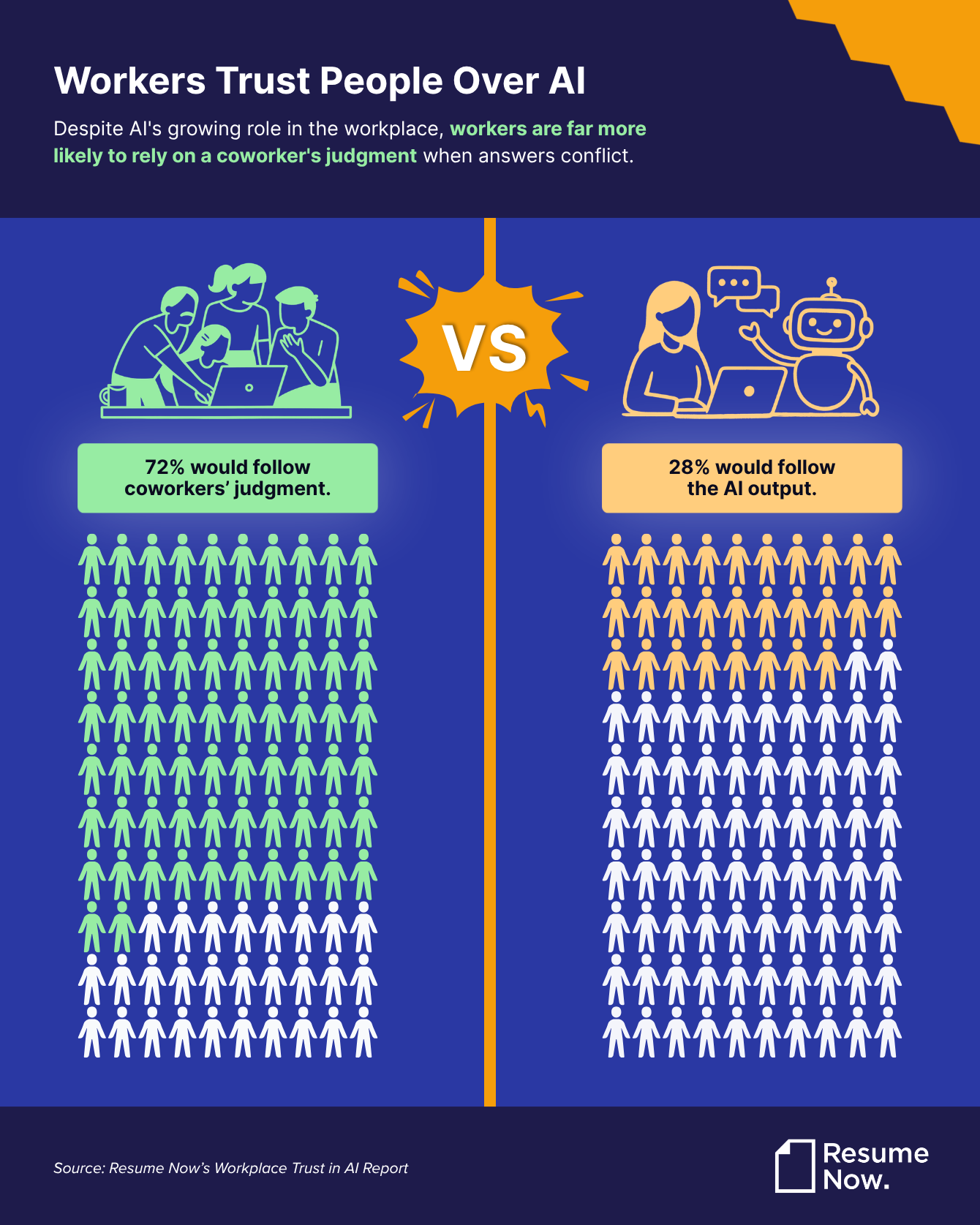
What this means: Workers give considerably more weight to a colleague's perspective when human and AI responses conflict. For employers, this reinforces the importance of keeping people involved in reviewing AI-generated information and making the final call.
Workers Are Still Adjusting to AI
While many workers say their trust in using AI for work has increased or stayed the same, a sizable share of them (28%) weren't using AI a year ago, suggesting workplace AI norms are still developing.
Among those who were using AI a year ago, their trust in using AI for work has:
- Stayed about the same: 37%
- Increased: 27%
- Decreased: 8%
What this means: Workplace confidence in AI is evolving rather than moving uniformly in one direction. With more than one-quarter of workers reporting that they weren't using AI a year ago, many may still be forming their expectations around where the technology is useful, reliable, and appropriate.
Colleague Confidence Remains Steady
Even as teams increasingly integrate AI, workers' views of their colleagues' work remain largely intact. Compared to a year ago, workers' trust in their coworkers' work has:
- Stayed about the same: 75%
- Increased: 18%
- Decreased: 8%
What this means: The growing use of AI doesn't appear to have broadly weakened confidence between coworkers. Most employees report no change in how they view their colleagues' work, suggesting that workplace relationships and professional credibility remain relatively stable as teams adopt new technology.
Workers Rely on AI for Information, Not Strategy
Workers appear most comfortable using AI to accelerate routine tasks. But confidence drops sharply when tasks require strategic thinking or judgment. When asked in which area they trust AI the most at work, workers reported:
- Research or information gathering: 24%
- Writing (emails/messages/updates): 14%
- Summarizing or synthesizing information: 13%
- Data analysis: 9%
- Planning or strategy: 3%
- Doesn't trust AI most in any area: 12%
- Doesn't use AI at work: 25%
What this means: Workers are most comfortable using AI for tasks that help them find, organize, or communicate information. Reliance falls substantially for planning and strategy, indicating that employees continue to reserve decisions requiring context, prioritization, and judgment for people.
AI Disclosure Expectations Vary by Context
Workers widely expect at least some level of transparency around AI use, but expectations differ depending on the situation. When asked when people should disclose AI use in work content, respondents said:
- Always: 51%
- Only when content goes to external audiences: 15%
- Only for high-stakes decisions (legal, financial, hiring, performance): 11%
- Only when asked: 14%
- Never/not necessary: 9%
What this means: Transparency has become a widespread workplace expectation, although employees differ on when disclosure is necessary. Organizations may benefit from establishing clear standards that explain when AI use should be disclosed.
The Future of Human-AI Collaboration
Building sustainable human-AI trust in the workplace will be the defining characteristic of success. By viewing AI not as a replacement but as a supportive partner, professionals can find balance between AI's efficiency in streamlining routine tasks and the high-level strategy and situational judgment that only people can provide.
For press inquiries, please contact Alexa Kalechofsky at alexa.kalechofsky@bold.com.
Methodology
The findings in this report are based on a survey of 1,006 employed U.S. adults conducted by Resume Now using Pollfish in June 2026. Respondents answered questions about decision-making, trust in AI, trust in coworkers, and AI disclosure expectations. Question formats included multiple-choice and single-select questions.
Demographic Breakdown
Survey respondents reflected a broad cross-section of the U.S. workforce. Participants were 50% male and 49% female, with 1% identifying as nonbinary or preferring not to answer. Generationally, 21% identified as Gen Z, 26% as millennials, 26% as Gen X, and 27% as baby boomers.
About Resume Now
Resume Now is a powerful resource dedicated to helping job seekers achieve their potential. Resume Now's AI Resume Builder is a cutting-edge tool that makes creating a resume fast, easy, and painless. Resume Now has been dedicated to serving job seekers since 2005. Alongside its powerful AI Resume Builder and stylish ready-to-use templates, it also features free advice for job seekers at every career stage, guides for every step of the hiring process, and free resources for writing cover letters. Resume Now is committed to supporting job seekers and workers alike and has conducted numerous surveys related to the experience, trends, and culture of the workplace. These surveys have been featured in Business Insider, CNBC, Fast Company, Yahoo!, Forbes, and more. Keep up with Resume Now on LinkedIn, Instagram, Facebook, and TikTok. Follow Resume Now as a preferred source in Google to receive more workforce trends, career insights, and labor market research in your personalized search experience.


Keith is a Certified Professional Resume Writer (CPRW) and trusted media source in the career industry with over a decade of experience helping job seekers stand out.
More resources

The AI Whelmed Worker: 44% Feel Overwhelmed by the Pressure to Learn & Use AI at Work
Resume Now s new report reveals that workers feel uncertain u...
The AI Skills Race: 43% of Workers Feel They’ve Fallen Behind
Resume Now finds that 43% of workers feel behind in their AI s...
Future Proof Career Skills: 10 Human Skills for Resumes in the Age of AI
Resume Now s analysis of O NET cognitive ability data across 8...
10 Jobs That AI Can't Replace Thanks to “Superhuman” Skills
Resume Now analyzed O NET data to identify AI-proof jobs that ...
Bring Your Own AI: 41% of Workers Say Employers Haven’t Prepared Them to Use AI at Work
A new Resume Now report finds that the bring your own AI (B...
Is AI Taking Over Jobs? 59% of Workers Expect AI Job Cuts in 2026
A Resume Now survey reveals growing concern that AI will lead ...
 Get the job 2x faster*
  Customize your cover letter