


 Make Resume Now a preferred source on Google
Resume Now released the Two-Sided Job Market Report, showing that projected job growth and employees' views of their employers' future don't always align. For workers trying to make sense of a changing job market, that means growth projections may tell only one side of the story.
Resume Now analyzed 70 U.S. occupational groups, comparing U.S. Bureau of Labor Statistics projected employment growth for 2025 to 2035 with Positive Outlook, the share of employee reviewers who have a favorable view of their employers' business future. In this report, Positive Outlook measures employee confidence in employers' futures.
Put simply, one measure shows where jobs are expected to grow or shrink; the other shows how employees view the future of the businesses behind those jobs.
Key Findings
- Job growth and employee outlook don't always line up. Fast-growing occupations don't always come with stronger employee confidence.
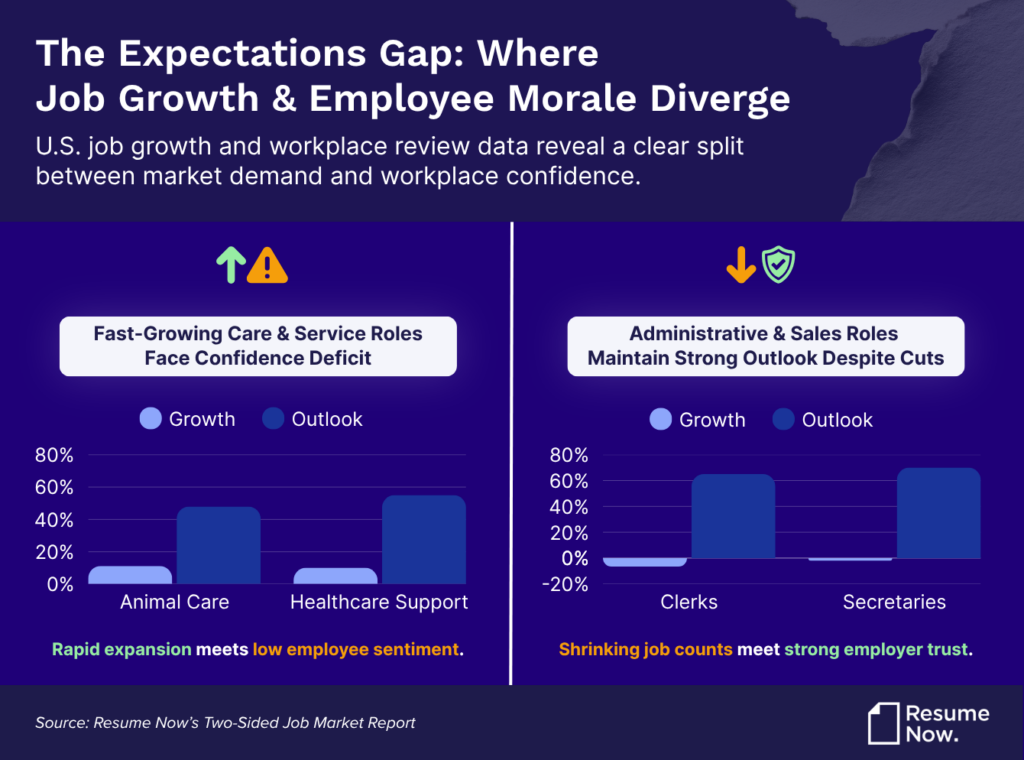
- Animal care shows the biggest disconnect. Animal care and service workers have 11.2% projected employment growth, one of the highest rates in the analysis, but just 48% Positive Outlook, the lowest among the 70 groups.
- Healthcare support shows a wide gap. Other healthcare support occupations, including medical assistants and dental assistants, have 10.1% projected employment growth but only 55% Positive Outlook.
- Secretaries show confidence despite projected decline. Secretary and administrative assistant occupations are projected to decline by 2.1% but have a 70% Positive Outlook.
Care & Service Jobs Show the Biggest Confidence Gap
Several care and service occupations are projected to grow quickly, yet employees are less positive about their employers' future.
| Occupation | Projected Growth | Positive Outlook |
| Animal Care and Service Workers | +11.2% | 48% |
| Other Healthcare Support Occupations | +10.1% | 55% |
| Health Technologists and Technicians | +6.5% | 59% |
| Supervisors of Personal Care and Service Workers | +5.6% | 53% |
The takeaway: Projected job growth doesn't always match employee confidence. These care and service fields are expected to add jobs, but workers are less confident in the future of the businesses that employ them.
Employee Confidence Holds Even as Jobs Shrink
Several office, administrative, and sales-related occupations are projected to lose jobs, yet employees show confidence in their employers' future.
| Occupation | Projected Growth | Positive Outlook |
| Financial Clerks | –6.5% | 65% |
| Information and Record Clerks | –3.9% | 64% |
| Supervisors of Sales Workers | –2.9% | 64% |
| Secretaries and Administrative Assistants | –2.1% | 70% |
The takeaway: Job growth vs employee confidence aren't always aligned. In these occupations, workers remain positive about their employers' future even as employment is expected to decline.
What the Two-Sided Job Market Means for Job Seekers
No single signal tells the whole story. Projected employment growth shows where jobs are expected to grow or shrink, while Positive Outlook shows how confident employees are about the future of the businesses they work for.
For job seekers, that means considering both sides. Job growth and employee confidence don't always move together.
Occupations that combine projected growth with strong employee outlook can offer two encouraging signals: expanding opportunities and confidence from workers already in the field.
For press inquiries, please contact Alexa Kalechofsky at alexa.kalechofsky@bold.com.
Methodology
Resume Now analyzed 70 occupational groups using aggregated, group-level data. Positive Outlook ratings come from Public Insight's proprietary workplace-review data and reflect the share of employee reviews indicating a favorable business outlook.
Public Insight organizes occupations using the Standard Occupational Classification system; Resume Now used the Minor Group level and paired each occupational group with U.S. Bureau of Labor Statistics projected employment growth for 2025 to 2035. Only groups with at least 5,000 employee reviews were included.
Researchers then compared Positive Outlook with projected employment growth across the 70 groups. The relationship was weak, with a Pearson correlation of 0.14.
Positive Outlook reflects employee-submitted views of employers' business outlook and is not a U.S. Bureau of Labor Statistics measure. Occupational groups contain multiple related job titles and may include employees working across multiple employers. Results reflect patterns across occupational groups and don't establish causation.


Keith is a Certified Professional Resume Writer (CPRW) and trusted media source in the career industry with over a decade of experience helping job seekers stand out.
More resources
Workplace AI Temp Check: Washington, DC, Arizona, & Colorado Lead in Business AI Use
Resume Now analyzed AI adoption by state revealing where repo...

The AI Whelmed Worker: 44% Feel Overwhelmed by the Pressure to Learn & Use AI at Work
Resume Now s new report reveals that workers feel uncertain u...

The AI Skills Race: 43% of Workers Feel They’ve Fallen Behind
Resume Now finds that 43% of workers feel behind in their AI s...

Human-AI Trust in the Workplace: 97% of Workers Still Put Human Judgment First
In an analysis of human-AI trust in the workplace Resume Now ...

Future Proof Career Skills: 10 Human Skills for Resumes in the Age of AI
Resume Now s analysis of O NET cognitive ability data across 8...

10 Jobs That AI Can't Replace Thanks to “Superhuman” Skills
Resume Now analyzed O NET data to identify AI-proof jobs that ...
 Get the job 2x faster*
 Customize your cover letter