

Table of contents
- Key Insights
- The AI Skills Race Is Leaving Workers Behind
- The AI Skills Race Is Driving Coworker Competition
- Peer Pressure Takes On a New Meaning in the AI Skills Race
- Falling Behind on AI Is Becoming a Career Risk
- AI Pressure Is Following Workers Off the Clock
- AI Pressure Isn’t Letting Up
- The AI Skills Race Is Becoming a Workplace Reality
 Make Resume Now a preferred source on Google
As employers raise the bar for AI readiness, many workers are feeling pressure to keep up or risk falling behind. According to a new national survey of more than 1,000 U.S. employed workers conducted by Resume Now, 43% of workers say their current AI skill level is behind what they believe is needed to stay competitive.
The findings from Resume Now's AI Skills Race Report show that workers are not only measuring their AI readiness against changing career expectations but also against their coworkers, with 39% concerned that coworkers who adopt AI more quickly will gain a competitive advantage at work.
Key Insights
- Workers are falling behind. 43% say their AI skills are behind where they need to be to stay competitive.
- Faster AI adopters are gaining an edge. 39% worry coworkers who adopt AI faster will have a competitive advantage.
- AI skills are becoming a workplace benchmark. 24% say their AI skills are behind those of their coworkers.
- AI skills are becoming part of job security. 35% worry that not having AI skills could negatively affect their job security.
- Pressure is following workers home. 37% feel pressure to build AI skills on their own time to keep up with coworkers or avoid falling behind.
- AI anxiety is rising. 32% are more concerned than they were a year ago about needing AI skills to stay competitive.
The AI Skills Race Is Leaving Workers Behind
Workers are divided on whether their AI skills are keeping pace with what they believe is needed to stay competitive. When asked how they would rate their current AI skill level against that benchmark, workers reported:
- Far behind: 20%
- Slightly behind: 23%
- Adequate: 45%
- More advanced than needed: 12%
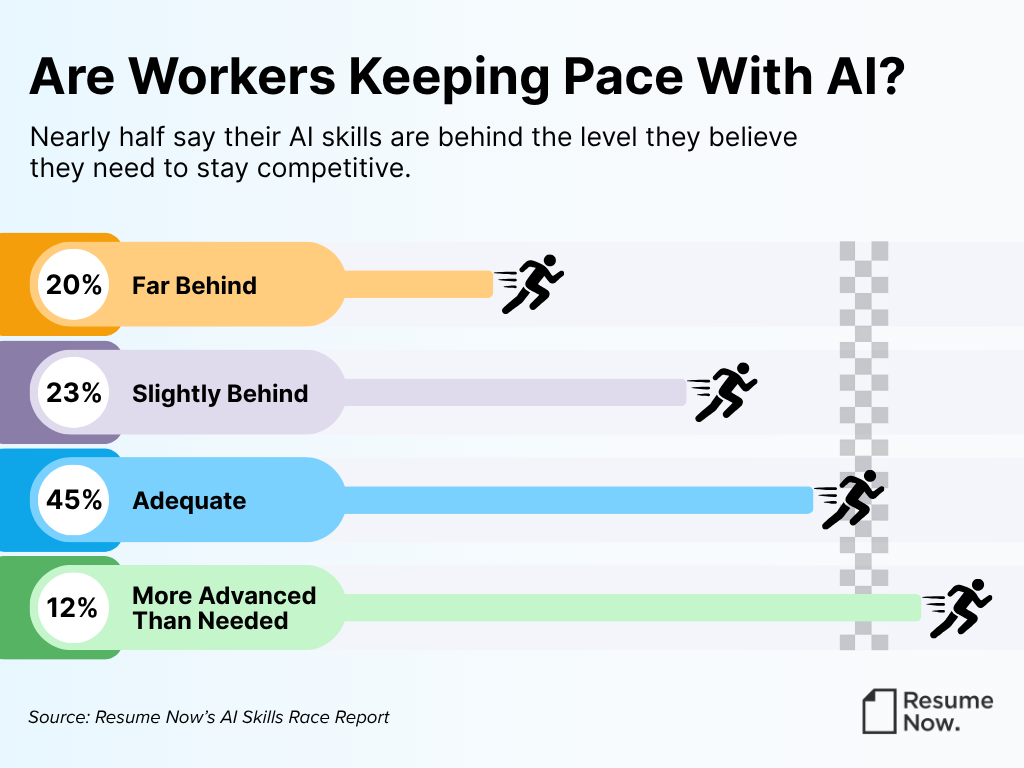
What this means: This AI skills gap—the difference between workers' current abilities and the AI skills they believe they need—suggests that workplace expectations are outpacing many employees' readiness. Even employees who feel capable today may still question whether their skills will remain competitive as AI becomes more embedded in everyday work.
The AI Skills Race Is Driving Coworker Competition
As AI adoption at work increases, workers are paying attention to how quickly their colleagues are adapting. In total, 39% are concerned that coworkers who adopt AI more quickly will gain a competitive advantage.
- Very concerned: 12%
- Somewhat concerned: 27%
- Not very concerned: 27%
- Not concerned at all: 34%
What this means: Workers increasingly view AI adoption as a potential source of workplace advantage. The concern that faster adopters may gain an edge suggests that AI skills are becoming part of how employees assess their standing and competitiveness relative to those they work alongside.
Peer Pressure Takes On a New Meaning in the AI Skills Race
Nearly 1 in 4 workers say their AI skills are behind their coworkers', adding another layer of pressure as employees try to stay competitive in their roles. When asked how they would rate their AI skills compared to their coworkers, respondents said:
- Far behind: 11%
- Somewhat behind: 13%
- About the same as their coworkers: 43%
- Somewhat more advanced than their coworkers: 23%
- Much more advanced than their coworkers: 10%
What this means: Coworker comparisons are adding another layer of pressure to the AI skills race. Although most workers believe they're keeping pace with their peers, 24% feel behind, showing how AI readiness is becoming a professional benchmark alongside broader workplace expectations.
Falling Behind on AI Is Becoming a Career Risk
As AI skills become an increasingly common workplace expectation, some workers are concerned that lacking them could negatively affect their job security. When asked how worried they are about this risk, respondents said they're:
- Very worried: 10%
- Somewhat worried: 25%
- Not very worried: 31%
- Not worried at all: 34%
What this means: For some workers, AI proficiency is becoming tied to job security, raising the stakes for workers who feel behind. The findings suggest employees increasingly see AI readiness as part of remaining valuable, employable, and prepared for changing workplace expectations.
AI Pressure Is Following Workers Off the Clock
As workers feel pressure to keep pace with AI expectations, some feel pushed to build skills outside of work hours to keep up with coworkers or avoid falling behind. When asked how much pressure they feel to develop AI skills on their own time, workers said:
- Feel significant pressure to develop AI skills on their own time: 14%
- Feel some pressure to develop AI skills on their own time: 23%
- Don't feel pressure to develop AI skills on their own time: 63%
What this means: The AI skills race is extending beyond the workday. For 37% of workers, pressure to develop these skills on personal time reflects how seriously they view the need to keep pace with coworkers and evolving expectations, showing that AI pressure at work doesn't always end when the workday does.
AI Pressure Isn't Letting Up
For many workers, concern about AI's growing role at work is either rising or holding steady. When asked to compare their concern to one year ago, respondents said:
- Much more concerned than a year ago: 11%
- Somewhat more concerned: 21%
- About the same: 45%
- Somewhat less concerned: 9%
- Much less concerned than a year ago: 14%
What this means: Concern about AI skills isn't fading with time. With nearly one-third of workers more concerned than they were a year ago and nearly half reporting no change, AI readiness appears to be an ongoing workplace concern rather than a temporary response to rapid technological change.
The AI Skills Race Is Becoming a Workplace Reality
The findings point to a workplace where keeping up with AI is becoming an ongoing concern—not just a one-time learning curve. For workers, that can mean navigating new expectations while figuring out how much time and effort to invest in building new skills. For employers, it underscores the importance of setting clear expectations and providing employees with opportunities to develop those skills on the job.
For press inquiries, please contact Alexa Kalechofsky at alexa.kalechofsky@bold.com.
Methodology
The findings in this report are based on a survey of 1,020 employed U.S. adults, conducted by Resume Now using Pollfish in May 2026. Respondents answered questions about AI skill readiness, workplace pressure to build AI skills, coworker comparison, job security concerns, and changing concern about needing AI skills to stay competitive. Question formats included single-select and multiple-choice questions.
Demographic Breakdown
Survey respondents reflected a broad cross-section of the U.S. workforce. Participants were 52% female, 47% male, 1% nonbinary, and less than 1% preferred not to answer. Generationally, 24% identified as Gen Z, 28% as millennials, 27% as Gen X, and 21% as baby boomers. Educationally, 18% held a graduate degree, 27% held a bachelor's degree, 18% held an associate degree, 35% held a high school degree or equivalent, and 2% had less than a high school degree.
About Resume Now
Resume Now is a powerful resource dedicated to helping job seekers achieve their potential. Resume Now's AI Resume Builder is a cutting-edge tool that makes creating a resume fast, easy, and painless. Resume Now has been dedicated to serving job seekers since 2005. Alongside its powerful AI Resume Builder and stylish ready-to-use templates, it also features free advice for job seekers at every career stage, guides for every step of the hiring process, and free resources for writing cover letters. Resume Now is committed to supporting job seekers and workers alike and has conducted numerous surveys related to the experience, trends, and culture of the workplace. These surveys have been featured in Business Insider, CNBC, Fast Company, Yahoo!, Forbes, and more. Follow Resume Now as a preferred source in Google to receive more workforce trends, career insights, and labor market research in your personalized search experience.


Keith is a Certified Professional Resume Writer (CPRW) and trusted media source in the career industry with over a decade of experience helping job seekers stand out.
More resources
Workplace AI Temp Check: Washington, DC, Arizona, & Colorado Lead in Business AI Use
Resume Now analyzed AI adoption by state revealing where repo...

The AI Whelmed Worker: 44% Feel Overwhelmed by the Pressure to Learn & Use AI at Work
Resume Now s new report reveals that workers feel uncertain u...
Human-AI Trust in the Workplace: 97% of Workers Still Put Human Judgment First
In an analysis of human-AI trust in the workplace Resume Now ...
Future Proof Career Skills: 10 Human Skills for Resumes in the Age of AI
Resume Now s analysis of O NET cognitive ability data across 8...
10 Jobs That AI Can't Replace Thanks to “Superhuman” Skills
Resume Now analyzed O NET data to identify AI-proof jobs that ...
Bring Your Own AI: 41% of Workers Say Employers Haven’t Prepared Them to Use AI at Work
A new Resume Now report finds that the bring your own AI (B...
 Get the job 2x faster*
  Customize your cover letter