


A new national survey from Resume Now finds that many workers are seeing their roles intersect with what AI can already do.
According to Resume Now's AI Value & Vulnerability Report, 4 in 10 (41%) say AI is already replacing, devaluing, or overlapping with parts of their job, and nearly one-third (29%) say AI could effectively complete at least half of their daily work tasks.
Key Insights
- AI is increasingly seen as a competitor, not just a tool. 29% of workers say AI could effectively complete at least half of their daily work tasks.
- AI is affecting how workers view their jobs' value and scope. 41% of workers say AI is replacing, devaluing, or overlapping with parts of their job.
- Productivity gains remain uncertain. While just over half of workers say they are confident AI improves productivity, 46% say they're not confident.
- AI's impact on skill growth remains limited. A majority of workers (55%) say AI has not changed how they use or develop their skills.
Workers See Their Value Becoming Vulnerable
How does AI impact job security? For many workers, concerns about AI stem from direct comparisons between their own work and what AI tools can already do. As AI becomes more competent, employees are recognizing which parts of their role compete with AI and which still require human judgment.
- 29% say AI could effectively complete at least half of their daily work tasks.
- 34% say AI could complete only a small portion of their work.
- 37% say AI could complete almost none of their tasks.
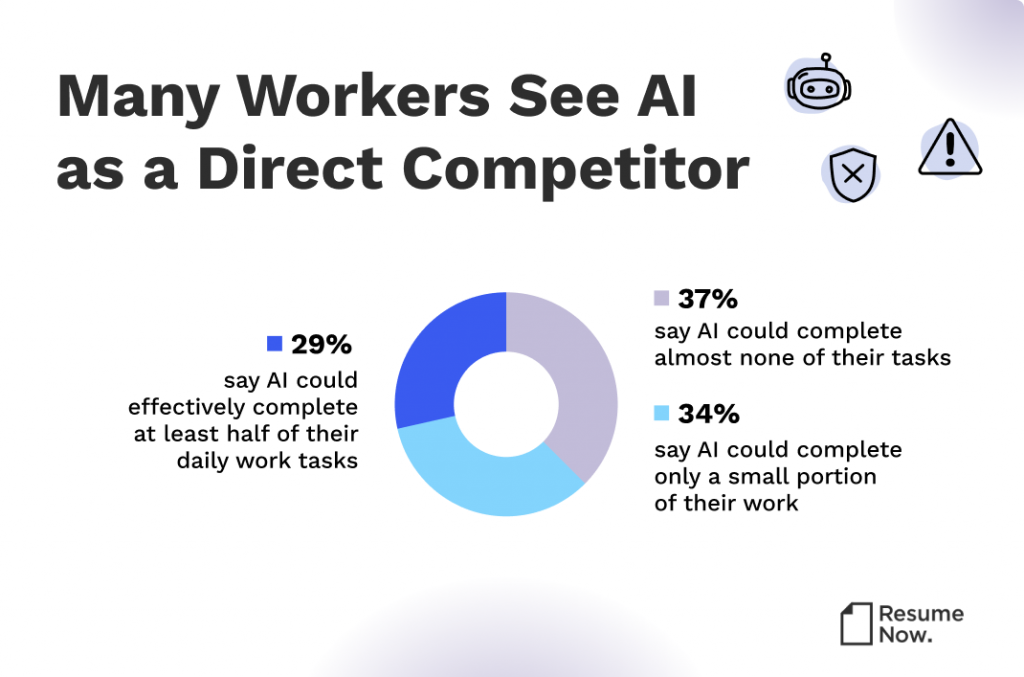
What this means: As workers use AI, they're weighing their own work against it. Employees are increasingly aware of which parts of their roles could be replicated and which still rely on human judgment.
When technology begins to overlap with core tasks, it starts to feel more like competition. Over time, that shift can make professional security feel more conditional than assumed.
AI Overlap Is Already Being Felt by Many Workers
Workers' perceptions of AI's impact on their roles vary, but a substantial share say AI is already intersecting with their day-to-day responsibilities. Rather than viewing AI solely as a supportive tool, many workers indicate that it is beginning to influence their job functions significantly.
Forty-one percent say AI is replacing, devaluing, or overlapping with parts of their job, including:
- 16% report AI is already taking over parts of their job or lowering its value.
- 25% say AI is starting to overlap with their responsibilities.
But the other 59% of survey respondents see it differently:
- 41% say AI supports their work but doesn't replace it.
- 18% say AI enhances their role and increases the value of their expertise.
What this means: For many workers, AI is no longer hypothetical. It's already intersecting with daily responsibilities in tangible ways. That overlap changes the dynamic.
Even when AI is positioned as supportive, the perception that it can absorb or diminish parts of a role introduces new tension. The conversation is shifting from "will AI affect my work?" to "when will AI take my job?"
Workers Are Split on Whether AI Actually Saves Time
While many workers recognize AI's growing capabilities, confidence in whether these tools truly improve productivity remains divided. So, how do people feel about AI tools? Rather than a clear consensus, employees report mixed experiences, reflecting uncertainty about whether AI meaningfully reduces workload or simply reshapes how work gets done.
- 54% of workers say they are confident that AI tools improve productivity.
- 17% are very confident.
- 37% are somewhat confident.
- 46% say they are not confident that AI improves productivity.
- 27% are not very confident.
- 19% are not confident at all.
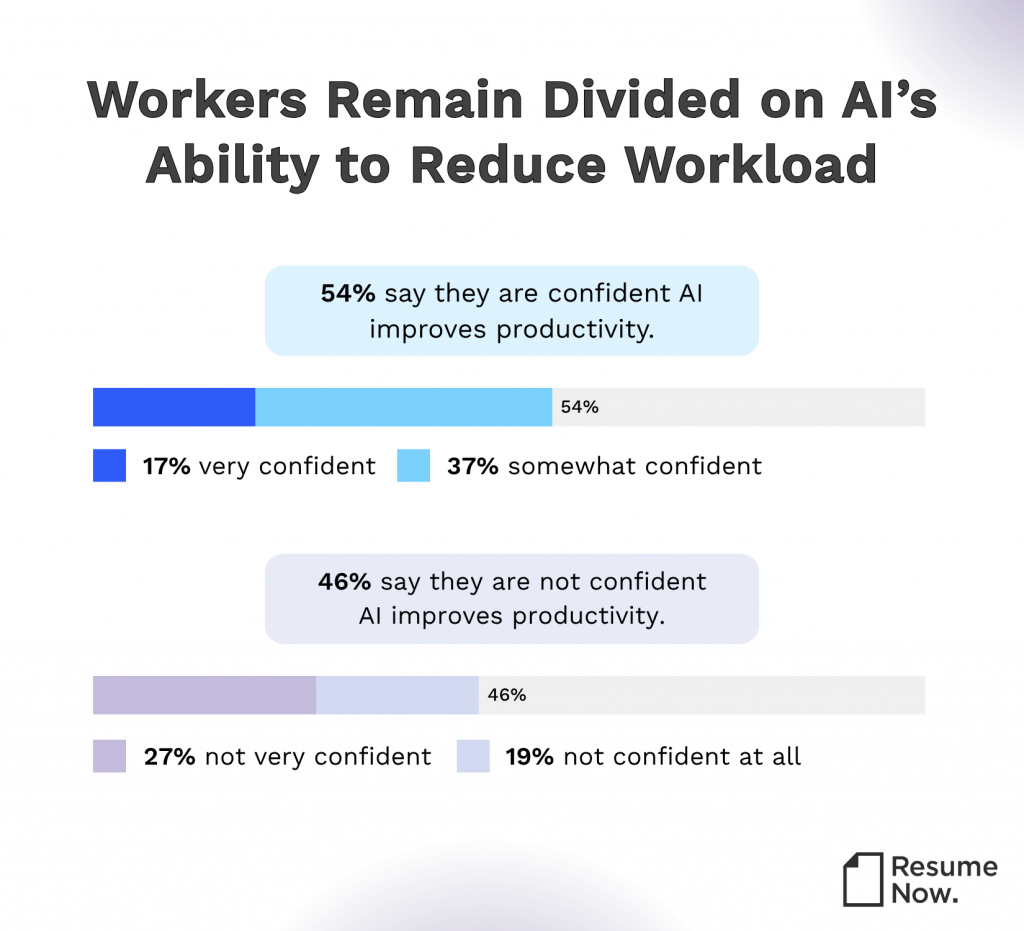
What this means: Confidence in AI's productivity gains is far from universal. While many workers see efficiency potential, a substantial share remain unconvinced that AI tools meaningfully improve output. That uncertainty matters, especially as AI increasingly overlaps with daily responsibilities.
When technology encroaches on core tasks without delivering clear, consistent results, it can heighten skepticism rather than trust.
Skill Development Has Not Shifted for Most Workers
While AI is becoming more capable at work, many employees have not yet seen meaningful improvements to how they use or develop their own skills. For most workers, AI has not brought any professional development opportunities.
- 55% say AI has not changed how they use or develop their skills.
- 36% say AI has helped them learn new skills faster or expand what they can do.
- 9% say AI has decreased how much they rely on their own skills.
What this means: Despite AI's rapid advancement, most workers are not experiencing it as a catalyst for skill growth. For many, the technology has not meaningfully changed how they develop or apply their expertise. That gap suggests adoption is outpacing integration.
Without intentional development strategies, AI risks becoming a passive tool rather than an engine for professional advancement.
Methodology
The findings in this report are based on a survey of 1,012 employed U.S. adults conducted by Resume Now using Pollfish in December 2025. Respondents answered questions about AI usage, job impact, and skill development. Question formats included multiple-choice and scaled-response questions.
Demographic Breakdown
Survey respondents represented a broad cross-section of the U.S. workforce. Participants were 52% female and 48% male. Generational representation included 15% Gen Z (born 1997 or later), 27% millennials (born 1981–1996), 27% Gen X (born 1965–1980), and 30% baby boomers (born 1946–1964).
About Resume Now
Resume Now is a powerful resource dedicated to helping job-seekers achieve their potential. Resume Now's AI Resume Builder is a cutting-edge tool that makes creating a resume fast, easy, and painless. Resume Now has been dedicated to serving job seekers since 2005. Alongside its powerful AI Resume Builder and stylish ready-to-use templates, it also features free advice for job seekers at every career stage, guides for every step of the hiring process, and free resources for writing cover letters. Resume Now is committed to supporting job seekers and workers alike and has conducted numerous surveys related to the experience, trends, and culture of the workplace. These surveys have been featured in Business Insider, CNBC, Fast Company, Yahoo!, Forbes, and more. Keep up with Resume Now on LinkedIn, Facebook, X, and Pinterest.
For press inquiries, contact Alexa Kalechofsky at alexa.kalechofsky@bold.com.


Keith is a Certified Professional Resume Writer (CPRW) and trusted media source in the career industry with over a decade of experience helping job seekers stand out.
More resources

The AI Whelmed Worker: 44% Feel Overwhelmed by the Pressure to Learn & Use AI at Work
Resume Now s new report reveals that workers feel uncertain u...
The AI Skills Race: 43% of Workers Feel They’ve Fallen Behind
Resume Now finds that 43% of workers feel behind in their AI s...
Human-AI Trust in the Workplace: 97% of Workers Still Put Human Judgment First
In an analysis of human-AI trust in the workplace Resume Now ...
Future Proof Career Skills: 10 Human Skills for Resumes in the Age of AI
Resume Now s analysis of O NET cognitive ability data across 8...
10 Jobs That AI Can't Replace Thanks to “Superhuman” Skills
Resume Now analyzed O NET data to identify AI-proof jobs that ...
Bring Your Own AI: 41% of Workers Say Employers Haven’t Prepared Them to Use AI at Work
A new Resume Now report finds that the bring your own AI (B...
 Get the job 2x faster*
  Customize your cover letter