


Popular Model Resume Examples
Entry-level model resume
An entry-level resume should emphasize relevant training, portfolio projects, and certifications to show your skills even if you have limited professional experience.

Emphasizes soft skills: By emphasizing strong communication, adaptability, and collaboration, this resume shows readiness for model responsibilities even with limited industry tenure, since the job seeker consistently partners with designers and engages clients to boost brand visibility.
Places skills over experience: The combination resume format is a strategic choice because it spotlights transferable strengths like brand promotion and social media marketing. For example, increasing brand visibility by 30% through social media helps demonstrate readiness for model roles beyond job titles.
Mid-career model resume
A mid-career model resume should emphasize applied experience, measurable results, and ongoing skill development to support higher-impact roles and advancement.

Includes mix of skills: This fashion model balances strong brand-promotion know-how and runway or editorial technique with reliable professionalism, creative collaboration, and adaptability across high-profile shoots. Their campaign results show they communicate clearly and connect well with design teams to drive visibility growth.
Begins with a powerful summary: This profile quickly signals relevant runway, fashion, and print modeling experience, supported by 4 years in high-profile shows and editorial campaigns. It also highlights brand promotion strategies and collaboration skills recruiters and ATS look for.
Experienced model resume
A resume for an experienced model should emphasize successful campaigns and measurable results, showing how their work advanced into higher-profile roles and greater responsibilities.
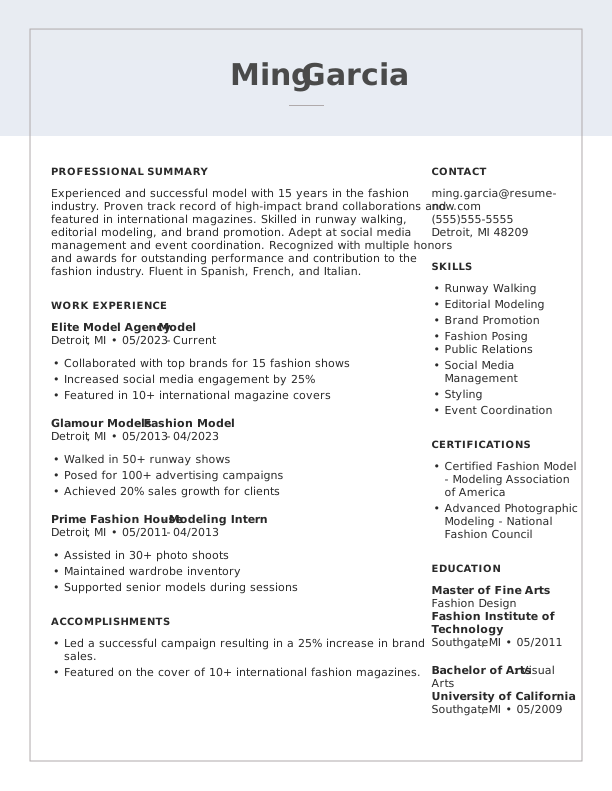
Quantifies achievements: Quantifiable achievements like 15 fashion shows, increased engagement by 25%, and 10+ international magazine covers make the impact of your modeling work easy for recruiters to assess. Clear metrics also build trust by showing consistent outcomes across runway, campaigns, and brand promotion.
Follows traditional format: A chronological resume format spotlights their extensive modeling background and makes it simple to see steady growth from modeling intern to fashion model and then to model. It also clearly connects each role to increasing brand exposure and performance results.
No experience model resume
A resume for an applicant with no experience should emphasize relevant projects, coursework, and hands-on practice that demonstrate readiness to contribute as a model.
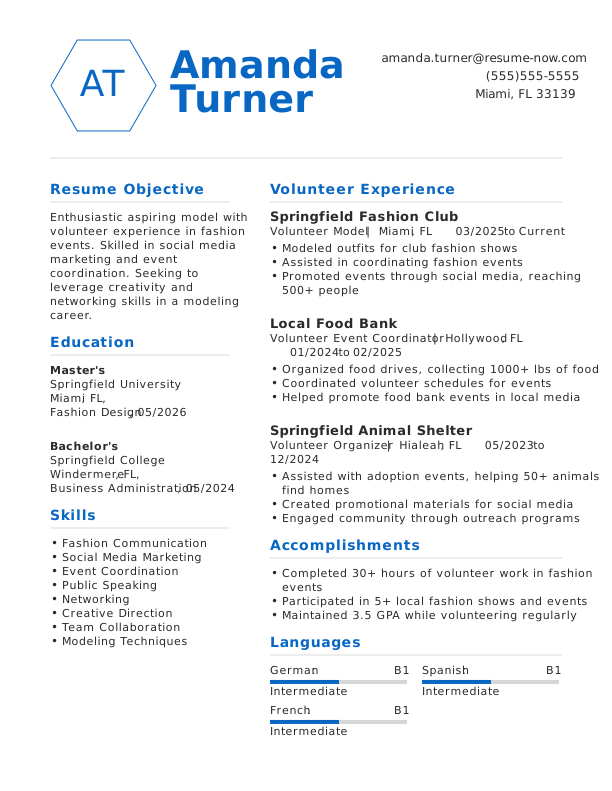
Avoids jargon: Inexperienced applicants may be tempted to "pad" their resumes with fashion buzzwords or complicated descriptions for basic tasks like event support or social media promotion. This approach is less effective than clear, simple wording that highlights real work, such as coordinating fashion events and promoting them to 500+ people.
Leads with education: Including coursework in fashion marketing, illustration, and textile science supports model-ready fundamentals in presentation and styling choices, helping demonstrate job-specific knowledge despite limited professional experience.
Model Resume Template
Use this professional resume template for a model as your foundation—simply copy and customize it with your own information.
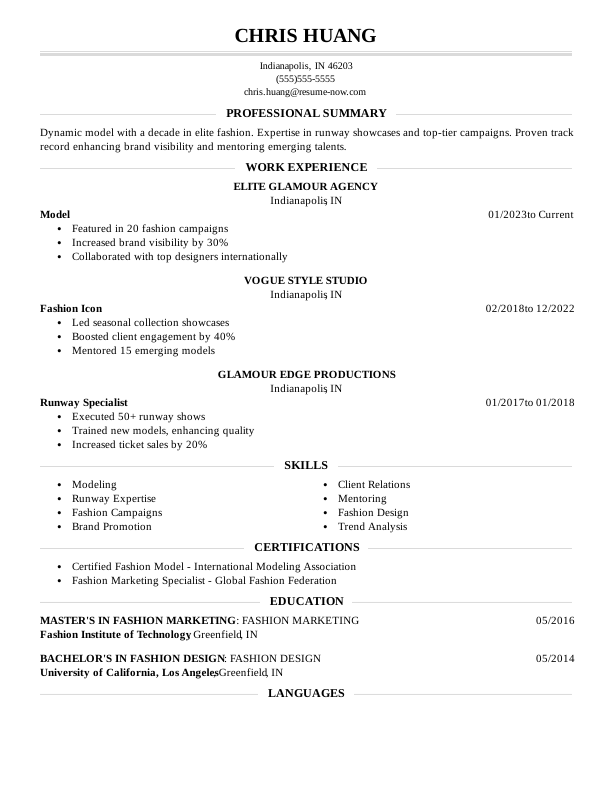
Chris Huang
Indianapolis, IN 46203
(555) 555-5555
chris.huang@email.com
Professional Summary
Dynamic model with a decade of experience in elite fashion. Expertise in runway showcases and top-tier campaigns. Proven track record of enhancing brand visibility and mentoring emerging talent.
Work Experience
Model
Elite Glamour Agency — Indianapolis, IN
January 2023–Present
- Featured in 20 fashion campaigns.
- Increased brand visibility by 30%.
- Collaborated with top designers internationally.
Fashion Icon
Vogue Style Studio — Indianapolis, IN
February 2018–December 2022
- Led seasonal collection showcases.
- Boosted client engagement by 40%.
- Mentored 15 emerging models.
Runway Specialist
Glamour Edge Productions — Indianapolis, IN
January 2017–January 2018
- Executed more than 50 runway shows.
- Trained new models to improve performance quality.
- Increased ticket sales by 20%.
Skills
- Modeling
- Runway Expertise
- Fashion Campaigns
- Brand Promotion
- Client Relations
- Mentoring
- Fashion Design
- Trend Analysis
Certifications
- Certified Fashion Model — International Modeling Association
- Fashion Marketing Specialist — Global Fashion Federation
Education
Master's in Fashion Marketing
Fashion Institute of Technology — Greenfield, IN
May 2016
Bachelor's in Fashion Design
University of California, Los Angeles — Los Angeles, CA
May 2014
Languages
- Spanish — C2
- French — Proficient (C1 Advanced)
- Italian — B1 (Intermediate)
Must-Have Skills on a Model Resume
A strong skills section helps you make a clear first impression and align your background with what employers are searching for. When you organize key abilities, you give hiring teams an easy way to understand your fit.
Performing arts professionals bring stories, emotion, and ideas to life. The skills you highlight should reflect your ability to connect with audiences, collaborate effectively, and deliver memorable experiences. Your resume should showcase how you contribute to powerful performances that leave a lasting impact.
The following data breaks down the most common hard and soft skills for a model resume according to Resume Now’s internal resume data.
Writing Your Model Resume
Now that you’ve reviewed these resume examples, you’re ready to learn how to write a resume in a clear, step-by-step way. We’ll guide you through the process section by section so you can build yours with confidence.
List your most relevant skills
An effective skills section for a model resume quickly shows you can meet the role. You want to highlight strengths like runway experience, commercial work, posing, and consistent presentation. Keep it easy to scan so recruiters can see your fit in seconds.
You should also mirror the keywords from the job listing. If it mentions "editorial," "commercial casting," "on camera confidence," or "fit and measurements," include those phrases where they truly apply. This helps you connect with human readers and signals to ATS that your resume matches what they are searching for.
Example of skills on a model resume
- Skilled in collaborating with photographers and designers to execute creative concepts
- Experienced in maintaining model release records and wardrobe organization
- Confident performer with strong communication and punctuality habits
- Detail-oriented with a focus on posture, styling consistency, and readiness
Your skills section should show hiring managers that you’re ready for the role’s expectations. Review the job description for technical requirements such as runway or photo shoot experience, posing direction, and familiarity with casting or scheduling tools, then pair those with soft skills like professionalism and strong communication. This combination signals you can perform reliably and work well with a team.
Highlight your work history
Your work experience section is the most critical part of your model resume. It should highlight your best outcomes and show how you turned professional readiness into strong results on set, in studio, or on location. Emphasize achievements like booked campaigns, reliable turnaround times, and feedback you improved through.
For each entry, include your job title, agency or client/company name, and dates of employment. This helps reviewers confirm your timeline and credibility in the industry. If relevant, add details such as the type of modeling work you did (print, runway, commercial) or the market focus (fashion, beauty, lifestyle).
Example of a model work experience entry
- Freelance Fashion and Commercial Model
- Independent Contractor | New York, NY | 2023–Present
- Modeled apparel, accessories, and lifestyle products for e-commerce campaigns, editorial shoots, and brand marketing materials.
- Collaborated with photographers, stylists, makeup artists, and creative directors to execute campaign concepts and meet client expectations.
- Completed 20+ photoshoots for emerging fashion brands and local businesses, adapting poses, expressions, and styling to suit each project.
- Built a reputation for punctuality, adaptability, and professionalism across repeat bookings and collaborative projects.
Tailor your model resume to the types of modeling jobs you want. For fashion and runway roles, emphasize your measurements, runway experience, and walk training. For commercial or lifestyle modeling, highlight your on-camera experience, versatility, and ability to convey different expressions and emotions. Include a link to your portfolio or digitals so agencies can easily evaluate your look.
Add portfolio work to your resume
For model professionals, the unique challenge is showing your range and experience without turning your resume into a photo gallery. A portfolio helps you demonstrate your look, styling versatility, and campaign results while keeping your resume clean and recruiter-friendly.
Place a portfolio link near your contact information at the top. Use a simple "portfolio highlights" section with three to four items, like runway work, brand campaigns, or editorial features. Keep titles short and add one measurable detail per item when possible.
Example of a portfolio highlights section
- Runway: Walked in 4 independent designer showcases during New York Fashion Week.
- Brand Campaigns: Featured in 6 e-commerce and social media campaigns for emerging fashion brands.
- Editorial Features: Appeared in 3 fashion editorials published in digital magazines.
- Commercial Modeling: Modeled for 5 lifestyle and beauty product photo shoots used in online marketing.
Include your education
Your education section should list your degrees and training in reverse-chronological order, starting with the most recent. For a model resume, include any fashion or performing arts programs, theater or dance training, and relevant workshops that support your work.
If your education is ongoing or incomplete, show your highest current level and add an expected graduation date when you can. You can also highlight role-relevant coursework or training like runway coaching, styling fundamentals, movement for performance, public speaking, or photography workshops. If you completed notable projects during school such as student campaigns or portfolio showcases, mention those briefly since they help demonstrate readiness.
Common certifications for a model resume
- Modeling and Runway Training Certificate
- Acting for Film and Television Certificate
- On-Camera Performance Certificate
- Commercial Acting Workshop Certificate
- Professional Makeup Application Certificate
- Posing and Movement Workshop Certificate
- Public Speaking Certificate
Sum up your resume with an introduction
Your resume should begin with a profile that introduces your modeling background and helps employers understand what to expect from you. Use this space to set the tone for your strengths, like experience in runway, studio work, or brand campaigns, and to guide recruiters toward the right opportunities.
A professional summary works best if you're an experienced model. It highlights your most relevant achievements at the top of your resume so hiring managers can quickly see your specialties, portfolio strengths, and any measurable results from past jobs.
Professional summary example
Detail-oriented model with 5+ years of experience delivering consistent, high-quality work for fashion and commercial campaigns. Proven ability to interpret creative direction quickly, maintain performance under tight production schedules, and elevate brand presentation through confident on-set presence. Skilled in posing technique, runway and studio modeling, and working collaboratively with photographers and stylists.
Resume objective example
Motivated model seeking to apply professionalism, strong posing and body awareness, and reliable communication to support creative teams. Eager to contribute a consistent on-set presence that helps deliver clear direction and high-quality results for clients.
Make it easy for agencies to assess your suitability by listing your current measurements, including height, bust, waist, hips, and shoe size, along with your hair and eye color. Keep these details accurate and up to date, as agencies often use them to match models with specific casting requirements.
Add unique sections to set you apart
Complete your resume with optional sections that highlight what makes you stand out as a model. These additions help you show employers your unique fit beyond experience alone.
Optional resume sections let you share relevant hobbies like photography, dance, or fitness routines that support your on-camera presence and discipline. You can also include volunteer work such as community arts programs or charity events where you helped promote awareness. When employers see how you use your time to practice skills and support meaningful causes, they gain insight into your professionalism, reliability, and values.
Three sections perfect for a model resume
- Work Samples: A portfolio section gives employers quick proof of your work. Include three to five samples, such as photoshoots, runway or commercial tests, and castings, with short notes on your role, styling needs, and results like bookings or feedback.
- Client Testimonials: Client testimonials add credibility to your resume by proving impact. Include two to three short quotes that showcase your creativity, reliability, and the results you delivered for real projects.
- Awards and Recognition: Add awards and recognitions to your resume to stand out. Include the awarding organization, honor name, and date received, such as an industry certification or public speaking recognition.
5 resume formatting tips
- Choose a format that matches your career stage
Your career level should guide your resume format. If you’re an experienced model with a clear booking history, choose a chronological resume to show steady work and growth. If you’re new or returning after a break, use a functional resume to emphasize strengths like runway experience, photoshoots, and versatility.
- Pick a smart resume template
Your model resume should use a professional resume template so hiring teams can read your experience and portfolio details quickly. A clear structure keeps measurements, brand work, and relevant training easy to find, while consistent formatting helps your resume pass ATS screening without getting distorted.
- Use an appropriate font
Choosing a professional font is important for both ATS and human readers. Choose a standard option like Times New Roman, Arial, or Calibri so your resume stays clear when scanned.
- Use consistent formatting
Keep your resume left-aligned with consistent margins so it looks organized, professional, and easy for hiring managers to scan.
- Aim for one page
For model resumes, resumes should be one page long in most cases so your best measurements, experience, and credits stand out fast. If you have a lot of professional work, two pages may be OK, but keep details tight and relevant.
What’s the Average Model Salary?
Model salaries vary based on location, career level, and qualifications. This data, provided by the Bureau of Labor Statistics, will show you the expected salary ranges for models in the five highest-paying states, including the District of Columbia. The figures reflect the most current salary data available, collected in 2024.
- Full Range
- Most Common (25th–75th percentile)
- Average
Tools for Your Job Search
Getting ready to apply for model roles? Before you submit, use our ATS Resume Checker to see how your resume may perform in the automated screening systems many studios and agencies use.
For stronger results, try our AI Resume Builder. It offers tailored suggestions based on your experience with shoots, auditions, and brand work, plus professional templates that help your portfolio highlights and measurable achievements stand out.
With both tools, you’ll move from draft to polished resume faster. You can streamline formatting, reduce guesswork about what to include, and save time while improving clarity for hiring teams.
Frequently Asked Questions
Last Updated: October 14, 2026
Yes. A cover letter adds context to your resume and creates another way for you to communicate with an employer. Write a cover letter to share what draws you to the role and highlight how your experience supports what they need. You can use an AI Cover Letter Generator to create a targeted draft quickly, then refine it so it sounds like you. You can also pick from cover letter template options that match your resume for a cohesive, professional application.
A CV (curriculum vitae) is typically longer and more detailed than a resume. While resumes are usually one to two pages, CVs can be several pages long and cover comprehensive details about your academic background, research, publications, and professional experience.
You’ll generally use a CV for roles in academia, research, medicine, or law. If you’re not sure which format fits your situation, an online CV Maker can guide you through building a polished document. You can also start with CV templates to match the tone and structure expected in your field.
Use a clean, professional resume template and tailor your summary and skills to match the job description. Add relevant keywords naturally so hiring managers and applicant tracking systems notice you faster.
Build a model-focused skills section that mixes technical strengths like Python, PyTorch, and data preprocessing with soft skills such as clear communication, critical thinking, and stakeholder collaboration. Then mirror those tools in your experience by describing how you trained or fine-tuned models, improved accuracy or latency, reduced errors, and reported results to guide decisions.
Prepare for your interview by practicing job interview questions and answers. Rehearsing ahead builds confidence, helps you explain your experience clearly, and keeps you calm when unexpected questions come up.
You can mention your career aspirations in your resume profile, but keep it brief. For example, instead of only writing "model seeking to specialize in image generation," use your cover letter to explain what you want to build next and why. Then target roles with advancement, training, mentorship, and growth opportunities.


Heather is a Certified Professional Resume Writer (CPRW) with more than 10 years of experience writing about job search and career topics. She is based in San Francisco.
More resources

Promotional Model Resume: Examples & Templates
As a promotional model your resume needs to catch the eye of ...

Fashion Designer Resume: Examples & Templates
As a fashion designer you need a resume that showcases your c...
College Resume: Examples & Templates
As a college student your resume should showcase the academic...
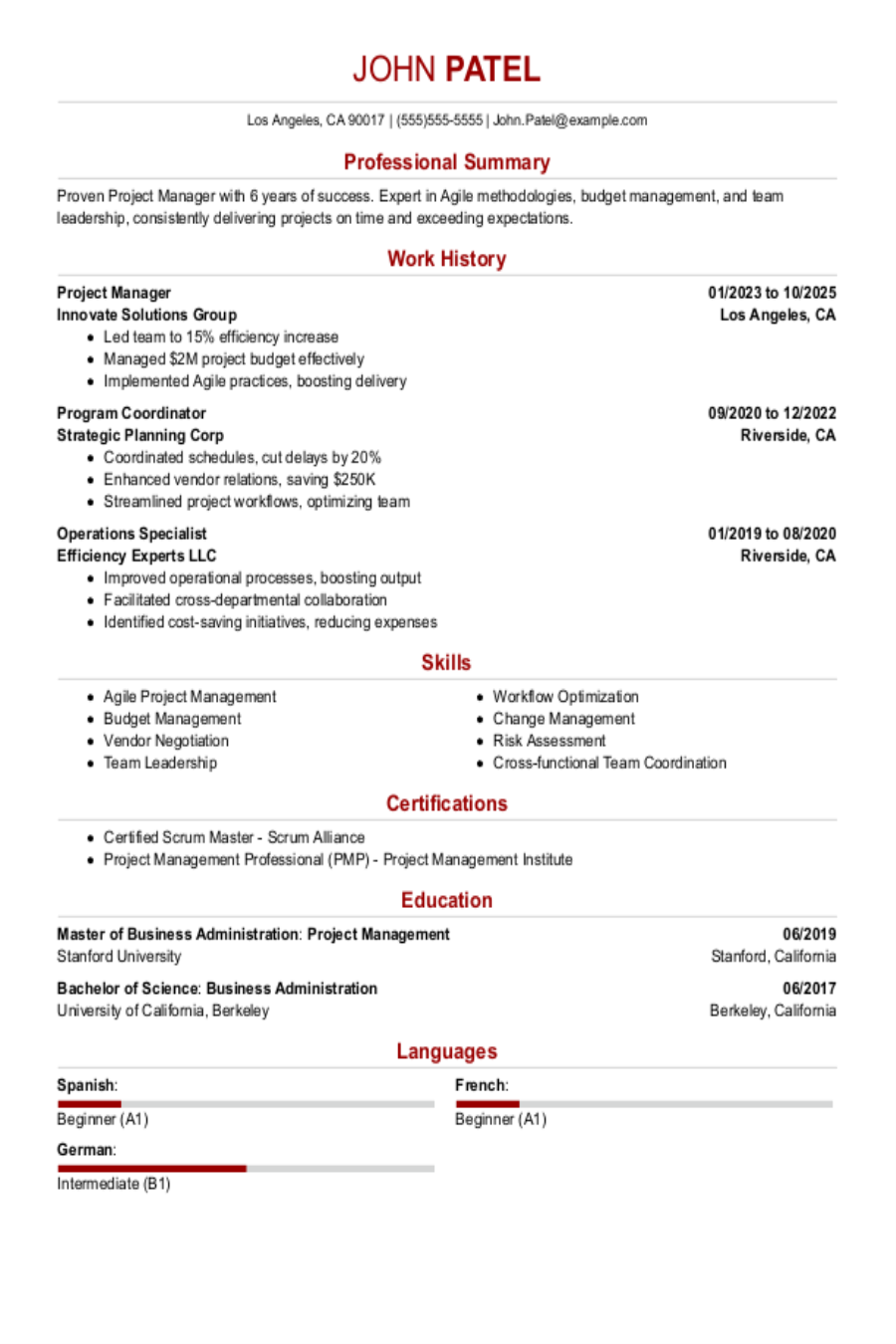
Project Manager Resume: Examples & Templates
A strong project manager resume demonstrates your ability to p...
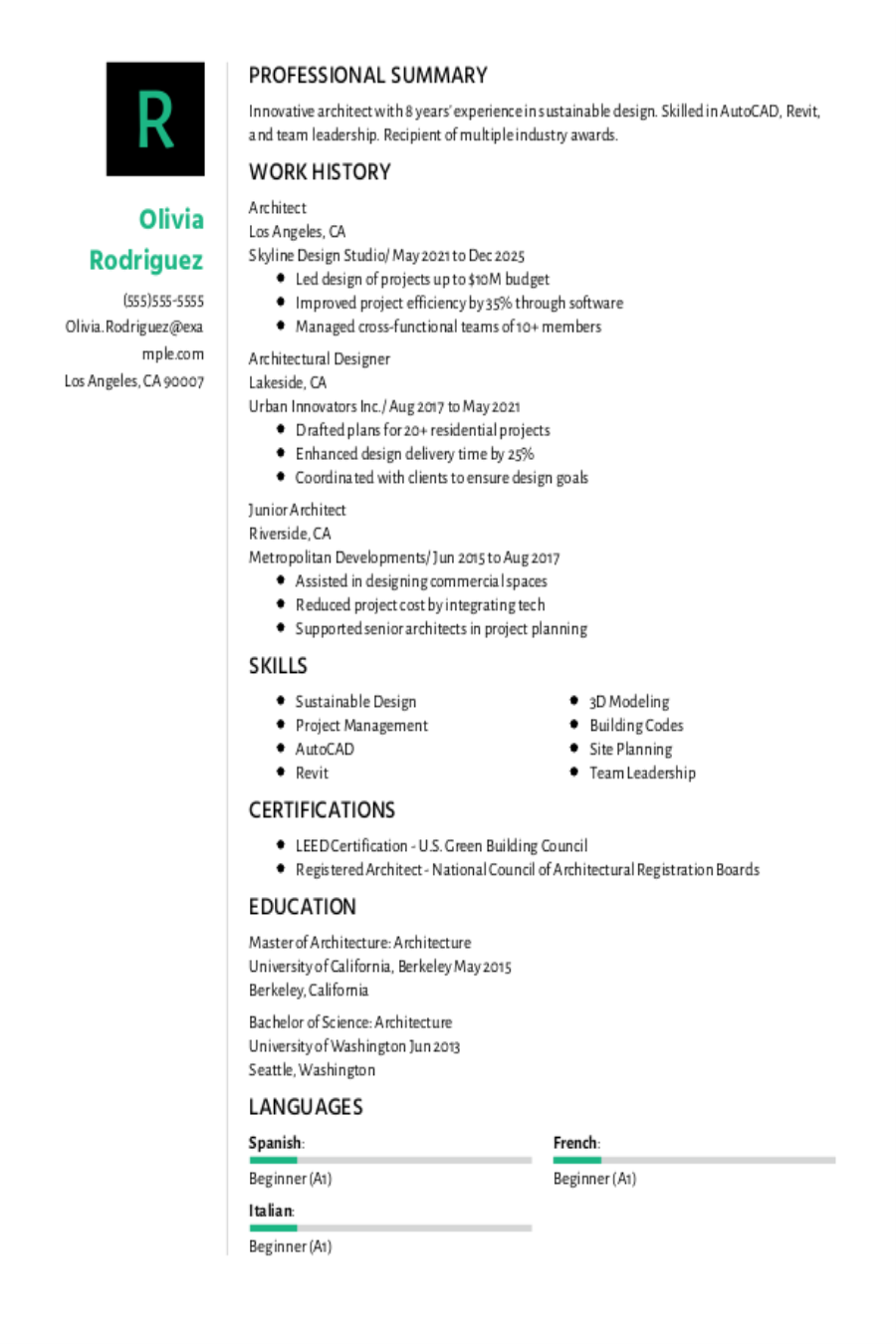
Architecture Resume: Examples & Templates
Review architecture resume examples to learn how to present yo...
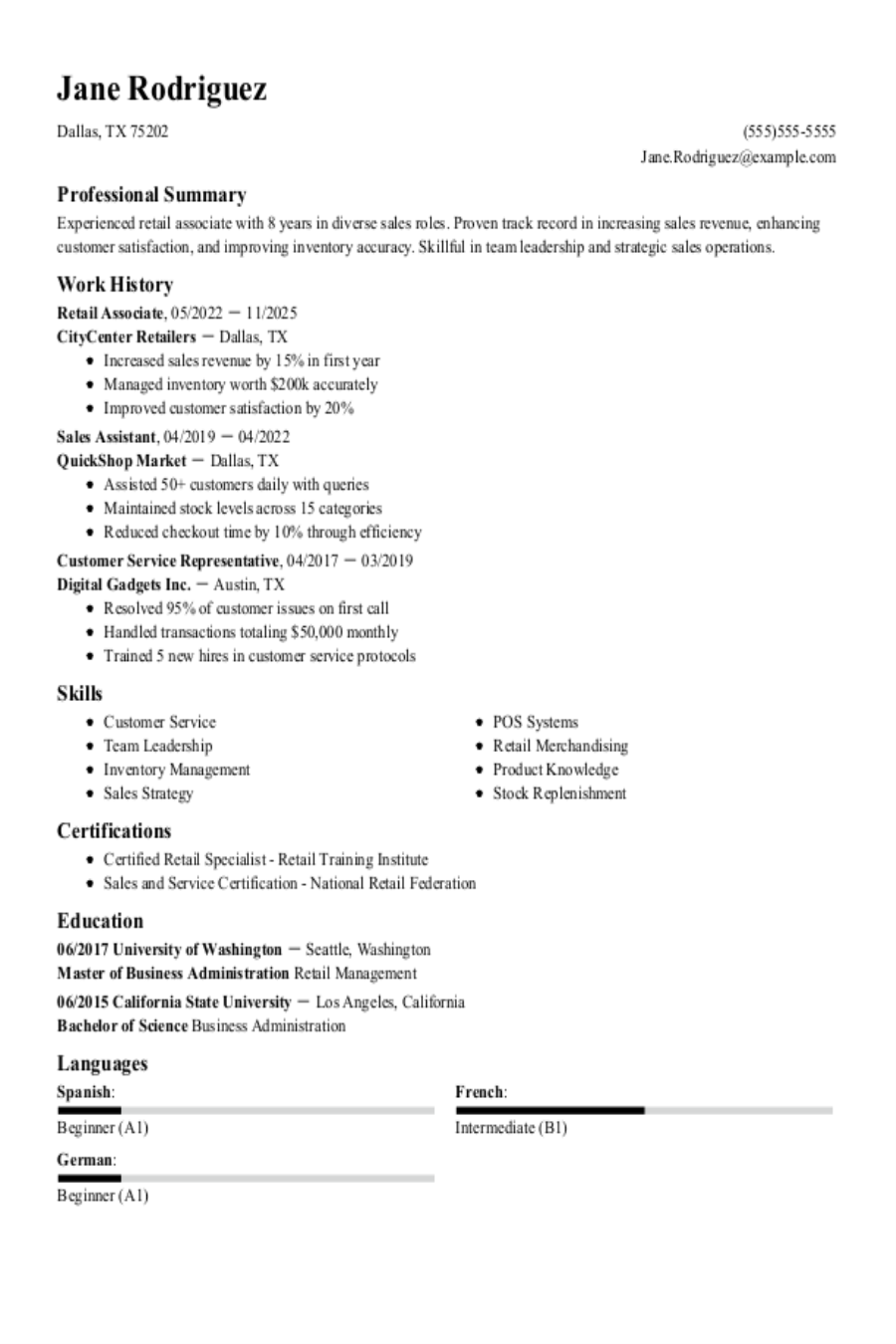
Retail Resume: Examples & Templates
A strong retail resume should highlight your customer service ...
 Get the job 2x faster*
 Customize your cover letter