

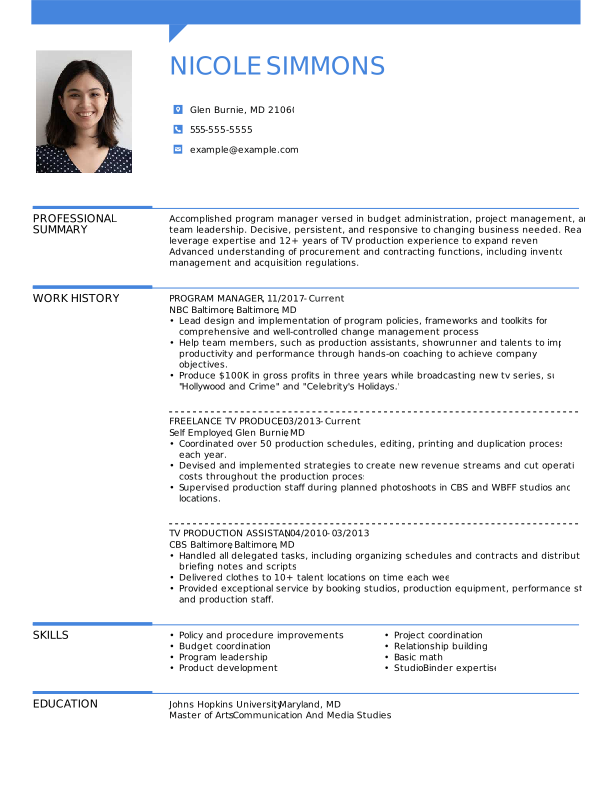

Have you ever wondered how long a resume should be for it to stand out when applying for jobs?
Millions of job seekers have asked the same question.
The simple answer—the right resume length is one or two pages. But the exact length will depend on how far along you are in your career.
Let's explore what that means for you:
In this guide, we'll answer:
- How long should a resume be?
- How do I shorten my resume?
- What if I have a lot I want to include in my resume?
Need help getting your resume to the right length? Try out our AI Resume Builder, and in just a few minutes, we'll put together a professional resume tailored to your needs. Try our customizable templates and expert suggestions to make your resume shine!
How Many Pages Should a Resume Be?
A resume should usually be one page long. But it can be longer depending on your career and resume needs. You should stick with a one-page resume if:
- You have less than 10 years of experience. If you have fewer than 10 years of relevant experience, a one-page resume is typically best. Early- and mid-career professionals can usually highlight their most important skills and accomplishments within one page.
- Your career trajectory is simple. If your work history is straightforward and closely aligned with the job you're applying for, one page is enough to showcase your qualifications clearly and effectively.
When Is It OK to Have a Two-Page Resume?
A two-page resume is OK when you have extensive experience to showcase on your resume, with the caveat that the experience must still be relevant and targeted for the role.
This means that a two-page resume is a good choice for:
- Candidates with 10 years of experience or more: If your career history goes back far enough, you may need two pages to give the employer appropriate context for your career.
- Candidates whose most relevant experience spans multiple employers or industries: When several roles directly relate to the position you're targeting, a two-page resume allows you to show progression and continuity without cutting important details.
- Candidates with a career history that includes many roles or clients: If you work in a field like consulting or freelance work, your resume may need an extra page to include all the different responsibilities you've tackled.
- Candidates with highly specialized or niche expertise: If the role depends on deep knowledge of specific tools, systems, or methodologies, a second page can help demonstrate depth without overcrowding key sections.
Pro tip
A long career doesn't mean that you have to write a two-page resume. If your experience isn't all relevant to the role, you can always trim it down to one page.
Can My Resume Be Three Pages or More?
No, resumes should never be longer than two pages. In nearly all industries, hiring managers expect resumes to be concise and focused, and anything beyond two pages is unlikely to be read in full. If you're struggling to summarize your experience within two pages, this is a strong signal that your content needs to be trimmed to include only the most relevant, targeted information.
Documents longer than two pages should be reserved for a curriculum vitae (CV). CVs are commonly used in academic, research, medical, and some government fields, and are designed to provide a comprehensive overview of a candidate's background, including publications, presentations, grants, and extensive credentials.
Not sure whether to write a CV or a resume? If you're applying for a standard job in the private or public sector, a resume is almost always the correct choice. Use a CV only if you're entering academia, research, medicine, or a government position that specifically requests one.
Why Does Resume Length Matter?
You may be asking yourself: Isn't the purpose of a resume to convince the employer of your skills? In that case, isn't it better to have as many skills as possible on your resume? Not really. When it comes to an effective resume, less is often more.
A great resume is targeted for the role you're applying for. That means that you need your most relevant skills to shine on your resume. Filling your document with details that are less relevant to the role can distract from the skills and experiences that matter.
Resume length is important for two reasons:
- Hiring managers are busy and don't have time to read lengthy resumes. In fact, it's commonly cited that recruiters spend an average of seven seconds reading a resume. You want your resume to be easy to read, clearly structured, and concise enough to communicate within that narrow window of time.
- Limiting the length forces you to be more concise and truly focus on your top skills and abilities. Filling your resume with as much detail as possible is an easy temptation, but your resume will be stronger if it's targeted to the role and laser-focused on relevant qualifications.
6 Tips for Fitting Your Resume on One Page
Whether you decide to keep it down to one page or expand it to two, getting your resume length right is an important step in your job search. The following tips will help you trim your resume down to size and focus on what matters most to recruiters.
Tip #1
Use Formatting to Your Advantage
Your resume length will be affected by the margins, line spacing, and resume font. You can gain or cut some space by adjusting these elements—as long as you follow the basic rules of resume formatting.
For example, your font size should be no smaller than 10 points and no larger than 12 points. If your resume is slightly too long, dropping the point size from 11 to 10 will help you reach your goal.
But be careful. You don't want to appear like you're trying to hide a lack of experience by super-sizing the margins or font. Always stick within the range of standard resume formatting.
Choosing a well-designed resume template can also help. Templates come with preloaded fonts and spacing, and they are professionally designed, so you don't have to fuss with the formatting. Simply find a style that works for you.
Tip #2
Focus on Achievements Over Responsibilities
Don't turn your resume into a list of job duties. This can quickly become a lengthy addition to your work experience section, and it's unlikely to resonate with most employers. Avoid paragraphs when describing your experience; Stick with short, impact-driven bullet points that focus on your achievements.
Start each bullet point with an action verb that shows your impact. This will help your experience section grab the hiring manager's attention. Then quantify your achievements.
How much money did you bring in? How many customers did you serve? How were you rated in your performance evaluations? Show these results with concrete data that demonstrates your contributions.
By focusing on metrics, you can cut the bullet points that don't matter.
Pro tip
Review our resume examples to see how successful candidates structure their work histories and use strong action words and data to showcase impact.
Tip #3
Omit Outdated Experience
Every time you refresh your resume, ask yourself whether you need to keep your earliest roles. When you were only 5 years into your career, it made sense to keep your first job out of college, but when you're 10 or 15 years deep, maybe it's time to drop that internship.
You should also take a critical look at your skills. Do you have any out-of-date software programs listed? Some resumes have qualifications that no longer matter—or could even undermine their case to an employer.
Cutting irrelevant info can save space and make your experience stronger.
Tip #4
Leave Out Irrelevant Education Details
Your education section should include only information relevant to the job. For most professionals, this means listing your most advanced degree, school, and graduation year. You don't need to include your high school information, GPA, or coursework unless you're a recent graduate.
If you're not a recent graduate, you can leave off your graduation year as well.
Tip #5
Combine Similar Roles or Experiences
If you've held multiple positions with similar responsibilities, group them together under one heading instead of listing each separately. This helps reduce redundancy while still showing career progression and growth.
This is especially useful for candidates who've changed jobs often, been promoted multiple times at the same organization, or freelanced for multiple clients. Grouping these experiences under one section can help avoid redundancies and save space.
Tip #6
Write a Concise Summary or Objective
Although your resume summary or objective is a great place to capture the recruiter's attention, keep it brief. Use this section as an opportunity to focus on your most relevant qualifications and save the others for the rest of the resume. Ideally, this section should be two to four sentences long, but if you are short on space, aim to keep it around two.
For help on how to write a concise summary, check out our AI Resume Summary Generator to get a better idea of what you can do to succinctly highlight your best professional qualities.
How to Use a Cover Letter to Add Context
With restrictions on the length of a resume, you may need to leave out details that show your value. Writing a cover letter gives you space to provide context for your experience, highlight key achievements, and explain how your background aligns with the role without burdening your resume.
It's also a place to clarify career changes, gaps, or transferable skills that don't fit on a single-page resume. By using a cover letter strategically, you can ensure that your resume is concise and easy for the employer to scan.
Need help creating an impactful resume? Our AI Cover Letter Builder will help you support your resume with a job-winning cover letter that you can submit in just minutes.
Key Takeaways
- One or two pages is ideal.
Most resumes should be one page if you have less than 10 years of experience or a straightforward work history. A two-page resume is ideal for candidates with extensive experience or specialized expertise. - Three pages make a resume too long.
Resumes should never exceed two pages. Longer documents are reserved for CVs, which are used in academia, research, medicine, or certain government roles. - Relevance is more important than length.
A shorter, targeted resume is stronger than a longer one filled with unnecessary details. Focus on skills and experiences that align with the job. - Formatting matters.
Adjusting font size, margins, and spacing within standard ranges can help fit content on one page without making it look cramped. Templates can make this easier. - Highlight achievements, not duties.
Use concise bullet points with metrics to show impact, rather than creating an exhaustive list of job responsibilities. - Trim early or irrelevant experience.
Remove outdated roles, skills, or education details that don't strengthen your candidacy. A targeted resume makes a stronger impression on employers. You can even combine similar roles to reduce redundancy.
FAQ
What's the ideal length for a resume?
For most professionals, the ideal resume length is one page. If you have extensive experience, multiple relevant roles, or specialized expertise, a two-page resume is acceptable.
The key is to make every line count and ensure the content is targeted to the job you're applying for.
Can my resume be 2 pages?
Yes, two pages are appropriate if your experience warrants it. This usually applies to candidates with 10 or more years of relevant work experience, leadership roles, technical or specialized expertise, or multiple roles that directly relate to the position.
Even if you do write a two-page resume, you should still make an effort to trim irrelevant content and ensure that your resume is focused on your most critical career details.
Do employers prefer long or short resumes?
Employers typically prefer short, concise resumes that are easy to scan. Hiring managers often spend only a few seconds on an initial review, so a single page is ideal for most candidates.
But this isn't always the case. Hiring managers for highly senior or specialized roles may expect longer resumes that align with the role's experience level.
Is a long resume a red flag?
A long resume isn't necessarily a red flag, but a resume that exceeds two pages—especially for a candidate in the early stages of their career—can signal a lack of focus or the inclusion of irrelevant details.
Most hiring managers will skim or skip content that is overly long. If you need more space, consider writing a CV instead, which is designed to cover extensive academic, research, or professional histories.
How far back in time should a resume go?
The rule of thumb for how far back to go on a resume is that experience older than 15 years can be cut without a problem.
The main point is that the ideal resume focuses on relevant, timely experience. The further you go back, the less relevant the experience becomes. You can always make an exception for experience that's particularly relevant to the role.
How long should my resume be as a student?
- Volunteer work
- Honors and awards
- Extracurricular activities
- Special projects
If you're writing a
, stick to one page. While some students
may find it challenging to fill out a one-page resume, it's possible to do so with some creativity.
We recommend adding optional resume sections to showcase your non-work experience. These sections include:
Anything you did during your schooling that used your specific talents might be a good addition to your resume.
How long should a CV be?
There is no set length for a CV. Generally, a CV is much longer than a resume. CVs are frequently used for academic, legal, medical, or scientific roles. Job seekers in these fields must include many sections you wouldn't necessarily find on a resume, like professional associations, publications, and conference attendance.
This can mean anything between two pages and more than five.


Don is a Certified Professional Resume Writer (CPRW) with more than 10 years' experience creating digital content, including four years helping job seekers develop their careers.
More resources

12+ Blank Resume Templates to Download & Fill In
Find a blank resume template that fits your experience and car...
What Should a Resume Look Like in 2026? (Examples)
A professional resume should use a clean easy-to-scan layout ...

What Is an ATS Resume? Definition & How to Write Yours
An ATS resume is a resume formatted to help applicant tracking...

8 Current Resume Trends for 2026 (With Tips & Examples)
Stay current with 2026 resume trends and learn how to make you...
 Get the job 2x faster*
  Customize your cover letter