


Table of contents
 Make Resume Now a preferred source on Google
Fast Facts
- The best resume format for older workers is usually chronological or combination, depending on your work history and career goals.
- Older workers should prioritize the last 10 to 15 years of relevant experience and focus on recent accomplishments rather than listing every job held throughout their careers.
- A strong resume for an experienced professional highlights transferable skills, current technical abilities, and measurable results that demonstrate value to employers.
- To reduce the focus on age, you can omit unnecessary graduation dates, use modern formatting, and emphasize qualifications that match the job description.
Returning to the job market or changing careers later in life can feel challenging, especially when you're unsure how to present years of experience to today's employers.
Your resume isn't an autobiography; it's a marketing document that shows how your skills, recent accomplishments, and experience can meet an employer's current needs.
Learn how to choose the right format, highlight relevant strengths, and create a resume that positions you for your next opportunity.
Need to build or update your resume? Our AI Resume Builder provides automatic formatting help, polished templates, and content suggestions based on your career level and input.
Challenges & Advantages for Older Workers in the Job Market
Older workers may face age bias, unfamiliar hiring practices, or questions about employment gaps when looking for a job. Years of professional experience can also bring valuable industry knowledge, transferable skills, and established relationships. Recognizing both the challenges and advantages helps you build a resume that focuses on your current value to employers.
Common Challenges for Older Workers
Older workers may need to address outdated assumptions, changing recruitment processes, or time away from the workforce. Understanding these obstacles helps you prepare a resume that emphasizes relevant qualifications, demonstrates adaptability, and makes it easier for employers to see how your experience fits their needs.
- Age discrimination: Federal law generally protects workers age 40 and older from age discrimination in hiring, but biased assumptions can still affect decisions. Some employers may incorrectly associate age with outdated technical skills or limited adaptability. Focus your resume on relevant accomplishments, current skills, and the qualifications the position requires.
- Changes in hiring practices: Online applications and applicant tracking systems (ATS) can make today's job search feel unfamiliar. Learning to write an ATS-friendly resume helps you organize your qualifications and include keywords from the job description.
- Employment gaps or career changes: Time away from work or a move into a new industry may raise questions about how your experience applies to a role. Highlight relevant skills, recent training, and accomplishments that demonstrate your readiness for the position.
- An unfamiliar job search process: If you haven't applied for jobs in years, you may need practice updating your resume, writing cover letters, and preparing for interviews. Breaking the process into manageable steps can help you regain confidence.
Strengths Older Workers Bring to the Job Market
Older workers can draw on years of professional and life experience to demonstrate their value to employers. Industry knowledge, transferable skills, and professional relationships can strengthen an application when they connect to the role's requirements and are supported by specific examples.
- Relevant experience: Years in the workforce build industry knowledge, practical expertise, and sound judgment. Highlight recent accomplishments that show how you've solved problems, improved processes, or delivered results.
- Transferable skills: Communication, leadership, collaboration, and problem-solving apply across many industries. If you're changing careers, identify transferable skills that align with the job description.
- Professional relationships: Former colleagues, managers, and industry contacts can help you discover opportunities, learn about employers, and secure references. Reconnecting with your network can complement your online job search.
Pro tip
The goal isn't to summarize your entire career—it's to show employers how your most relevant skills and accomplishments can help meet their current needs.
14 Resume Tips for Mature Workers
A strong resume for older workers highlights relevant experience, current skills, and measurable accomplishments while keeping the focus on value to employers. These resume tips for older workers cover formatting, age-related concerns, transferable skills, employment gaps, and modern job search tools to help you present your qualifications.
Tip #1
Choose a Resume Format That Plays to Your Strengths
The best resume format depends on your career history and goals. A chronological resume highlights your work experience, a functional resume emphasizes skills, and a combination resume balances both. Choose the format that makes your most relevant qualifications easiest to find, whether you're continuing your career, changing industries, or returning to work.
- A chronological format lists jobs in reverse-chronological order, starting with your most recent position. This is a strong choice if you have a steady work history and want to showcase career growth.
- A functional format prioritizes skills over employment history. It may work for certain career transitions or portfolio careers built around diverse projects, but it can make it harder for recruiters and ATS to assess your career progression.
- A combination format highlights key skills before presenting a chronological work history. It's especially useful for career changers who want to connect experience from different industries.
Tip #2
Curate Your Experience Using the 10–15-Year Rule
Most resumes should prioritize the last 10 to 15 years of experience, rather than documenting an entire career. This helps employers focus on your current capabilities and keeps your resume concise. Older experience can still be included when it directly supports your qualifications, but it doesn't need the same level of detail.
Include your most recent and relevant positions, emphasizing accomplishments that demonstrate your value. For earlier roles, consider a brief section titled "Additional Experience" without detailed descriptions. A two-page resume can be appropriate for experienced professionals when the content justifies the length.
Tip #3
Omit Graduation Dates & Unnecessary Early Dates
Removing graduation dates and other unnecessary early dates keeps attention on your qualifications rather than your age. List your degree, institution, and relevant credentials without a graduation year when the date isn't required. Keep accurate dates for your work history, and never misrepresent your employment timeline.
For example, you can list a bachelor's degree without including the year you earned it. You can also omit older certifications that have expired or no longer apply to your field. Prioritize recent training, current credentials, and relevant accomplishments.
Tip #4
Replace Your Objective With a Strategic Professional Summary
A professional summary gives employers a concise introduction to your experience, strongest skills, and value to the role. Unlike a resume objective, which focuses on what you want from a job, a summary emphasizes what you offer. Aim for two to four sentences tailored to the position you're pursuing.
Use specific skills and achievements rather than generic phrases such as "hardworking professional" or "seeking a challenging position." Your summary should give recruiters a reason to keep reading. For example:
Operations manager with 15+ years of experience improving workflows, leading cross-functional teams, and managing complex projects. Skilled in process improvement, budget oversight, and team development, with a record of reducing costs and increasing operational efficiency. Adept at aligning daily operations with business goals while building collaborative, high-performing teams.
Tip #5
Build Out Your Technical & Modern Tool Skills
Demonstrating current technical skills shows employers you can work with today's tools and systems. List the software and platforms relevant to your target role, including collaboration tools, productivity suites, industry-specific applications, and AI tools. Provide examples of how you've used them when possible.
Depending on your field, relevant tools might include:
- Collaboration: Zoom, Slack, Microsoft Teams
- Productivity: Microsoft 365, including Excel and PowerPoint, and Google Workspace
- Project management: Asana, Trello, or similar platforms
- AI tools: ChatGPT for brainstorming, drafting, research support, or organizing information, when relevant to your work
Avoid listing outdated technologies or generic details such as typing speed unless the employer specifically requests them. If you need to strengthen your technical or computer skills, take a short course or practice with the tools used in your industry.
Tip #6
Highlight Core Competencies & Transferable Skills
A dedicated core competencies section helps recruiters quickly identify the skills that match a job description. Choose six to 10 relevant strengths, such as project management, client relations, budgeting, team leadership, or data analysis. This section is especially useful when your experience spans several roles or industries.
Transferable skills can also come from volunteer work, community leadership, and personal projects. For example, organizing a fundraising event can demonstrate budgeting, planning, stakeholder communication, and team coordination:
- Coordinated 35 volunteers for a coastal wetlands cleanup, organizing schedules and project logistics to clean more than 900 acres in 30 days.
Tip #7
Be Transparent About Employment Gaps
Employment gaps are common and don't automatically disqualify you from a job. If you've taken time away for caregiving, health, education, travel, or another personal reason, focus on presenting your work history accurately and showing that you're ready for the role. You don't need to disclose private details.
Use a consistent date format throughout your resume, and make sure your work history accurately represents your employment timeline. If you completed training, volunteered, freelanced, or developed relevant skills during a gap, include those activities when they strengthen your application.
Tip #8
Apply Modern Formatting & Design Rules
A clean, readable resume helps recruiters quickly find your qualifications and makes it easier for ATS software to process. Use a simple layout, consistent spacing, and standard fonts rather than elaborate graphics or decorative elements.
Follow these formatting guidelines:
- Font: Choose a readable font, such as Arial, Calibri, or Aptos. Use approximately 10 to 12 points for body text and 14 to 16 points for section headings.
- Margins: Aim for about 0.5 to 1 inch on all sides.
- Layout: Use clear headings, consistent bullet points, and a straightforward, preferably single-column structure. Keep your contact information in the main body of the document rather than in a header or footer, where some ATS may not read it correctly.
- File type: Follow the employer's instructions. PDF is often appropriate when accepted; DOCX may be preferred by some systems.
- File name: Use a professional, descriptive name, such as "Firstname.Lastname.Resume.pdf."
Tip #9
Quantify Accomplishments With Action Verbs & Metrics
Specific accomplishments are more persuasive than general descriptions of responsibilities. Start bullet points with strong action verbs, then explain what you did and include measurable results when available. Numbers help employers understand the scale of your work and the impact you made.
For example:
- Instead of: Taught English and civics to high school students.
- Try: Taught English and civics to 300+ students, contributing to a 44% improvement in average test scores each semester.
Other useful metrics include revenue generated, costs reduced, customers served, projects completed, and processing time saved. Use accurate figures you can explain, and don't invent results when exact numbers aren't available.
Tip #10
Tailor Your Resume With Keywords From the Job Description
Matching your resume to the job description helps employers identify your relevant qualifications and can improve how well an ATS recognizes your experience.
Review each listing for required skills, credentials, tools, and responsibilities, then incorporate the terms that accurately describe your background.
For example, if a listing emphasizes "budget management," use that phrase when it reflects your experience rather than relying only on a broader term such as "financial oversight." Include keywords naturally in your summary, core competencies, and work history bullets.
Tip #11
Refresh Your Digital Presence
Your resume, email address, and professional profiles should present a consistent, current picture of your qualifications. Use a professional email address, keep your LinkedIn profile up to date, and check that your listed job titles, dates, and accomplishments match across platforms.
A professional Gmail or Outlook address is a straightforward choice if your current email address feels dated or includes an unprofessional nickname or birth year. An AOL, Yahoo, or Hotmail address isn't automatically unprofessional, but consider whether a simple, more current-looking address would present you more effectively.
If you include a LinkedIn profile on your resume, make sure it reflects your recent experience, skills, and professional interests. Remove outdated information and review public social media content that prospective employers may see.
Tip #12
Seek Targeted Upskilling & Professional Development
Targeted training can help you close skill gaps, show adaptability, and prepare for changing industry expectations. Before enrolling in a course or pursuing a certification, review job listings for the qualifications employers repeatedly request. Focus your time and money on skills that support your career goals.
Options include online courses, professional certifications, industry workshops, webinars, and relevant volunteer projects. Add completed training to your resume when it demonstrates a useful skill or recognized qualification. If you're changing careers, prioritize learning that bridges your previous experience with your intended field.
Tip #13
Write a Custom Cover Letter to Provide Context
A tailored cover letter lets you explain why you're interested in a position and how your experience meets the employer's needs. It's also an opportunity to connect experience from different industries, address a career change, or briefly explain a gap when that context is useful.
Focus on two or three relevant qualifications and support them with examples. Avoid apologizing for your age or overexplaining your work history. Instead, show how your background can help the organization solve problems or achieve its goals.
Tip #14
Leverage AI Resume Builders & ATS Checkers
AI resume builders and ATS resume checkers can simplify the application process by helping you organize your experience, improve bullet points, and identify missing keywords. These tools can be especially useful when you're returning to the job market or adapting your resume to unfamiliar hiring practices.
Use AI to brainstorm accomplishment statements, tailor your summary, or identify skills that match a job listing. Review suggestions for accuracy, tone, and relevance. Never allow a tool to invent credentials, inflate achievements, or include personal information you don't want to share.
Sample Resume for Older Workers
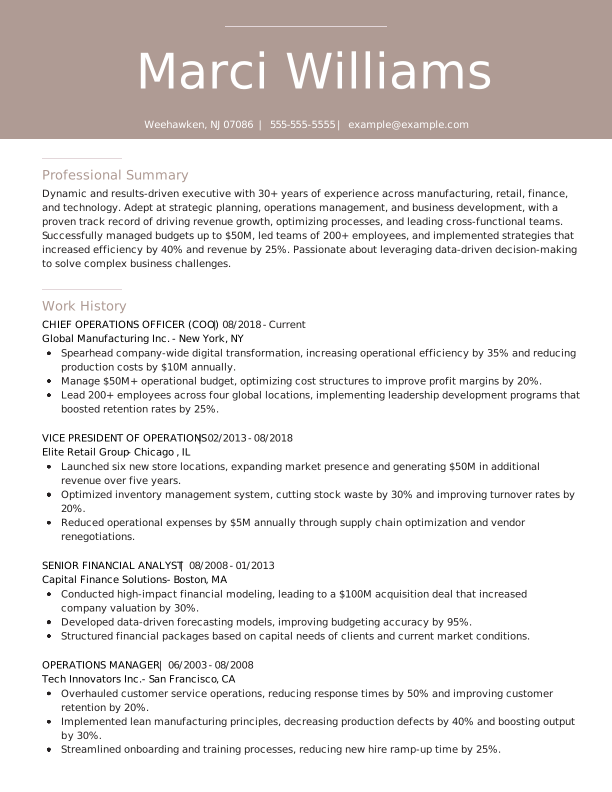
A strong resume for seniors or older workers emphasizes recent accomplishments, relevant skills, and measurable results rather than listing every job held throughout a career. The following example shows how to organize work experience, highlight transferable skills, and use a clean, professional format to demonstrate current value to employers.

Why this resume works: This example focuses on the candidate's most recent and relevant experience instead of listing every job from a 20-year career. It uses a modern reverse-chronological format, omits graduation dates, emphasizes current technology skills, and replaces generic responsibilities with measurable accomplishments. The core competencies section also gives ATS software clear, relevant keywords while making the candidate's transferable strengths easy for recruiters to scan.
Resources & Community Programs for Senior Job Seekers
Free training programs and public workforce services can help older job seekers refresh their skills, explore new career paths, and access job search support. From paid, work-based training to online technology courses, these resources offer practical ways to strengthen your qualifications without committing to expensive programs.
Explore the Senior Community Service Employment Program (SCSEP)
The Senior Community Service Employment Program (SCSEP) provides eligible unemployed adults ages 55 and older with paid, part-time community service assignments and work-based training. Participants gain experience at nonprofit and public organizations while preparing for unsubsidized employment.
Pro tip
Eligibility generally includes income limits, so check the program requirements and find a local provider before applying.
Build Digital Skills With Free Online Courses
If you're changing careers or want to become more comfortable with modern workplace technology, explore IBM SkillsBuild. The platform offers free courses in AI, cybersecurity, data analytics, and professional skills.
Some learning paths also provide digital credentials you can add to your resume or LinkedIn profile. Choose courses that match the skills employers request in your target field.
Connect With Local Workforce Services
Your local American Job Center can connect you with free resume assistance, interview workshops, career counseling, job listings, and training opportunities. Services vary by location, and some programs have additional eligibility requirements.
You can also use CareerOneStop to find state career resources, local workforce development boards, and training programs that may qualify for public funding.
Key Takeaways
- Trim your work history. Prioritize the last 10 to 15 years of relevant experience and remove unnecessary details from older roles. Highlight recent achievements, technical skills, and relevant certifications.
- Remove unnecessary dates. Omit graduation years and outdated credentials when they aren't relevant, but keep your employment history accurate.
- Choose clean formatting. Use a reverse-chronological or combination format, a readable font such as Arial at 10 to 12 points, and consistent spacing.
- Update your contact information. Use a professional email address, such as Gmail or Outlook, and refresh your LinkedIn profile.
- Tailor every application. Match your skills and accomplishments to the job description, incorporating relevant keywords naturally.
- Check your final file. Save your resume as a PDF when accepted, using a clear file name such as "Firstname.Lastname.Resume.pdf." Use AI tools or an ATS resume checker to identify potential improvements before applying.
- Take one practical next step. Contact a local workforce center or choose a short, relevant online course to refresh your skills. Free training and career support can help you build momentum and approach your next job search more confidently.
Frequently Asked Questions
What is the best resume format for older workers?
For most experienced professionals, a chronological resume makes it easy for employers to follow your career progression, while a combination resume puts relevant skills and accomplishments front and center. Choose the format that best showcases your qualifications and recent contributions. Functional resumes may work for specific career transitions, but they can make it harder for recruiters to assess your employment history and career growth.
How far back should an older worker go on a resume?
Older workers should generally focus their resumes on the last 10 to 15 years of relevant work experience. Prioritize recent roles, accomplishments, and skills that match the job you're targeting. You can shorten or omit older positions unless they demonstrate important qualifications or industry expertise. This approach keeps your resume focused on your current value while still allowing you to highlight experience that supports your candidacy.
How can older workers avoid age discrimination on a resume?
Older workers can reduce age-related assumptions by emphasizing recent accomplishments, current technical skills, and qualifications that match the job description. Consider omitting graduation dates and leaving off outdated skills or early-career roles that aren't relevant to the position. An older worker or senior resume should use clean, modern formatting to help keep the attention on qualifications and value.
How should 60-year-old professionals write a resume?
Professionals in their 60s should write a resume that highlights recent accomplishments, relevant skills, and experience that aligns with their target role. Focus on the last 10 to 15 years of work history, use a modern format, and emphasize current technical abilities and measurable results. You can omit graduation dates and older, unrelated positions to keep the resume concise. Tailor each application to the job description rather than trying to summarize your entire career.
What resume mistakes make older workers look outdated?
Resume mistakes that can make older workers' experience look outdated include listing decades of unrelated work history, including graduation dates unnecessarily, using dated templates or formatting, and overlooking current technology skills. Long objective statements, generic descriptions of job duties, and outdated terminology can also weaken a resume. Instead, use a clean layout, highlight recent accomplishments, incorporate relevant keywords from the job description, and demonstrate familiarity with tools and skills required for the role.


Megan is a career industry editor dedicated to helping job seekers excel in their careers.
More resources

How to Write an AI Friendly Resume That Impresses Human Recruiters
Learn how to create an AI-friendly resume with clear formattin...

How to Write a Resume for an Internal Position (Examples, Templates, & Guide)
A resume for an internal position should highlight your curren...

How to Make a Canadian Resume: Format, Examples, & Expert Tips
Learn how to create a Canadian resume with the right format s...

12+ Blank Resume Templates to Download & Fill In
Find a blank resume template that fits your experience and car...
What Should a Resume Look Like in 2026? (Examples)
A professional resume should use a clean easy-to-scan layout ...
 Get the job 2x faster*
 Customize your cover letter