


Table of contents
 Make Resume Now a preferred source on Google
Transferable skills are the abilities you can carry from one role, industry, or experience to another—and they're often what make you stand out in a competitive job market.
Whether you're changing careers, reentering the workforce, or applying for a promotion, skills like leadership, communication, and teamwork show employers you're ready to succeed.
In this guide, you'll learn what transferable skills are, see examples of the ones employers value most, and discover how to highlight them on your resume to secure more interviews.
Not sure where to start with building a resume? Our AI Resume Builder is a great tool for beginners and seasoned pros alike. It offers professional formatting help, stylish resume templates, and ready-to-use content suggestions to help you conquer writer's block.
What Are Transferable Skills?
Transferable skills are abilities and strengths you can apply across different jobs, industries, and career paths. Common examples include problem-solving, critical thinking, and adaptability.
While most transferable skills are soft skills, hard skills can also transfer between roles and industries. Hard skills are technical abilities learned through education, training, or hands-on experience, while soft skills are interpersonal traits you use to work effectively with others.
For example, communication is a transferable soft skill that can help a cashier provide excellent customer service and later help them collaborate with colleagues as a graphic designer.
Likewise, hard skills such as data analysis, project management software, budgeting, and bilingual communication can transfer across a wide range of careers and workplaces.
Why Are Transferable Skills Important?
Transferable skills are important because they show employers you can succeed in different roles and adapt to new challenges, even if you don't have direct experience in the industry.
Hiring managers often look beyond job titles and focus on skills like communication, leadership, teamwork, and problem-solving because they contribute to long-term success in almost any workplace. Transferable skills can help you:
- Show your value beyond technical, job-specific skills alone
- Prove you can learn quickly and succeed in new environments
- Stand out when changing careers or reentering the workforce
- Qualify for roles without direct industry experience
- Strengthen your resume if you have limited work experience
Transferable skills are especially valuable in today's job market, where employers want candidates who can grow with the company and adjust to changing workplace demands.
10 Transferable Skills Examples
Now that you understand what transferable skills are and why they're important, let's look at examples of the top transferable skills employers consistently value across industries.
1. Communication
Communication is one of the most valuable transferable skills because it affects how you share information, collaborate with others, and build professional relationships.
Strong communication skills can help you succeed in nearly any role, whether you're interacting with customers, leading a team, writing reports, or presenting ideas.
Employers often look for candidates who can communicate clearly, professionally, and effectively in both verbal and written settings.
2. Organization
Organization is a transferable ability that helps you manage tasks, prioritize responsibilities, and stay productive in fast-paced work environments.
Nobody wants to lose precious time helping their employee track down missing paperwork or waiting around for a co-worker to show up to a meeting they've forgotten about.
Good organizational skills help you stay on top of things and present yourself as someone who can improve efficiency, reduce mistakes, and help teams meet deadlines more effectively.
3. Flexibility
Flexibility is a transferable skill that shows you're equipped to adapt to changing priorities and work environments.
Employers value flexible employees because they can handle new challenges, learn unfamiliar tasks, and remain productive during periods of change.
Whether adjusting to new technology, shifting deadlines, or different team dynamics, flexibility demonstrates resilience and a willingness to grow in any role.
4. Time Management
Time management is a transferable strength that helps you prioritize responsibilities, meet deadlines, and stay productive in busy work environments.
Looming deadlines can be stressful as they add a lot of pressure to your workday. But a candidate with excellent time management skills is one who employers can trust to use time wisely, prioritize effectively, and complete critical tasks within the expected time frame.
5. Resourcefulness
Resourcefulness is an important transferable skill that shows you can solve problems, think creatively, and find effective solutions with the tools and information available to you.
A resourceful employee is curious about their role and can adapt to challenges, work independently, and take initiative when unexpected situations arise.
This skill is especially important in fast-paced industries where critical thinking and quick decision-making are essential, such as healthcare, emergency services, finance, and technology.
6. Problem-Solving
Problem-solving is a transferable skill that demonstrates your ability to identify challenges, evaluate solutions, and make effective decisions.
In both independent and collaborative environments, an employee who's excited to tackle challenges is an indispensable asset.
Whether resolving customer concerns, troubleshooting issues, or finding more efficient ways to complete tasks, strong problem-solving abilities are valuable in almost every industry and role.
7. Teamwork
Most jobs require employees to work closely with coworkers, clients, or other departments, which makes teamwork skills essential for any industry or role.
Being able to collaborate effectively, share responsibilities, and support group goals demonstrates that you can contribute to a positive and productive work environment.
Employers often prioritize candidates who work well with others and adapt easily to team dynamics.
8. Computer Skills
Basic computer skills are valuable in nearly every industry because most workplaces rely on technology for communication, organization, and daily operations.
Hiring managers often look for candidates who can quickly learn new technology and use digital systems effectively.
Experience with tools like Microsoft Office, spreadsheets, email platforms, project management software, or data entry systems can transfer across a wide range of roles.
9. Creativity
Creativity is an important transferable skill that helps you develop new ideas, solve problems in innovative ways, and approach challenges from different perspectives.
Employers value creative thinking skills because they can improve processes, encourage innovation, and support better decision-making in the workplace.
They're useful in both creative and non-creative roles, especially when adapting to change or finding more effective ways to complete tasks.
10. Leadership
Leadership is transferable across industries and even applies well to roles that don't involve actual management or team leadership responsibilities.
Strong leadership skills demonstrate your ability to guide others, take initiative, and contribute to team success.
Leadership experience can come from many different situations, including managing projects, training coworkers, volunteering, or leading teams in previous roles.
How to Feature Transferable Skills on a Resume
Highlight transferable skills in your resume summary, work experience section, and skills section to make your background more relevant to the role you're targeting.
Transferable skills are most effective on a resume when they're woven throughout multiple sections instead of listed in only one place. Employers want to see not just which skills you have, but how you've applied them in real work situations. Here's how:
Showcase Skills in Your Resume Summary
Your resume summary is one of the first things employers see, so it's a prime place to highlight your most relevant transferable skills right away.
Focus on two or three key strengths that match the job description and show how they support your overall experience.
Instead of simply listing skills, briefly connect them to results or the value you bring to an employer. Here's an example for a customer-facing retail sales associate:
"Customer-focused retail sales associate with strong communication and problem-solving skills, experienced in assisting customers, processing transactions, and maintaining organized store environments. Proven ability to improve checkout efficiency and reduce average customer wait time by 15% during peak hours through task coordination and teamwork. Recognized for reliability and a proactive approach to improving daily store operations."
Back Up Your Skills With Work Experience
Your work experience section is where transferable skills carry the most weight because employers want to see how you've applied them in real situations.
Use each job entry to show how you used abilities like communication, teamwork, problem-solving, or leadership to achieve results. Focus on actions and outcomes that demonstrate impact, not just responsibilities.
Whenever possible, include measurable achievements to strengthen your credibility and show the value you brought to previous roles. Here's an example for the retail sales associate from above:
Retail Sales Associate | Safeway
Seattle, WA | June 2022–August 2025
- Assisted an average of 80+ customers per shift, resolving questions and issues to ensure a positive checkout experience.
- Reduced average customer wait times by 15% during peak hours by streamlining checkout flow and supporting team coordination.
- Trained and onboarded three new employees on store procedures and customer service expectations in a fast-paced retail environment.
List Skills in a Dedicated Section on Your Resume
Your resume skills section should give employers a quick, scannable snapshot of your most relevant transferable abilities.
Instead of overloading it with every skill you have, focus on the strengths that best match the job description and support your experience.
Include a balanced mix of core transferable skills such as communication, teamwork, problem-solving, time management, adaptability, and organization.
You should also add role-relevant abilities that reinforce your experience and make your resume more targeted to the position you're applying for. Here's an example:
Skills
- Customer service
- Communication
- Problem-solving
- Teamwork
- Time management
- Organization
- Cash handling
Pro tip
Not sure which skills to highlight on your resume? Start with the job description. The employer's required and preferred skills are your best guide for identifying the relevant keywords and abilities to emphasize in your resume to demonstrate that you're a strong match for the role.
Example Resume With Impressive Transferable Skills
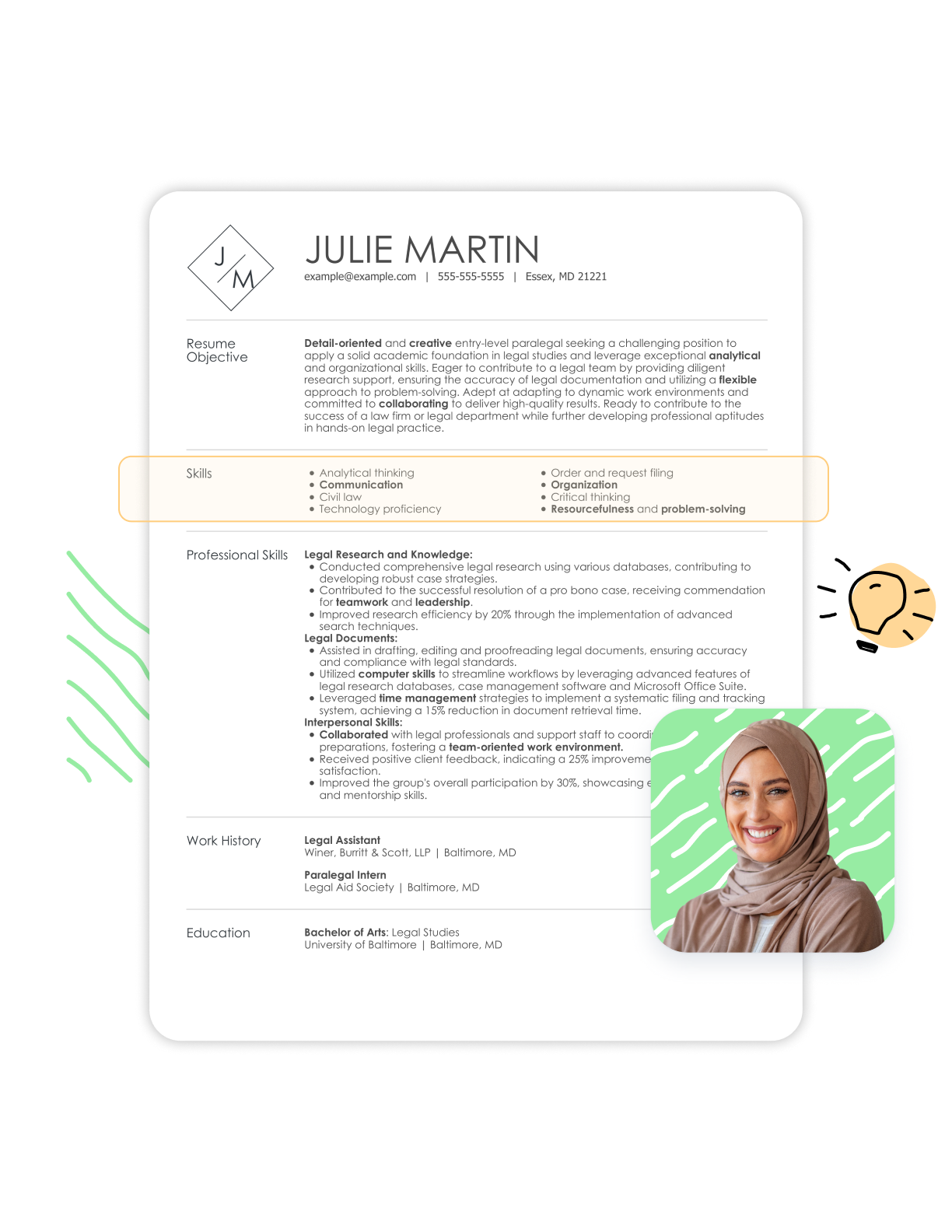
Let's look at an example resume that's full of transferable skills to help visualize how to highlight them throughout each section:
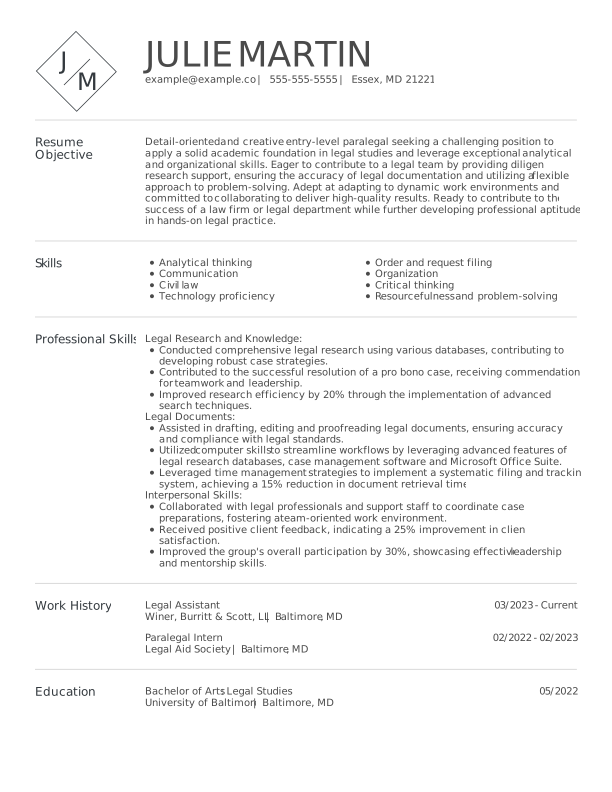
This sample resume features transferable skills in nearly every section, helping the candidate demonstrate their abilities despite limited work experience as a paralegal.
Pro tip
You can explore our full selection of resume examples to see how to highlight transferable skills in your resume across roles, industries, and career levels.
Key Takeaways
- Transferable skills work across industries and roles.
These abilities—like communication, problem-solving, and teamwork—stay valuable no matter what job or career path you pursue. - Both soft and hard skills can be transferable.
While soft skills are most common, technical abilities like software knowledge or data handling can also carry over to different jobs. - Highlight transferable skills throughout your resume.
Each part of your resume, including your summary, work history, and skills sections, should reinforce key strengths in different ways. - Demonstrate skills in action, don't just list them.
The strongest resumes connect transferable skills to real accomplishments and measurable results from your experience. - Tailor your transferable skills to the job description.
Matching your transferable skills with keywords from the posting helps your resume feel more relevant and improves ATS visibility.
Frequently Asked Questions
How do I identify my transferable skills?
To identify your transferable skills, start by reviewing your past jobs, volunteer work, education, or everyday responsibilities, and look for patterns in what you consistently did well.
Focus on tasks where you communicated, solved problems, organized work, led others, or adapted to new situations.
These repeated actions often reveal your strongest transferable skills, even if they weren't formally labeled as such on the job.
What are the most valuable transferable skills?
The most valuable transferable skills are those that help employers understand how you'll perform in different roles, such as communication, problem-solving, teamwork, and adaptability.
Other highly valued skills include organization, leadership, critical thinking, and resourcefulness, as they show you can handle responsibility, make decisions, and contribute effectively.
What are the nine skills for success?
- Communication
- Teamwork
- Problem-solving
- Time management
- Adaptability
- Leadership
- Organization
- Critical thinking
- Creativity
The nine skills for success are a set of core abilities that help individuals perform effectively in the workplace and adapt to a wide range of roles and industries:
These skills are essential because they support productivity, collaboration, and decision-making, making them valuable in nearly any career path or professional environment.
What are examples of transferable skills?
Examples of transferable skills include negotiation, active listening, and emotional intelligence, which help improve collaboration and workplace relationships across many roles.
Other strong examples are project coordination, data interpretation, and decision-making under pressure, all of which support effective performance in different environments.
Skills like multitasking, stakeholder management, presentation skills, and initiative are also transferable because they apply across industries and job functions.
What are the four C's of soft skills?
The four C's of soft skills are communication, collaboration, critical thinking, and creativity, and they're considered core abilities for success in almost any workplace.
Communication focuses on clearly sharing and receiving information, while collaboration emphasizes working effectively with others.
Critical thinking involves analyzing situations and making informed decisions, and creativity supports innovation and problem-solving.


Hailey is a career writer whose work for Resume Now helped job seekers excel in their careers.
More resources

How to Write a Resume for an Internal Position (Examples, Templates, & Guide)
A resume for an internal position should highlight your curren...

How to Make a Canadian Resume: Format, Examples, & Expert Tips
Learn how to create a Canadian resume with the right format s...

12+ Blank Resume Templates to Download & Fill In
Find a blank resume template that fits your experience and car...
What Should a Resume Look Like in 2026? (Examples)
A professional resume should use a clean easy-to-scan layout ...

What Is an ATS Resume? Definition & How to Write Yours
An ATS resume is a resume formatted to help applicant tracking...
 Get the job 2x faster*
  Customize your cover letter