

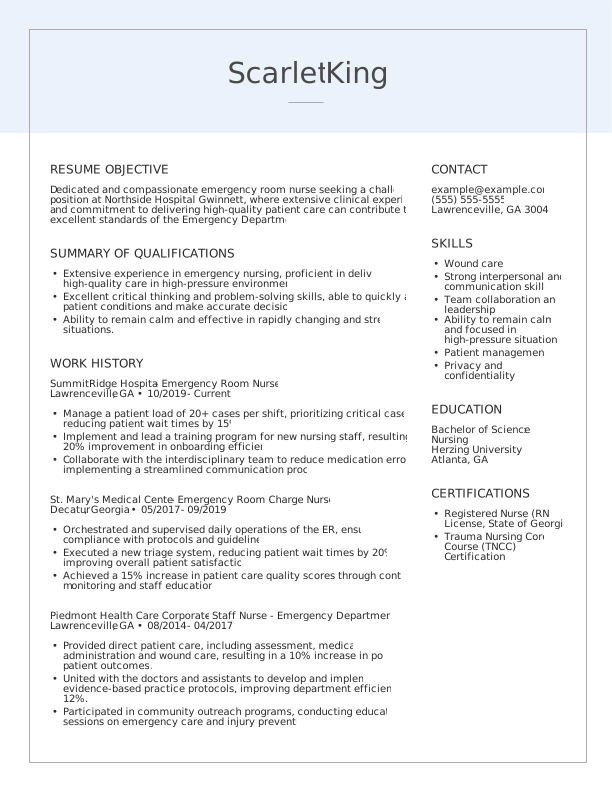

A summary of qualifications on a resume is your opportunity to sum up the highlights of your professional journey.
Yet, you may be wondering, "How do I capture years of experience, skills, and accomplishments in just a handful of bullet points?" That's where we come in.
In this guide, we'll show you:
To make the process easier, consider using a resume builder. These tools provide templates and guidance to help you create a professional and polished resume quickly.
What Is a Summary of Qualifications?
A summary of qualifications is a brief section at the top of your resume that highlights your most relevant skills, achievements, and experiences.
Think of it as your career's greatest hits album—a carefully curated list of your top professional accomplishments.
This section is typically formatted using bullet points to quickly showcase your most impressive qualifications, allowing hiring managers to quickly grasp why you're the ideal candidate for the position.
Why a summary of qualifications is important
A qualifications summary is important because it can:
- Grab the attention of hiring managers
- Elevate your most relevant skills
- Highlight your core competencies
- Tailor your resume to specific job requirements
- Showcase your unique value as a worker
- Help you stand out among other applicants
- Provide a quick snapshot of your professional profile
Overall, this section presents an opportunity to establish your immediate relevance. Much like the rest of a targeted resume, a summary of qualifications is most effective when you use it to align your skills with those sought by employers.
Qualifications summary vs. professional summary vs. resume objective
It is easy to confuse a summary of qualifications with a resume summary or a resume objective. While all three aim to highlight your qualifications, they differ in format and focus:
- Qualifications summary: Bullet points, focused on quantifiable achievements
- Professional summary: Brief paragraph, provides a narrative career overview
- Resume objective: Statement of career goals, suitable for entry-level or career changers
Each one of these can act as a resume profile that introduces your top strengths. Which one you choose will depend on your career stage and job application.
Let's take a deeper dive.
Summary of qualifications
As stated earlier, a qualifications summary is a concise list of your top skills, achievements, and experiences relevant to the job you're applying for. It's typically presented in bullet-point format and focuses on quantifiable accomplishments.
Here's an example:
Professional summary
A professional summary is a brief paragraph at the beginning of your resume that provides a snapshot of your career, highlighting your most significant skills and experiences.
Here's an example:
Resume objective
A resume objective is a statement of your career goals and how they align with the role you're applying for. It's particularly useful for entry-level candidates or those changing careers, as it focuses on what you aim to achieve rather than what you have already accomplished.
Here's an example:
Okay, so now that you understand the differences, how do you write a summary of qualifications on a resume? Let's take a look.
Pro tipJust as you choose the type of profile to place at the top of your resume, you'll also need to pick a resume format. For new professionals with diverse skill sets or nonlinear career paths, a functional resume format can be particularly effective. Unlike traditional chronological resumes, a functional resume emphasizes your skills and qualifications rather than your work history.
How to Write a Summary of Qualifications
Writing a summary of qualifications isn't difficult, but it does require special attention to get the job done. Here are four steps to consider.
1. Identify your skills
Do an inventory! This means taking time to thoroughly assess and list all the skills you've acquired throughout your career. Don't just think about work experience. Reflect on your formal education, on-the-job training, volunteer work, and even personal projects where you learned or developed valuable skills.
Here are some professional skills you can include in your summary:
- Soft skills: These are personality traits that determine how you work individually and as part of a team. Examples include active listening, adaptability, and emotional intelligence.
- Hard skills: These represent the specific abilities and professional knowledge that are gained through formal education or hands-on experience. Examples include data analysis, foreign language fluency, and financial auditing.
- Technical skills: These are the specialized skills required to operate complex tools, software, or machinery, often specific to a particular industry or profession. Examples include cloud computing, medical imaging, and CAD design.
- Transferable skills: These are versatile skills developed in one environment that remain valuable when transitioning to a different role or industry. Examples include time management, public speaking, and creative problem-solving.
- Research skills: This involves your ability to find, evaluate, and organize information efficiently, demonstrating your critical thinking and problem-solving abilities. Examples include documentation and archive management.
- Interpersonal skills: Sometimes called "people skills," these reflect your ability to build positive, productive relationships with colleagues and clients alike. Examples include communication, collaboration, and conflict resolution.
- High-income skills: These are specialized, high-demand capabilities that add significant value to a company's revenue. Examples include AI business development, project management, and finance law.
- Computer skills: These skills relate to navigating digital technology essential to the modern workplace. Examples include coding, cybersecurity, and network maintenance.
- Writing skills: Such skills indicate your ability to convey ideas across various platforms, ensuring your message is always understood by your target audience. Examples include grammar knowledge, copywriting, and editing.
After you have an idea of what your skills are, it's time to review the job description.
2. Align your skills with the job description
You need to be concise and relevant with your summary, so carefully read the job description. Pay close attention to the required qualifications and responsibilities listed, looking for recurring themes or specific keywords that stand out.
These keywords are often programmed into applicant tracking systems (ATS) that many companies use to screen resumes. Even highly qualified candidates might be overlooked if their resumes don't include these crucial keywords.
As you review, make a list of the skills and qualifications that match your own. This will help you tailor your summary to the specific role you're applying for.
Remember, the goal is not to stuff your resume with keywords, but to authentically represent your qualifications in a way that aligns with the job requirements.
3. Use quantifiable metrics
As you write your summary, use concrete numbers to demonstrate your achievements. This adds credibility and helps employers understand the scope of your accomplishments. Also, begin each bullet point with strong action verbs to create impact.
Here's an example:
4. Demonstrate your unique value
Qualification summaries are about differentiating yourself from other candidates. Consider what makes you stand out in your field. Perhaps you have a unique combination of skills, or you've achieved something remarkable in your career.
Think about the problems you've solved, the innovations you've introduced, and the unique abilities you bring to your work. This is your opportunity to showcase why you're exceptional.
Remember, your unique value proposition should align with the company's needs while highlighting what sets you apart from other applicants. This could include specialized training, industry recognition, or a track record of exceeding expectations in ways that are particularly relevant to the role you're seeking.
When you put all these steps together, you can write a summary of qualifications that gets you noticed by shining a light on your skills and achievements. In the next section, we'll provide some examples of how that can look.
Summary of Qualifications Examples by Job Type
When you write your resume, you'll need to customize the summary of qualifications to fit the specific job you're applying for. This helps to highlight the most relevant skills and experiences that align with the job requirements.
Therefore, every profession and industry needs a little special care. Take a look and find a summary of qualifications example that best matches your own career goals, and use it as a guide when writing your resume.
Customer service
See a full customer service resume.
Marketing manager
See a full marketing resume.
Software engineer
See a full software engineer resume.
Executive assistant
See a full executive assistant resume.
Financial analyst
See a full financial analyst resume.
Graphic designer
See a full graphic designer resume.
Summary of Qualifications Examples by Career Level
Your summary should also be tailored to match your career level. Whether you're a student about to graduate, an entry-level candidate, or an experienced professional looking to highlight decades of achievements, your summary should appropriately match your career stage.
Let's break this down in more detail using examples.
Students
Entry-level professionals
Mid-career professionals
Experienced professionals
Career changers
Key Takeaways
A summary of qualifications is a great way to highlight your best, most relevant skills and achievements. Using the bulleted list at the top of your resume helps these qualifications stand out to hiring managers and recruiters. It is also a place for the ATS to detect keywords. When you put this all together, your resume takes on a new level that is more likely to get noticed. Remember the following key takeaways to help you get started writing.
- Hit the high notes.
Your summary is your career's greatest hits album. Make it count. - Punch it up.
Use bullet points for quick, impactful reading. - Speak their language.
Align your skills with keywords from the job description to make your resume ATS-friendly. - Cover a range of skills.
Include a mix of hard skills, soft skills, and notable achievements. - Keep it tight.
Aim for about four to six bullet points so you don't overwhelm the reader. - Polish your presentation.
Consider using a professional resume builder for optimal formatting.


Don is a Certified Professional Resume Writer (CPRW) with more than 10 years' experience creating digital content, including four years helping job seekers develop their careers.
More resources

8 Current Resume Trends for 2026 (With Tips & Examples)
Stay current with 2026 resume trends and learn how to make you...

How to Write a Resume: Guide & Examples for 2026
Learn how to write a resume that gets interviews with our step...

How to Write a Resume With ChatGPT (Step by Step Guide & Prompts)
Learn how to write a resume with ChatGPT using targeted prompt...

Transferable Skills: Examples & How to List Them on Your Resume
Write a resume that stands out by making the most of your tran...

How to Use Resume Now’s AI Resume Builder for Free
Try Resume Now s AI-powered Resume Builder for free to access ...

References Available Upon Request on Your Resume: Is It Necessary?
References available upon request is a phrase added to the bot...
 Get the job 2x faster*
  Customize your cover letter