

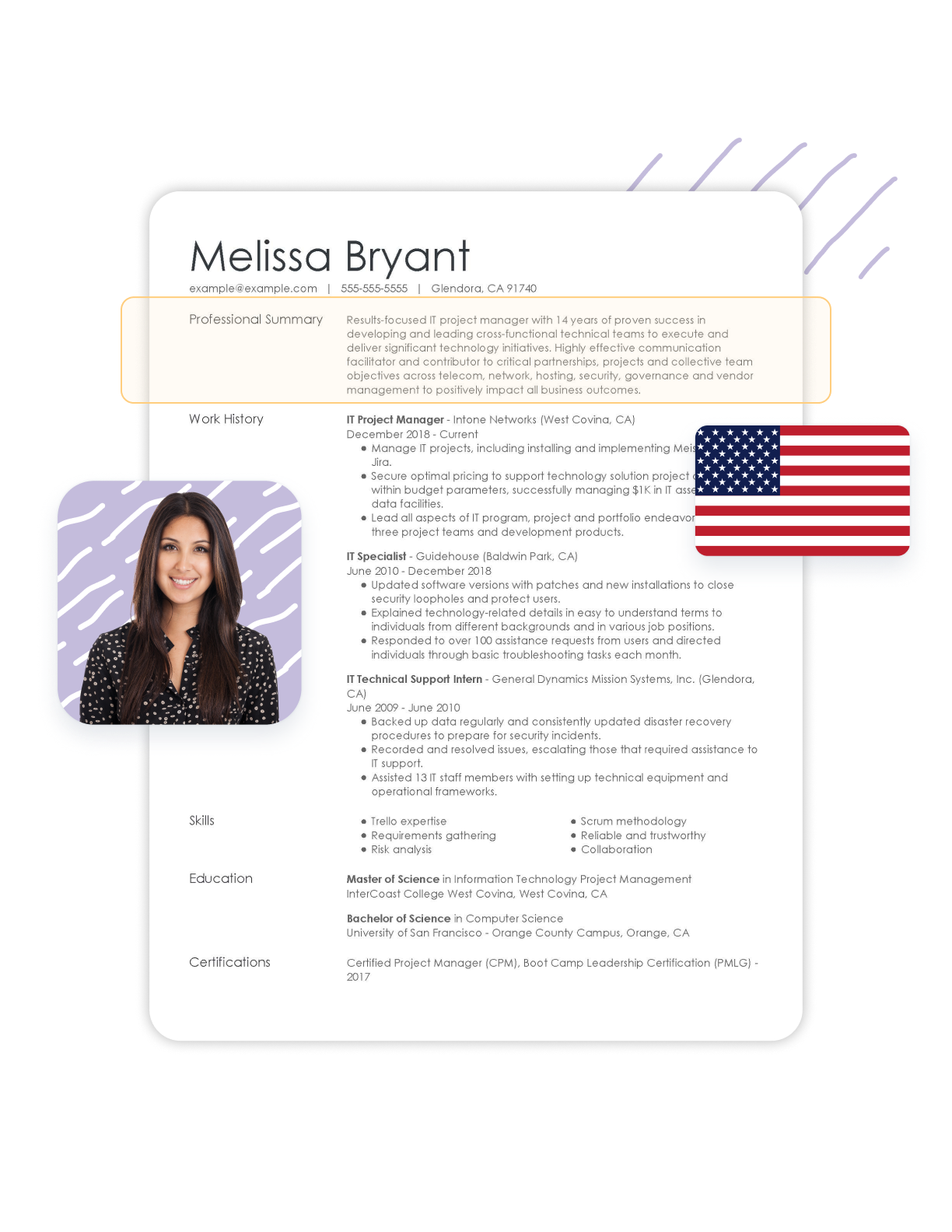

If you're looking for a job in the United States, then you will need a resume that meets proper expectations, especially when it comes to format and content.
So what is the correct U.S. resume format and what does it entail?
We'll show you so you can get started writing.
This guide will explore:
Are you working on your U.S. resume? Our AI Resume Builder can make it effortless. Just enter your job title, and you'll get tailor-made text for every part of your resume, ensuring it aligns perfectly with the expectations for resumes in the United States.
What Is the U.S. Resume Format?
The three main resume formats used in the U.S. are:
- Chronological: This is the most common U.S. resume format. It focuses on work experience, using a majority of the page to list job history in reverse-chronological order. This works especially well if you've been working for several years and can highlight responsibilities and achievements.
- Functional: Also known as a skills-based resume, this format highlights your skills and minimizes your work history. This is great for people who are changing careers, have had breaks in their work history, or are new to the job market. It lets you highlight what you can do, not just where you've done it.
- Combination: This is a hybrid of the chronological and functional resumes. You start with your skills and achievements, then list your jobs in reverse order. This format is perfect for mid-career professionals who have relevant skills and also want to show a solid work history.
Pro Tip:
The U.S. standard resume format is between one and two pages long, depending on your experience level.
U.S. resume sections
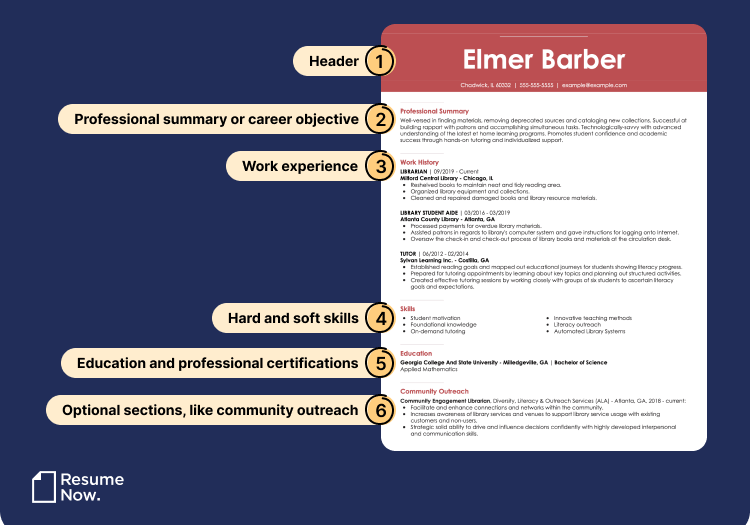
Although each format has a different area of focus, an American resume should always contain the following five sections:
- Contact header: Provide your name, phone number, and email at the very top of the page to make it as easy for hiring managers to identify and reach out to you.
- Professional summary or objective: This is a brief introductory paragraph that highlights your top qualifications or career goals. It's like an "elevator pitch" that provides a quick snapshot of why you're the right fit for the role.
- Work experience: Here you will outline your professional history, typically listing your previous roles, responsibilities, and key achievements.
- Skills: This list should quickly communicate your core competencies and ensure your resume aligns with the job requirements.
- Education and certifications: List your academic background, degrees, and any specialized credentials or licenses you've earned to verify you have the necessary foundations for your field.
You may also add other sections. For example, a functional resume usually contains a summary of qualifications, which is an additional section that focuses on your top skills. You can also consider adding:
- Volunteer experience: This can be a great way to show character and gain credit for relevant skills you've used outside of a traditional office setting.
- Honors and awards: Showcase formal recognition you've received for excellence in your field or academics.
- Languages: List any additional languages you speak and your level of proficiency in each.
- Hobbies: This can be used to include personal projects that highlight complementary skills and experience.
Only add these sections if they are relevant and do not take up too much space.
U.S. Resume Sample
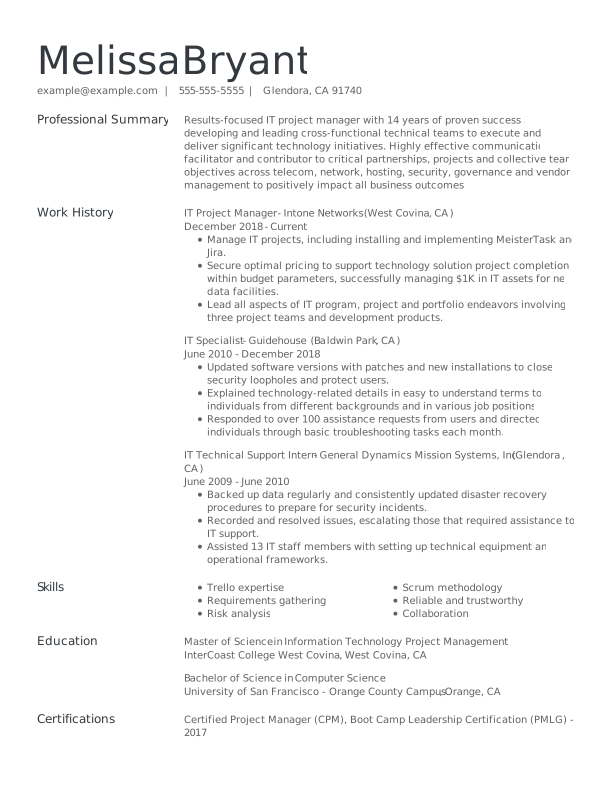
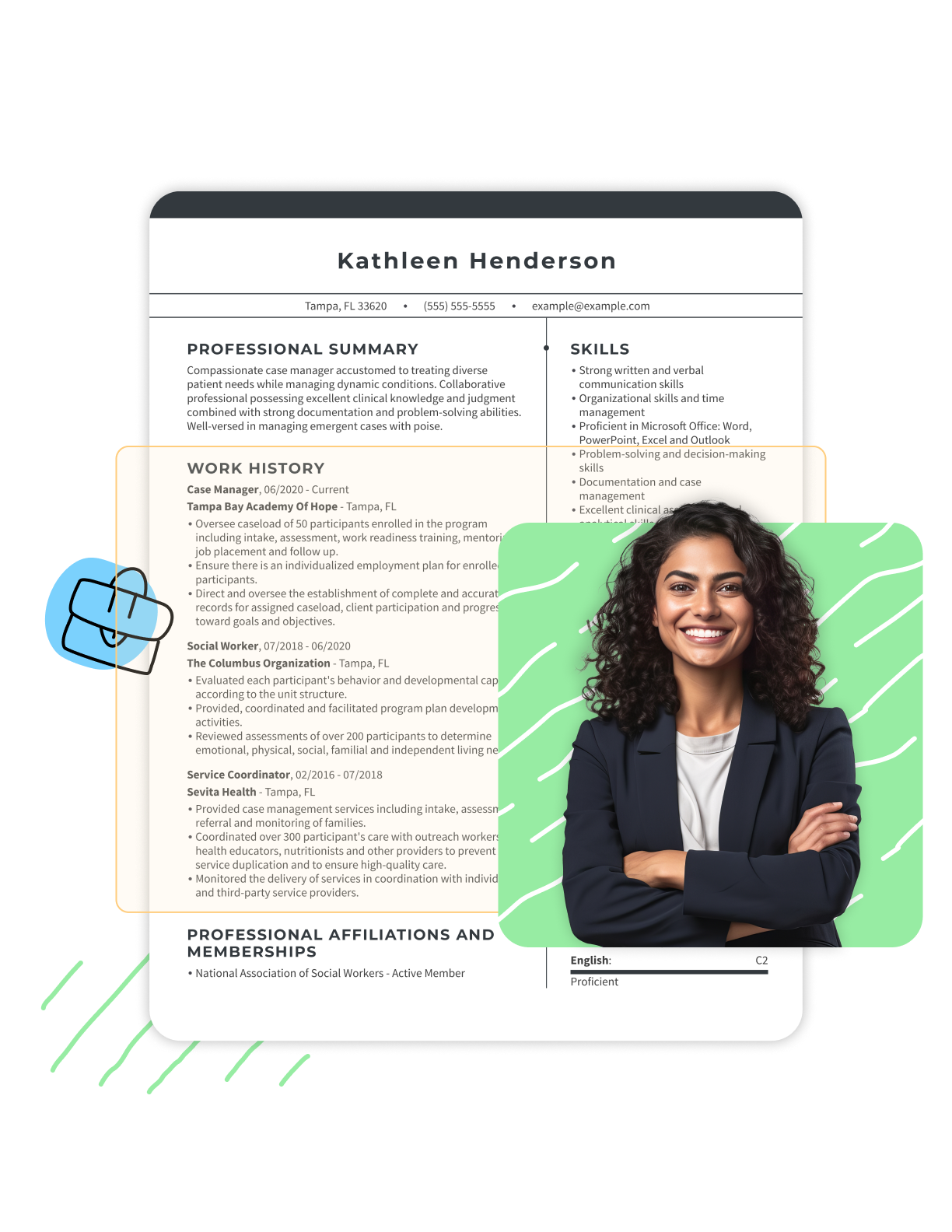
Here is a U.S. resume example that shows you how everything can be put together. You'll notice that this particular example uses the chronological resume format.
Resume for a nursing student with no job experience
How to Write an American Resume
Starting your job search in the U.S. requires a well-crafted resume that stands out to employers.
This guide will walk you through each step of creating an effective U.S. resume, ensuring that you present your qualifications and experiences in the best possible light.
We'll cover the following:
- Choosing a U.S. resume format
- Adding contact info to your header
- Summarizing your career
- Laying out a job history section
- Highlighting your education
- Filling your resume with skills
- Optimizing for keywords
- Including a cover letter
Let's check out the first step: selecting the right format for your application.
1. Choose a U.S. resume format
Picking the right resume format can really help show off your strengths. Whether you've worked for years or are just starting out, there's a format that fits your needs. As discussed earlier, you can pick a chronological, functional, or combination format to write your American resume.
Here are some tips to make sure your resume looks good and reads well.
U.S. resume-formatting tips
Knowing how to format a resume is just as important as having good content. A chaotic and unprofessional design might turn off employers in the U.S. Therefore, make sure to:
- Start with a template. Choosing a resume template gives you a structured starting point to organize your information clearly. It saves time and ensures your resume looks polished, whether you're using a simple design or something more creative.
- Keep standard margins. Set your resume margins to 1 inch on all sides for a tidy layout. If you need more space, you can slightly reduce them, but avoid going below half an inch to keep your resume readable.
- Choose a simple font. Stick to classic, easy-to-read fonts like Times New Roman or Arial, in 12-point size for the body of your resume. Use black font color for consistency, and remember to use just one font type to keep your resume looking professional.
- Use clear section headings. Organize your resume with clear headings for each section: Contact Information, Professional Summary or Resume Objective, Work Experience, Education, and Skills.
- Ensure an easy-to-read layout. Align your text to the left for a clean, formal look. Use bullet points to list your experiences and skills, making your resume easy to skim and understand at a glance.
- Use American English measurements and spelling. Remember that the U.S. uses a customary system for measurements (inches, feet, pounds, etc.) and has subtle differences in spelling conventions when compared to British English, such as "color" vs. "colour," "organize" vs. "organise," and "license" vs. "licence."
2. Add contact info in your header
You want employers to reach you easily, right? That's why you need a clear header with easy-to-read contact info.
Here's what you should include in your header:
- Name: Your full name, prominently placed at the top
- Phone number: A current phone number where you can be easily reached
- Email address: A professional email address, ideally based on your name
- LinkedIn profile: An updated URL link to your LinkedIn profile, if you have one
- Location: Your city and state
With your contact information clearly outlined, let's move on to introducing yourself in a way that captures the employer's interest right from the start.
3. Introduce yourself with a summary
At the top of your U.S. resume, you should include a three- to five-sentence paragraph. This is called a resume profile, and there are different types suiting different circumstances.
Most job seekers would be satisfied by a resume summary. These are brief overviews of your professional experience, major achievements, and skills. They are best suited for job seekers with some experience in their field, as they briefly highlight your career peaks and key strengths.
Pro Tip:
Save time and try our AI Resume Summary Generator to get one in just a few clicks.
For others, a resume objective may be a better idea. These are statements about your career goals and how you can benefit the company. Objectives are ideal for those new to the workforce, changing careers, or with gaps in their employment history. They focus on your ambitions and how they align with the company's goals.
Let's look at these types of profiles in action.
Here's what a summary looks like:
Here's what an objective statement looks like:
Now that we've covered how to introduce yourself on your resume, let's move into detailing your work history.
4. Lay out your work history
The biggest section in most U.S. resumes is job history. Here, you list your previous roles, starting with the most recent.
But you don't simply recite what you did. Instead, you list your most relevant and impressive accomplishments in each position, using bullet points to make it easier to read at a glance.
Here's what an entry in a U.S. work experience section for a marketing professional might look like:
Pro tip:Use action verbs such as "Spearheaded," "Led," "Managed," and "Collaborated" at the start of your bullet points and quantify achievements whenever possible to make your contributions stand out.
5. Highlight your education
Making an education section can be tricky when you're applying for jobs from outside the U.S.
The types of degrees available and what they mean might not be immediately clear to employers.
If you have qualifications in a different country, mention any equivalencies or how they relate to U.S. standards.
Highlight any U.S.-based certifications or licenses relevant to the job.
Here's what this might look like:
6. Fill your U.S. resume with skills
Many skills translate from industry to industry, and even from country to country. They are your key to a wide range of places and professions.
As an essential resume ingredient, there are a couple of different ways to add skills to your resume.
- Add your skills in dedicated sections. This section should be a concise list of your abilities that are most relevant to the job you're applying for. For example, you can have a "Computer Skills" section for hard skills and a "Key Competencies" section for soft skills. This makes it easy for employers to quickly see if you have the skills they need.
- Add skills throughout your resume. Leverage your professional summary and your work history sections by including sought-after skills. This helps to contextually show how you've applied your qualifications in real-world situations, enhancing the narrative of your professional accomplishments.
Which types of skills should you add? Well, that really depends on the job.
Some occupations rely heavily on technical skills, while others, such as service-sector roles, utilize more soft skills. Let's look at examples of different skill types.
Here are some hard skills often found on U.S. resumes:
- Data analysis
- Software proficiency (e.g., Adobe Creative Suite, Microsoft Office Suite)
- Programming languages (e.g., Python, Java, C++)
- Project management (e.g., Agile, Scrum)
- Foreign language proficiency
- SEO/SEM marketing
- Cloud computing
- Social media management and digital marketing
- Graphic design
Here are some soft skills often found on U.S. resumes:
- Communication
- Leadership
- Problem-solving
- Time management
- Adaptability
- Teamwork
- Creativity
- Attention to detail
- Customer service
Bear in mind, this isn't a showdown between hard skills and soft skills. Rather, the most well-rounded candidates have a mix of both skill types.
Next, we'll show you how to use keywords to optimize your resume for employers in the U.S.
7. Optimize for ATS with keywords
Many American companies use applicant tracking systems (ATS) to screen resumes for keywords and other metrics, passing along the strongest for hiring managers to review. These software can make or break your chances of getting an interview, so make sure your resume is ATS-friendly.
When it comes to keywords, read the job description closely and highlight any you come across.
For example, here's a job description for a customer service representative, with the keywords in bold:
Once you have the keywords, revisit your resume to find places where the keywords make sense. Here's a professional summary using some of the keywords found above:
Pro Tip:
Not sure if your resume is ATS-friendly? Use our free ATS Resume Checker to get a score and receive tips.
8. Include a cover letter
In the U.S., cover letters are often included with a resume.
Although not always required, they are strongly recommended because they give you an advantage for several reasons, including:
- Adding a personal touch: A cover letter allows you to introduce yourself in a more personal manner, going beyond the bullet points of your resume to tell a compelling story about your career journey and aspirations. This personal touch can make you more memorable to hiring managers.
- Explaining your circumstances: If you have gaps in your employment, are changing careers or have other unique situations (i.e., you're looking to relocate or get a promotion), a cover letter provides an opportunity to explain these circumstances in a positive light, directly addressing potential concerns employers may have.
- Demonstrating interest in the company: Writing a cover letter gives you a chance to show that you've done your homework about the company and the role. You can tailor your letter to reflect how your skills and experiences make you an ideal fit for the position and how you align with the company's values and goals.
Pro tip:Consider using a cover letter template that matches your resume to create a cohesive and professional appearance for your application materials.
When you put all these steps in place, you're set up to write a great U.S. resume. Before we go, just to be safe, we'll show you what to omit from your resume.
What to Leave Off Your US Resume
When crafting your U.S. resume, you want to know what to include and what to leave out.
Certain details that might be standard or expected in resumes from other countries can be counterproductive or even frowned upon in the United States.
Here's what you should leave off your U.S. resume:
- Personal address: Given privacy concerns and the irrelevance of proximity in many jobs, especially with the rise of remote work, your full home address is unnecessary. It's sufficient to list your city and state to provide a general idea of your location.
- Photo: While common in other countries, in the U.S., it's generally not customary to include a photograph unless you're applying for roles in certain creative industries or acting. Including a photo can inadvertently lead to bias in the hiring process.
- Age or date of birth: Age is not a factor in determining your ability to perform a job. Including this information can lead to age discrimination. It's best to focus on your experience and skills.
- Social Security number (SSN): For security reasons, never include your SSN on your resume. Employers do not need this information until the later stages of the hiring process, typically for a background check after a job offer.
- Salary history: Disclosing your previous or current salary can negatively impact your ability to negotiate a fair salary. Focus on your skills and the value you bring to the potential employer.
- Reasons for leaving previous jobs: The resume is not the place to explain why you left or are leaving a job. This can be discussed in your cover letter or during the interview if necessary.
- Marital status or family details: This information is not relevant to your application and can lead to discrimination. Employers in the U.S. are focused on your professional qualifications.
- Religious or political affiliations: Unless you're applying for a position within a religious or political organization where such information might be relevant, it's advisable to leave these details out to avoid potential bias.
- References: Listing references on your resume is no longer common practice. In fact, don't even include the line "References Available Upon Request." Instead, create a separate document where you list the names and details of three or four references the employer can follow up on to share if prompted further down the line.
Keep these points in mind to ensure your American resume meets the proper professional standards.
The U.S. Hiring Process
After you apply with your American resume, what else can you expect?
First, understand that the timeline for a response can vary from a few days to several weeks. If selected, you'll likely conduct a short phone screen where you will be asked basic information about yourself, your resume, and your interest in the position.
After that comes the longer interviews, either in-person or virtually, where you will go more in-depth about your qualifications and goals. Depending on the position, you may have several rounds of interviews, such as panel interviews or portfolio reviews.
Pro tip
After your interview, send a brief thank-you email to each person you spoke with within 24 hours. This is polite, reiterates your interest in the role, and leaves a lasting, positive impression on the hiring team.
If you are offered a job, keep in mind that negotiation is a common part of the process. It's perfectly acceptable to discuss your salary, benefits, or start date before signing. Approaching these conversations with a blend of confidence and professionalism shows that you a prepared professional ready to join the team.
USA Resume Key Takeaways
- Choose the right US resume format.
Select a chronological, functional, or combination format based on your career history and goals. - Optimize your header.
Include essential contact information, but leave out personal details like your full address or SSN for privacy and relevance. - Detail your work history with achievements.
Focus on accomplishments in your job history using action verbs and quantifiable results to demonstrate your impact. - Highlight your education appropriately.
For degrees from outside the U.S., clarify their U.S. equivalency and focus on relevant certifications or licenses. - Use keywords effectively.
Tailor your resume with keywords from the job description to pass ATS scans and appeal to hiring managers. - Include a cover letter.
Complement your resume with a cover letter that adds a personal touch, explains unique circumstances, and demonstrates interest in the company. - Keep design consistent.
Use matching templates for your resume and cover letter for a cohesive and professional look.
FAQ
Is a U.S. resume the same as a CV in other countries?
In some countries, such as the U.K. or in Europe, a resume can be considered interchangeable with a CV. In the United States, on the other hand, a CV is a longer document, usually for academic or research positions, that provides a comprehensive history of your entire career.
Is it OK to include a headshot on a U.S. resume?
In the United States, it is standard practice to exclude photos from your resume to help employers comply with anti-discrimination and labor laws. Unless you are applying for a role in acting or modeling, it is best to leave out any headshot and focus on your professional qualifications.
Should I put U.S. citizen on my resume?
Generally, you do not need to list your citizenship status on a U.S. resume. If a position requires specific clearance or work authorization, the employer will typically ask you to verify your eligibility during the application or interview process.
How long is a U.S. resume?
The ideal length for a U.S. resume is one to two pages, depending on your level of experience. Entry-level candidates should aim for a single page, while seasoned professionals with 10 or more years of experience may extend to a second page to capture relevant achievements.
What format do I use for an American style resume?
The most widely accepted format is the chronological resume in the U.S., which lists your most recent experience first. That said, you can also use a functional or combination format if you need to focus on specific skills or are navigating a career change.


Don is a Certified Professional Resume Writer (CPRW) with more than 10 years' experience creating digital content, including four years helping job seekers develop their careers.
More resources

How to Make a Canadian Resume: Format, Examples, & Expert Tips
Learn how to create a Canadian resume with the right format s...

12+ Blank Resume Templates to Download & Fill In
Find a blank resume template that fits your experience and car...
What Should a Resume Look Like in 2026? (Examples)
A professional resume should use a clean easy-to-scan layout ...

What Is an ATS Resume? Definition & How to Write Yours
An ATS resume is a resume formatted to help applicant tracking...
 Get the job 2x faster*
  Customize your cover letter